This story is part of a series on gun violence reduction strategies produced with the support of the Solutions Journalism Network.
VALLEJO — Last Fourth of July, Courtney Whitney, a grandmother, was laying in bed after spending the evening with friends when a bullet entered her home and struck her in the back of the head, killing her. Using video footage, police identified a man shooting out of his car while driving south on I-80.
The suspect, identified as Jose Guadalupe Castillo, 42, had been arrested in Vallejo two months earlier for negligent discharge of a firearm. Had he been in another Bay Area city, he may have been targeted for an intervention to get him to stop shooting.
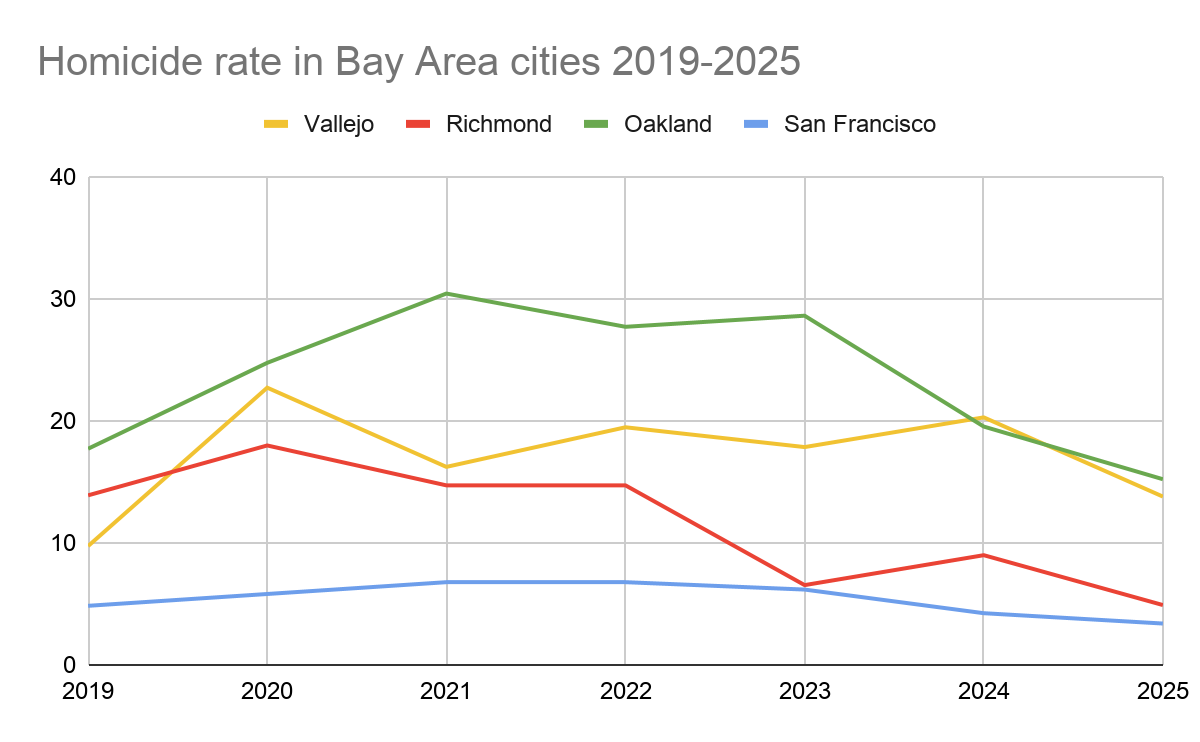
Various cities in the Bay Area have historically struggled with gun violence. But last year San Francisco, Oakland and Richmond all had record low homicides, while Vallejo lags behind.
Neighboring cities have long running and established gun violence reduction programs, which deploy credible messengers to communities afflicted by gun violence and attempt to interrupt cyclical conflicts and repeat offenders.
Reducing violence “should be a public health strategy and approach,” said Tinisch Hollins, a North Vallejo resident and executive director for Californians for Safety and Justice Coalition, a criminal justice reform advocacy group.
That means addressing the underlying conditions and root causes of the violence. “It can't just be the police department, and police department dollars,” Hollins said.
An April report by the state Department of Justice recognized both Richmond and Oakland as leading examples of cities successfully reducing homicides through violence reduction strategies.
Meanwhile, Vallejo has received millions of dollars in state grants over the past eight years to set up similar programs, but key aspects of the proposals were not implemented and the programs were quietly abandoned after a few years.
In April, Vallejo launched its latest strategy, called Project VISION, offering a new opportunity. But the program's success may depend on whether the city can implement best practices from other cities.
While strategies addressing gun violence differ, there are some consistent actions successful cities have taken to accomplish their goals. The Vallejo Sun consulted with experts in gun violence reduction to identify six key areas that contribute to the success of gun violence reduction programs. They are:
A champion: Other cities, such as Richmond and Oakland, have leaders in charge of reducing violence. These people occupy city leadership positions with a long commitment to their mission. They drive the efforts.
Problem analysis: Before trying to solve a problem, it's essential to understand it. Successful cities have deeply examined what’s driving patterns of gun violence.
Infrastructure: The most successful efforts are enabled by dedicated infrastructure to coordinate resources within the city.
Regional coordination: Violence and conflicts often cross city borders and successful efforts recognize and address that reality.
Transparency and accountability: Other cities publicize their efforts and data so that their work is understood and traceable and they are accountable for it.
Long-term funding: Reducing homicides is not an overnight effort. The cities with the most drastic decreases have been at it for decades.
A Champion
A policy brief by the University of Pennsylvania Crime and Justice Policy Lab identified key capacities cities need for success in violence reduction efforts. It said that first, cities need political governance “where city leaders prioritize and commit to reducing community violence while holding agencies accountable.”
Vaughn Crandall, director of technical assistance at the Crime and Justice Policy Lab and one of the authors of the brief, said in an interview that cities ”need some kind of local champion,” someone who is willing to say, “this is the problem we have, and this is the problem that we need to address.”
Mike McLively, a senior staff attorney at the Giffords Law Center, a policy group dedicated to gun violence prevention, said in an interview that Richmond is a good example of this.
“For Richmond, it was Bill Lindsay, who was the city manager at the time, because he took a chance as city manager and agreed to fund the Office of Neighborhood Safety,” he said.
Lindsay, who was Richmond’s city manager for 13 years, from 2005 to 2018, helped create Richmond’s Office of Neighborhood Safety in 2007. It is now the longest running city office of its kind in the nation.
Thirteen years is an unusually long time to remain as city manager. But Lindsay’s long tenure, and his continuous backing of the Office of Neighborhood Safety, has been credited by various experts as having enabled Richmond’s success.
The Department of Justice report stated that Richmond was so successful in their violence reduction efforts that the city “is on the cusp of losing eligibility for [California Violence Intervention and Prevention] Grant funding,” as the funds are reserved for communities disproportionately impacted by gun violence.
At the time of the Office of Neighborhood Safety’s founding, the idea was radical and its strategies unproven. The California Violence Intervention and Prevention grant wasn’t around to subsidize it either.
City managers, charged with everything from the city budget to daily operations, are usually risk averse. In an interview, Lindsay explained what led the city to take the leap.
Richmond was viewed as one of the most dangerous cities in the United States in the 1990s and early 2000s, which stalled the city’s economic development. City leadership decided that stopping homicide should be the city’s top priority if it was to grow.
“Richmond has a lot of potential, still has a lot of potential,” Lindsay said. “But the biggest obstacle toward realizing its potential was violent crime.”
Like putting a man on the moon during the Kennedy Administration, reducing homicides became a thematic, all out city-wide effort, he said.
As they were beginning to map out a strategy, then-Councilmember Tom Butt told Lindsay, “if we're going to do this, we're going to need a czar, a violence prevention czar,” according to Lindsay.
“We were going through financial problems, so I was really leery about adding another staff member,” said Lindsay. “But really, what he said made sense.”Lindsay hired DeVone Boggan as the Office of Neighborhood Safety’s first director in October 2007.
Boggan, a Vallejo resident who worked with chronic juvenile offenders, was already working in Richmond as part of a three-person consulting team doing a problem analysis of Richmond’s gun violence challenge.
Lindsay provided Boggan with “extraordinary latitude, authority, support, and protection in pursuit of that mission,” Boggan said.
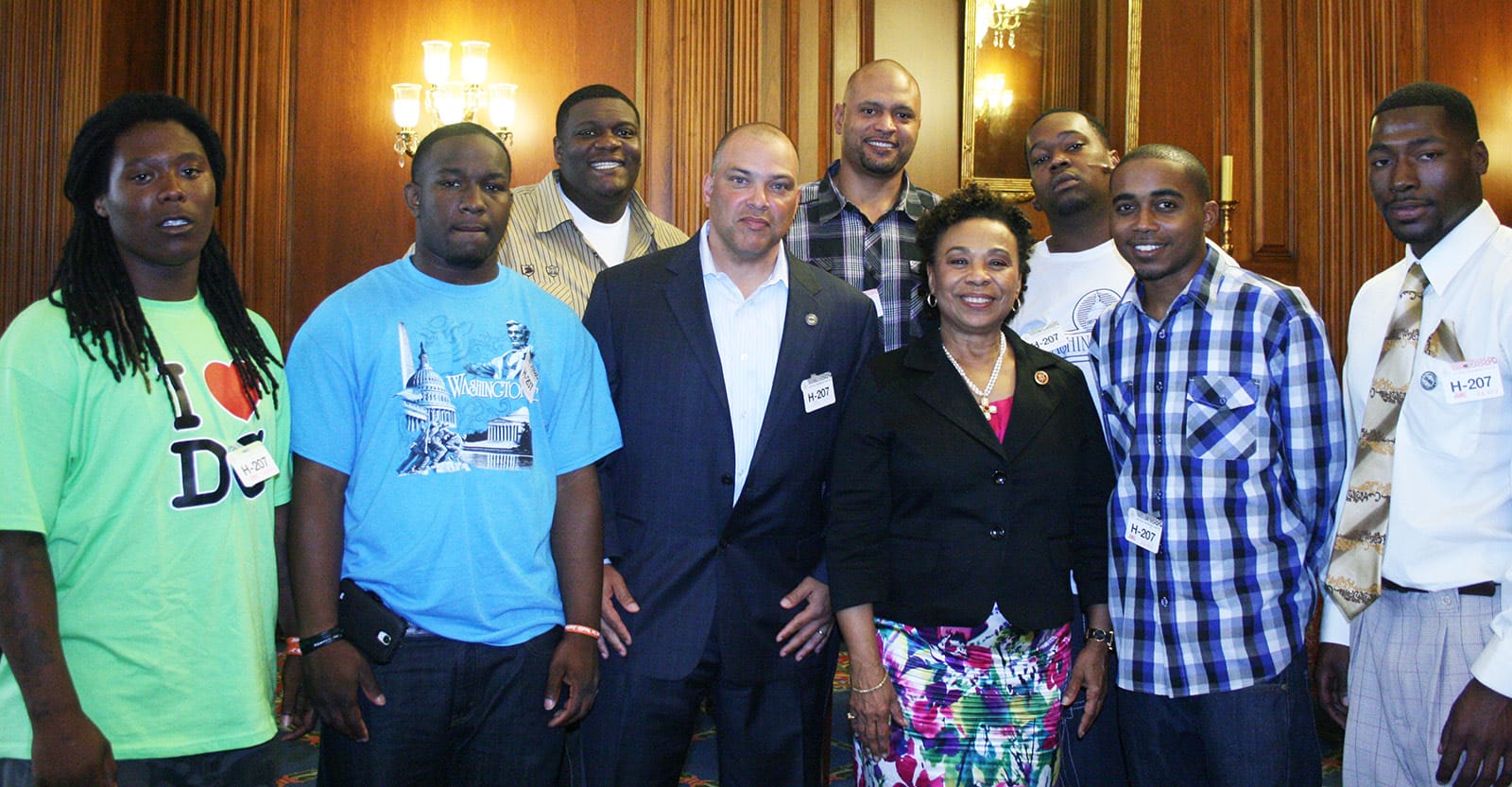
Lindsay said the two men “agreed that both of us were kind of on suicide missions.”
“When I took on Richmond, [it] was in a horrible financial situation,” Lindsay said. “And Devonne was coming on with a homicide rate that was kind of off the charts.”
As the homicide rate came down, Lindsay continued his support for the Office of Neighborhood Safety and found it to be a good investment for the city.
“If you do what you say you're going to do and you're effective at it, then I'm going to keep supporting it,” said Lindsay. “If you're too successful, you don't take the money away, you invest more in it if you need it.”
The Police Department and Office of Neighborhood Safety did not always see eye to eye as the new city department took responsibility for problems that cities usually try to solve through policing. "Navigating these difficult relationships, as city manager, that was my responsibility,” Lindsay said.
“When there is a problem coming up and the [Office of Neighborhood Safety is] being unfairly attacked – and they were from time to time by some council members – then you stick up for them and say, ‘No, that is not right,’” Lindsay said.
Meaningful reductions in homicides take years if not decades. Lindsay’s long-term support and dedication to the mission meant efforts did not waver.
Boggan said that Richmond’s success “was not any single program, person, or institution. It was an entire city deciding that reducing gun violence mattered,” he said. “It started with leadership.”
Problem analysis
The University of Pennsylvania policy brief identifies a “Data-Informed Problem Analysis” as the second key capacity for effective gun violence reduction.
This kind of problem analysis is a formalized, data-centered study to understand the people and forces behind most homicides. It is usually done by an outside consultant in order to avoid bias.
The core assumption behind violence intervention is that most shootings can be traced to a handful of individuals engaged in cyclical and retaliatory conflicts. Being able to identify those individuals allows intervention workers to focus their efforts.
“We identified [gun violence] as the critical issue facing the city,” said Lindsay. “The simplest solution is, ‘let's just hire more police officers.’”
“Just increasing the number of police officers wasn't going to work,” he said. “It should be something that really tries to work with community members.”
In Richmond, the city concluded that violence was largely driven by a feud between North and Central Richmond. They realized that less than 30 people were driving most of the gun violence, Boggan said during a presentation last year.
The city sought to have members from the conflicting communities try to stop those conflicts, focusing efforts on those at the center of it. Being independent of police gave the intervention workers the credibility needed to intervene in conflicts from within.
Oakland also targets those most at risk of gun violence The state Department of Justice report credited the city with spending “far less time doing unfocused, area-based enforcement with low-risk individuals, and a much greater amount of time understanding the current violence dynamic and focusing on the very small number of individuals driving that violence.”
Building infrastructure
Gun violence reduction experts also stress the importance of building a violence intervention ecosystem to coordinate efforts and facilitate communication between different government agencies and partnering nonprofits.
This has been important in Oakland, which has been conducting violence intervention work for decades with various non-profits and government agencies undertaking similar efforts.
In 1994, Oakland non-profit Youth Alive! started the first and now oldest hospital-based violence intervention program in the nation to reach victims of shootings immediately by their hospital bedside. It's a strategy inspired by the observations of trauma surgeons who kept operating on the same patients for the same wounds.
According to the city’s Department of Violence Prevention, these kinds of interventions decrease the chances of immediate retaliation and re-injury for patients.
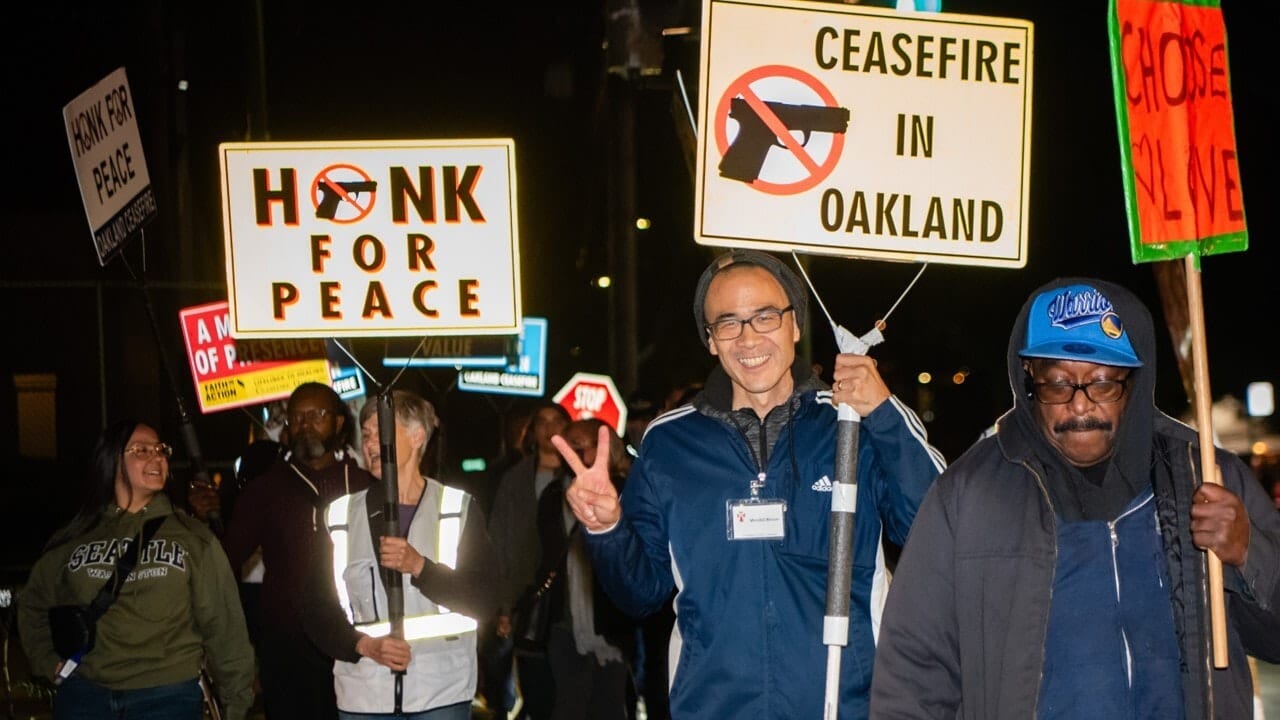
The city later launched its Ceasefire program in 2012, which was operated by the Police Department to conduct targeted violence intervention. They reached out to people known to commit violent offenses, offered them services if they stopped, but threatened a law enforcement response if they didn’t.
To coordinate the various efforts, manage funding, aid in communication and data sharing, Oakland launched the Department of Violence Prevention in 2017. Involved parties include the police, the district attorney’s office, community partners, city leadership, and more.
While the intervention efforts in Oakland were successful, Ceasefire stalled during the pandemic due to shifting political priorities. The department cut funding to intervention efforts and switched to area-based enforcement. The state DOJ later blamed the change in strategy for exacerbating the pandemic-era homicide spike, highlighting the need for consistent and targeted efforts.
Oakland has since resumed intervention work. Last year, the Department of Violence Prevention gave close to $13 million in grants to 26 different non-profits doing violence reduction, including Youth Alive!
Youth Alive! Deputy Director John Torres said in an interview that when it comes to violence prevention, “there is a big table, with a lot of folks interested, all with their own angle to go about it.”
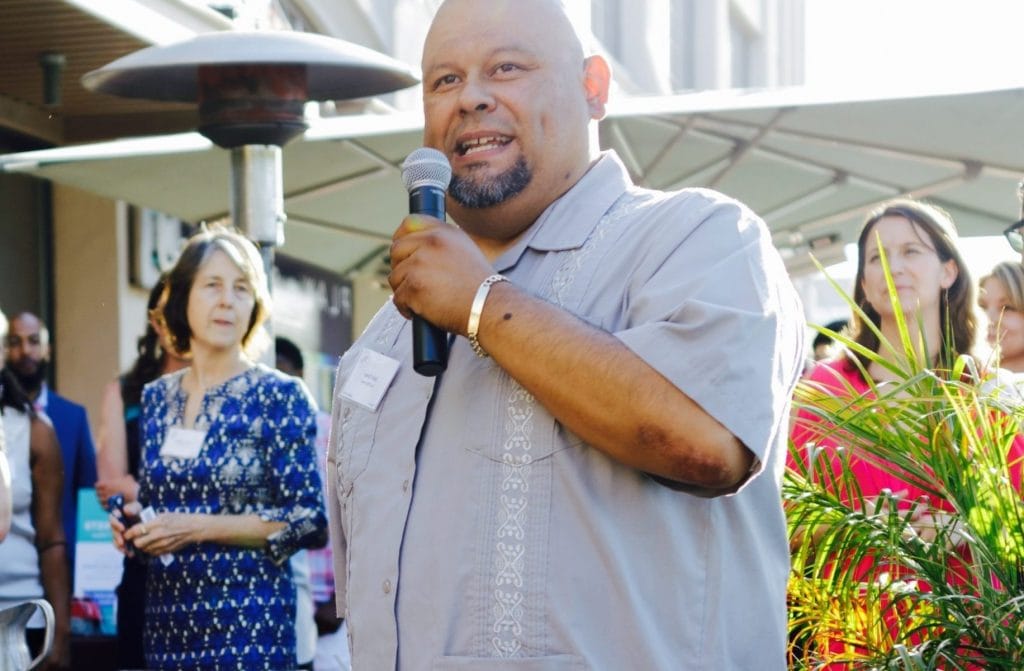
Coordinating those efforts becomes essential for an effective city-wide strategy.
Every Thursday, Oakland stakeholders review every gun homicide, non-fatal gun injury, and shooting at a car or house.
“You've got a group of stakeholders who are getting around a table in person and from different organizations and asking: ‘do we know who's involved, which organizations work with this family?’” McLively, the attorney at the Giffords Law Center, said.
“Like, ‘oh, I know their brother and they're going to want to be getting retaliation because of this relationship,’” he said. “Like that level of specificity.”
Addressing every shooting means being able to offer resources to people who may otherwise slip through the cracks.
But that level of coordination between stakeholders “can sometimes only happen if there's a central body with some resources, like an Office of Neighborhood Safety that can bring people together,” said McLively.
Hollins, of the Californians for Safety and Justice Coalition, said there are pros and cons to having a centralized office versus a non-profit partnership and there are examples of effective violence reduction strategies run through police departments. But ultimately, any strategy only succeeds when strong leadership is present and city dollars and infrastructure are prioritized for it.
“If you're doing it right, you're communicating, and you have access,” Hollins said.
Coordinating regional efforts
Intervention work today is different than what it was 20 years ago. The landscape of violence in the Bay Area is much more widespread.
Across the Bay Area, rising costs and gentrification have pushed people to move to new cities, bringing their belongings, social ties, and conflicts with them.
Intervention workers in Richmond go all the way to Antioch because that’s where the work takes them.
“It's all linked together,” Kenny Brown, an intervention worker in Richmond, said in an interview.
“When I was growing up, we were all just one city and you’re just from this side [of town],” Brown said. “It turned into, ‘okay, I'm from here, my family from here, but because my family moved to Vallejo, now we got ties over there, and now everybody is all connected.’”
Shevvy Franklin, another Richmond intervention worker, said, if a violence reduction program is “just based off one city, you’re putting a band-aid on the wound.”
Franklin and Brown said that social media and rap music are also broadening conflicts and connecting groups that are further apart.
Violence interruption is effective when violence interrupters have relationships with the community. But as the areas of interconnected violence widens, so does the need to increase one’s reach.
Because of that, some experts are calling for a Bay Area-wide coalition of violence reduction efforts.
“What we really need in the East in the Bay Area is more of a regional sort of sharing and strategizing,” UC Berkeley professor Jason Corburn said in an interview.
“It's important for a regional approach, and it's really important for those frontline violence interruptors, to be in conversation with one another, across these different jurisdictions,” Corburn said.
Transparency and accountability
According to Corburn, violence reduction work needs to be held at the same standard of transparency and accountability as any other city department.
“Just like we want cities to ensure that there's good sidewalks and parks and housing and infrastructure, preventing gun violence should be part of that,” Corburn said.
Cities that allocate funds through the city budget place strict scrutiny on how that money is used.
For example, the Oakland Department of Violence Prevention publishes an interactive dashboard of its activities while Richmond’s Office of Neighborhood Safety has to present yearly reports to the City Council on its efforts and progress.
“They put time into it, we used to do this with all of our departments in our city,” Lindsay said. In addition, the city of Richmond would also conduct performance audits using a third party auditor to do “thorough reviews of what they were doing.”
Before the creation of the Office of Neighborhood Safety, the Richmond City Council used to sporadically award contracts to non-profits for violence reduction efforts, Lindsay said.
“It didn't have accountability, it wasn't competitively bid,” he said. “It was just, well, we're going to spend money on this. I think that is not a good approach.”
Funding structure for long term efforts
Last year, the federal government cut over $800 million worth of grants for violence reduction efforts. Local organizations including Youth Alive! have lost funding as a result.
Even though the state of California has affirmed its commitment to keep funding CalVIP, as federal funds become scarcer, it creates more pressure to diligently spend the available grant money.
Former U.S. Assistant Attorney General Amy Solomon said in an interview that “grant funding can play an important role in seeding innovation and scaling programs that work.”
“But even in the best of times, cities need to create the infrastructure to support these strategies and programs over time,” she said. “That kind of systemic commitment is essential to long-term success.”
The Bay Area cities that have been most successful in reducing gun violence have set up dedicated funding streams for their programs.
Oakland for example passed several tax measures to fund violence reduction efforts. In 2004, voters passed Measure Y, renewed it in 2014 as Measure Z, and again as Measure NN in 2024, providing tens of millions of dollars in funding.
Richmond’s Office of Neighborhood Safety has its funds directly allocated from the city budget.
Using local funds, incorporated into the city budget, also means more transparency over how the money is spent.
City managers may feel leery of taking on extra costs, but Sam Vaughn, the current director of Richmond's Office of Neighborhood Safety, said that it pays off.
“It’s an investment. Like Richmond has so many new housing and businesses,” Vaughn said. “They weren't doing that ten years ago, because people didn't feel safe.”
But the Office of Neighborhood Safety couldn’t have done it without “sustainable consistent resources that don't waver with politics,” he said.
Next steps for Vallejo
Boggan said that Richmond’s greatest contribution is perhaps showing “what becomes possible when Community Violence Intervention is treated as permanent public infrastructure rather than a temporary project.”
While Vallejo has tried similar efforts, they have not been consistent. Every few years, the city launches a new project aimed at reducing gun violence. Most have been run through the understaffed police department. Each new project drew few lessons from previous ones.
Vallejo’s difficulties include turnover in city leadership, whether the police chief or city manager, causing a lack of a consistent champion.
The city also has never published a formal problem analysis. The Police Department has pointed to gang activity, but has provided little elaboration.
Corburn has worked in Vallejo in the past doing data analysis for Advance Peace, a non-profit which the city once awarded $700,000 for violence intervention. But emails between Corburn and the Police Department obtained through a public records request show that Corburn was unable to readily access the department’s data.
There have been consistent difficulties in communication between police and community partners, according to grant reports and correspondence obtained through public records requests.
Vallejo police have made little data from previous violence reduction efforts public, causing concern around transparency from City Council members.
And the city’s sporadic efforts have relied mostly on state grant funding, so it has not been able to fund any strategy long term.
Boggan said that when “courageous leadership, community accountability, institutional commitment, sustained investment, and the voices of those closest to the violence” align around a common mission, it proves that “cities can save lives.”
Absent of those things in Vallejo, the city runs the risk of spending millions of dollars again with scarce results.
According to Corburn, success doing so not only makes cities safer, “it can reorient the face of local government.”
“That's the underappreciated part of community public safety,” Corburn said. When people “see themselves as part of that local government and doing positive work, they start trusting, investing and seeing value in local government.”
Independent local news depends on you
The Vallejo Sun is supported by readers who value reliable, in-depth local news. Your support helps us continue investigating important issues and keeping Vallejo informed.
Become a member today- policing
- Vallejo
- Vallejo Police Department
- Oakland
- Richmond
- Tinisch Hollins
- Californians for Safety and Justice Coalition
- VISION
- Vaughn Crandall
- Bill Lindsay
- Mike McLively
- Giffords Law Center
- Devone Boggan
- Ceasefire
- Youth Alive!
- John Torres
- Kenny Brown
- Sam Vaughn
- Shevvy Franklin
- Jason Corburn
- Amy Solomon