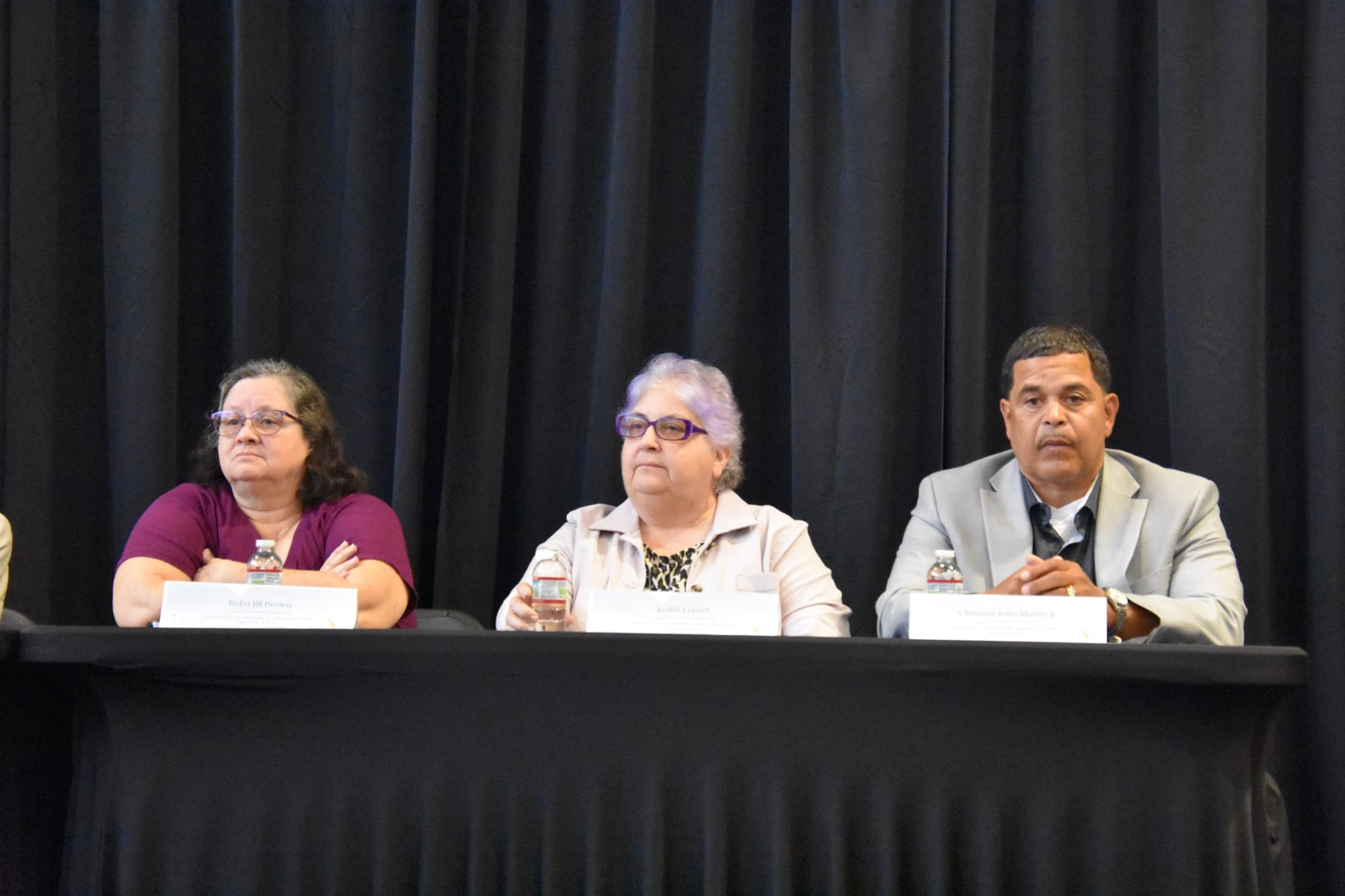

VALLEJO – Three candidates are running to represent the residents of District 4 on the Vallejo City Council. Charles Palmares is running for re-election for a second term, with two challengers looking to unseat him — maritime business advocate Chris Platzer and San Francisco Foundation senior officer Brianna Rogers.
District 4 represents Vallejo’s downtown area, Mare Island, and the city’s waterfront areas.
How to vote: Ballots will be mailed to voters this week, and the completed ballots must be signed and postmarked before the polls close at 8 p.m. on Nov. 3. Voters can also vote in person on Nov. 3, Election Day.
How we reported this story: We solicited questions from our audience and attended community forums to find out what questions mattered most to Vallejo voters. We then interviewed each of the candidates to learn more about their positions and what they plan to do in office. You can find out more about how we cover elections on our FAQ.
Charles Palmares

Charles Palmares is running again to represent District 4, after winning the election in 2022 in a close race against former Vallejo School Board Trustee Ruscal Cayangyang.
Palmares is a former Planning Commissioner and member of the Participatory Budgeting Delegate Working Group. He is a military veteran who also worked in the civil affairs branch of the U.S. Army, and he said he has 15 years of experience in operations management, data analysis, quality control and manufacturing.
In his first term, he said he successfully advocated for a number of programs and projects, such as a sex trafficking reduction strategy on Sonoma Boulevard, the installation of traffic-calming and sideshow deterrence infrastructure and the establishment of a behavioral health crisis team.
He said his goals, if re-elected, are to improve the quality of life in Vallejo’s neighborhoods, including creating a “neighborhood improvement task force”; strengthening businesses and available jobs by “soliciting large-employer firms, sustaining our local and small businesses, and preparing our workforce”; and reducing violent and property crimes through law enforcement and preventative programs.
Palmares’ ideas to improve economic development include bringing shipbuilding and clean energy manufacturing firms to Mare Island. He said the city should also take a leading role in developing the local workforce through collaboration with Cal Poly Maritime Academy, local schools and the county. He also suggested more pop-ups and street events, and collaborating with Solano County Fairgrounds to bring in music festivals.
He said Vallejo has struggled because the Economic Development Department “has not had strong, decisive director-level leadership” and has not been collaborating closely with Planning and Development Services.
To create more revenue, Palmares said he would consider raising taxes, following a performance audit and the development of a long-term financial plan.
For housing, he wants to “incentivize mixed-use infill development on empty lots” and streamline permitting processes. He is pushing for remote building inspections and reduced fees for renovations and new projects.
He supports rent stabilization, tenant anti–harassment protections, and a tenant’s right to counsel. If elected, he said he will “also push for an anti-slumlord ordinance in my second term.”
Palmares said to address homelessness, particularly in the White Slough encampment, he intends to push City Manager Harry Black “to take ownership of the problem.” He said he wants the council to “be invested in developing by-name lists of each encampment,” along with a list of “what resources are available at the moment.”
To address illegal trash dumping, he said he would push for more lighting, monitoring, signage and barriers at hot spots. “I would also push for higher fines,” he said.
On public safety, Palmares said that in 2025, he advocated to then-City Manager Andrew Murray that the Vallejo Police Department hire a project manager with experience in police reforms to ensure that the department stays on track with its state-mandated reforms.
Regarding Flock Safety cameras, Palmares said while he wants the police department to effectively address criminal activity, residents’ First and Fourth Amendments must also be protected. “What I am investigating now is whether we can institute a robust and regular auditing process that can accomplish both objectives,” he said.
On federal immigration enforcement, Palmares said, “I have no trust in ICE. After seeing how they have operated so recklessly and with impunity nationwide, I do not want to collaborate with them in any way.”
Palmares also took a hard-line stance against data centers: “I intend to propose a moratorium or outright ban in the near future,” he said.
He has also opposed California Forever’s East Solano Plan since 2024, saying it would draw financial resources and staff bandwidth from the county and seven cities, and threaten “our precious ecosystems and water supply.”
To improve public perception of the council, Palmares said he wants Black to establish a customer service task force, with “middle managers” in each city department, to help city employees get the time and space to improve customer service. He said staff in different departments also need to work more collaboratively, and the council needs a legislative aide or executive assistant to improve responsiveness to constituents.
Palmares said the city lacks ownership of problems. “Residents do not want to hear excuses; they want to see results,” he said.
- Fundraising: Palmares has not raised any money, aside from his own contribution of $100, as of mid-September.
- Endorsements: Palmares has been endorsed by the Sierra Club and Solano County Orderly Growth.
Brianna Rogers
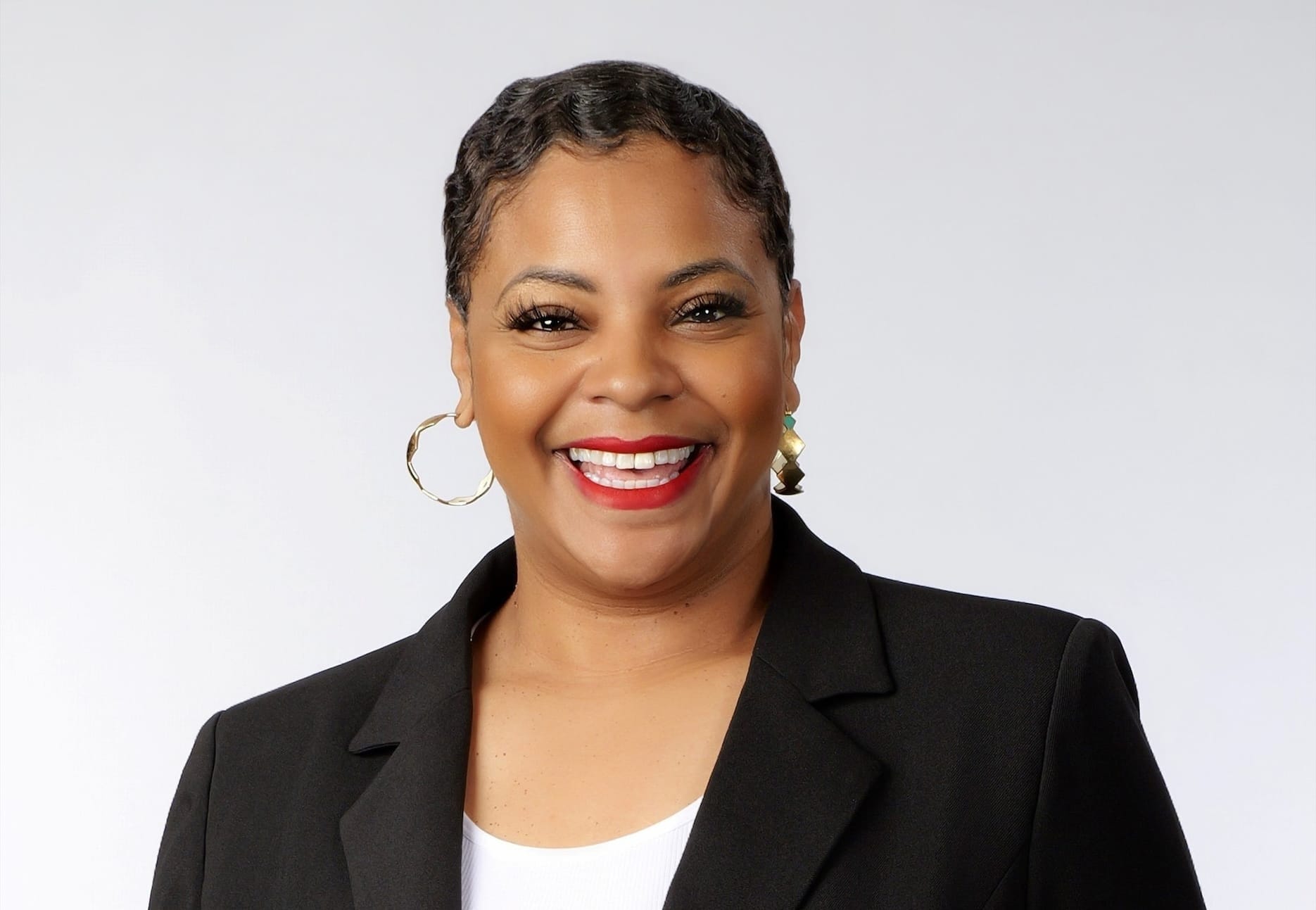
Brianna Rogers became a Vallejo homeowner in 2023, being born and raised in Berkeley. She is a senior program officer at the San Francisco Foundation, and said she brings experience from working on public policy in Alameda and San Francisco counties. She has a masters degree in public policy from Georgetown University, and said she knows how to find and leverage philanthropic dollars and state and federal grants.
“When I talk to people about Vallejo I get very excited,” Rogers said.
However, she added she has multiple priorities, if she’s elected to represent the district.
“We have people illegally dumping. We have really struggling commercial corridors,” she said. “We have homelessness without efficient solutions. With our current City Hall, I couldn't see how they leaned into these issues.”
Rogers wants to ensure that city departments are “less fragmented” and reduce the city’s high turnover rate.
“I have been shocked at how the city is run. City leadership lacks strategy and alignment as far as clear goals and intended outcomes,” she said.
She said she wants to see City Manager Harry Black build “a high performing culture” and have more ”regular performance reporting.”
“I know I’m jumping into chaos,” Rogers added.
Rogers said she was once a Section 8 voucher holder for more than 20 years, and added she’s passionate about improving Vallejo’s housing availability and issues with homelessness.
“Both compassion and accountability can exist at the same time,” she said. “People need housing, and they also need treatment.”
Rogers said the city should align closely with agencies providing different services to people exiting homelessness, and ensure that different programs work together effectively — while better managing grants “with measurable outcomes and clear data gathering and assessment.” She also said that the Vallejo Housing Authority should be more accessible, calling it "disrespectful" that since last year, the Housing Authority office has been closed to public access, allowing online-only appointments.
Rogers said if elected, she would ask housing staff about all projects that have been proposed or permitted, and ask why some are not headed toward construction.
For renters, she said, “Stability means enforcing tenant protections, preventing displacement and preserving existing affordable housing.”
Rogers also emphasized the need to clean up trash and debris in encampment areas, such as in White Slough, without displacing people. She said the city needs individual housing plans with coordinated case management and multiple housing pathways.
On police reform in the city, she said she wants to see an effective police department with clear, “institutionalized” accountability in place, calling the badge bending practice “deeply disturbing.”
“There’s a huge opportunity to implement the mandated reforms with strong independent oversight and transparent reporting,” she said. “A community can't rebuild trust if we minimize the harm.” In order to move forward, she said that people need to know that City Manager Black and Police Chief Jason Ta will work together to build trust with the community and with city staff.
On Flock Safety cameras, she said all public safety technology needs effective guardrails, and she feels that Flock “doesn't have guardrails right now” because “the plane is being built as we’re flying it.”
Rogers said the city needs to know what data is being collected by Flock, who can access it, and what audits are taking place to prevent abuse of the data. She also noted that residents in the Crest neighborhoods have “advocated for Flock cameras” amid recent violent shootings.
“Some live in communities where they are privileged to say, ‘Get it out.’ Some live in communities where bullets are flying and they say, ‘Get the cameras here now,’” she said. “My job is to listen to both and see what can work best for everyone.”
On the use of AI, she said it could help improve the city’s management of services and efficiency in delivering them, but noted it “should assist human decision making, not replace accountability.”
Rogers said that while she is open to reviewing proposals for data centers, she thinks “a huge facility consuming significant resources but producing relatively few permanent jobs requires a very different analysis.”
On California Forever, Rogers said the project’s developers must show how it would benefit existing residents, rather than competing with them for resources.
“I want jobs to come to Vallejo. I want housing to come to Vallejo. I am pro responsible growth, but creating an entirely new community at that scale requires extraordinary scrutiny,” she said.
“Desperation for economic development cannot be our strategy anymore,” Rogers added. “Vallejo has a self-esteem issue, and we need to be clear we are not desperate anymore.”
- Fundraising: Rogers has raised about $19,842 as of June 30, including from her own contributions totaling $2,530. Top contributors include Vallejo teacher Amber Logan, realtor Jonisha Smith, and Everett & Jones BBQ International LLC.
- Endorsements: Rogers has been endorsed by the Solano County Democratic Party, the California Democratic Renters Council, Black Women Organized for Political Action, Solano County Supervisor Cassandra James, and Vallejo city councilmembers Alex Matias and Tonia Lediju.
You can read more about Brianna Rogers’ campaign on her website and reach out to her at info@briannaforvallejo.com.
Chris Platzer
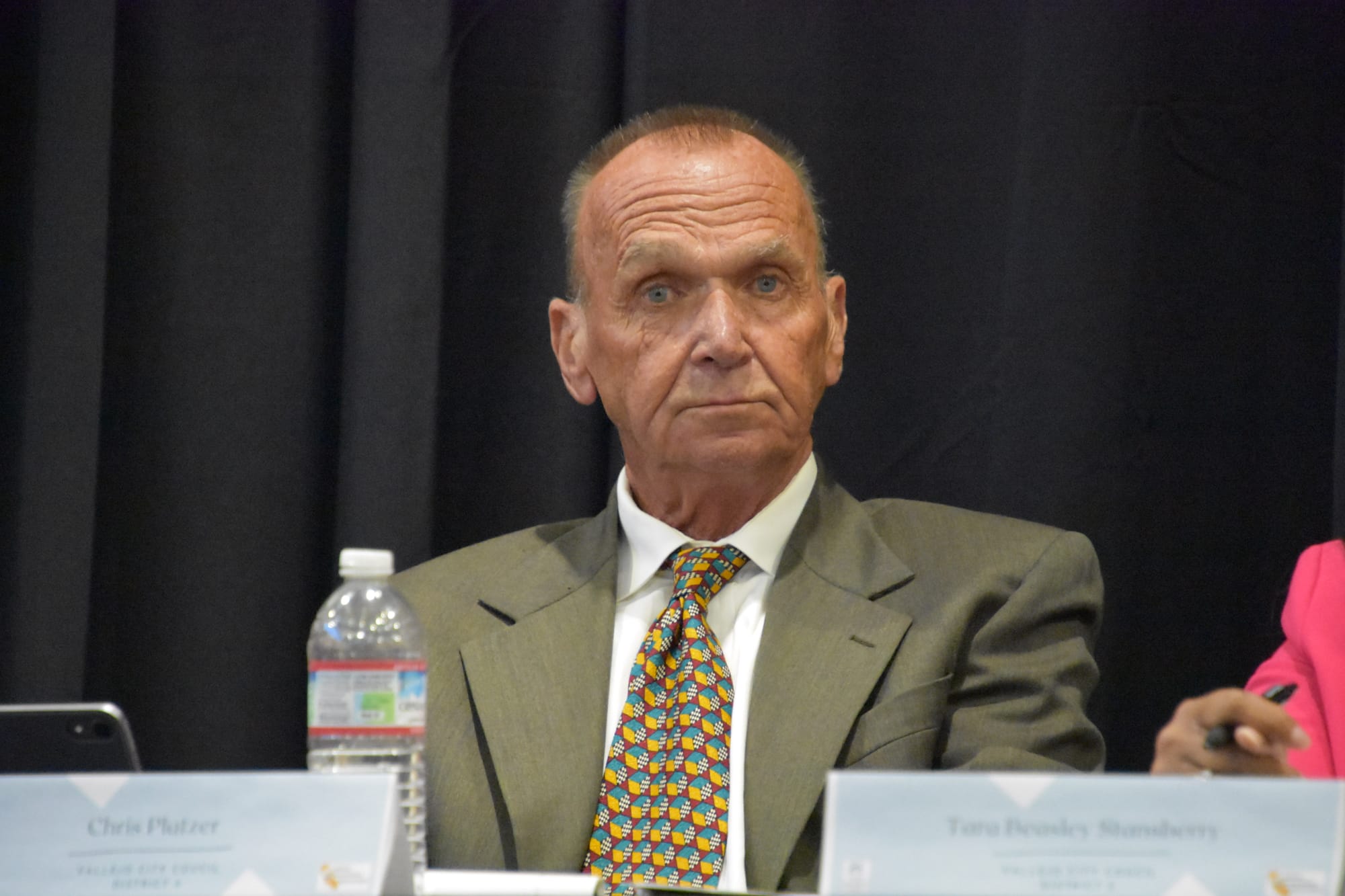
Running for council for the third time is Chris Platzer, who has lived in Vallejo for 34 years. He unsuccessfully ran for city council in 2013 and in 2022, when Palmares won the seat.
“I want to focus on economic development, particularly the opportunities we have on Mare Island and our waterfront,” he said. “Those assets can help us create good jobs and generate the revenue we need to improve city services.”
Platzer lists his occupation as an “animal rights advocate and former Planning Commissioner” in his candidate statement on the city website. He told the Vallejo Sun he has also worked in the maritime industry and at technology companies Digital Research and Novell. He resigned from the Planning Commission in April 2020 after being observed drinking beer and throwing a cat during a commission meeting held on Zoom.
His three main issues are improving economic development and available jobs, along with “revitalizing the downtown and waterfront, and restoring confidence in city government.” Platzer wants to accomplish these goals with the improvement of Mare Island and the city waterfront, as well as transforming the Indian Alley neighborhood into a “vibrant arts and cultural destination,” and reimagining Parking Lot J as “a downtown zócalo.” Of the latter, he said it needs to be more than an asphalt “storage place for cars.”
Platzer on his website and in an interview emphasized his idea for developing “The Ark,” or a waterfront houseboat community, to improve business and housing opportunities in the area.
He also emphasized the importance of clean streets and public infrastructure, saying, “If Vallejo wants to revitalize places like Indian Alley, Parking Lot J, and the waterfront, those public spaces need to be clean, maintained, and taken care of.”
When asked about improving public safety and perception of the police department, he said that accountability “makes legitimate policing stronger, not weaker.” Regarding Flock cameras, he said that such technology needs meaningful safeguards to ensure residents’ privacy and civil liberties.
When asked about ICE and federal immigration activity in the city amid the Trump administration’s enforcement efforts, he said, “Vallejo can respect federal authority while making sure its own police department remains focused on protecting the entire community and operating within the law.”
Platzer also emphasized restoring confidence in the city government.“People need to believe that their elected officials are listening, that taxpayer dollars are being spent responsibly, and that when the city makes a commitment, it follows through,” he said.
He said that to improve stability for homeowners and renters, the city should build more homes while preserving the current stock and providing assistance “to the residents who need it most.”
Platzer also wants to update the city’s infrastructure.“We can’t expect businesses and private investors to invest in Vallejo if the city isn’t willing to maintain its basic infrastructure,” he said. He said the city of Vallejo, if it raises or introduces taxes, must demonstrate that it has exhausted responsible alternatives and can demonstrate to residents exactly what their money will accomplish.
On the use of AI, Platzer said he is comfortable embracing new technology “when it makes government more effective, more transparent, and less expensive” while cautioning against using it “as a substitute for human judgment, accountability, or public participation.”
At an election forum on Sept. 3, Platzer proposed turning Mare Island into a major AI hub.
“Everybody's going to be talking about AI in the next couple of years — it's already happening. Turn Mare Island into the AI manufacturing hub for the Bay,” said Platzer. “By that I mean autonomous boats, robots, all that good stuff.”
He said of California Forever, “Vallejo should be aggressively developing the assets it already owns and controls.”
If elected, Platzer said he wants “to bring a practical, results-oriented approach to the Council: identify our assets, establish priorities, find the money, get the projects moving, and hold ourselves accountable for delivering them.”
- Fundraising: Platzer has not filed a statement reporting contributions his campaign received as of mid-September.
You can read more about Chris Platzer’s campaign on his website.
Independent local news depends on you
The Vallejo Sun is supported by readers who value reliable, in-depth local news. Your support helps us continue investigating important issues and keeping Vallejo informed.
Become a member today