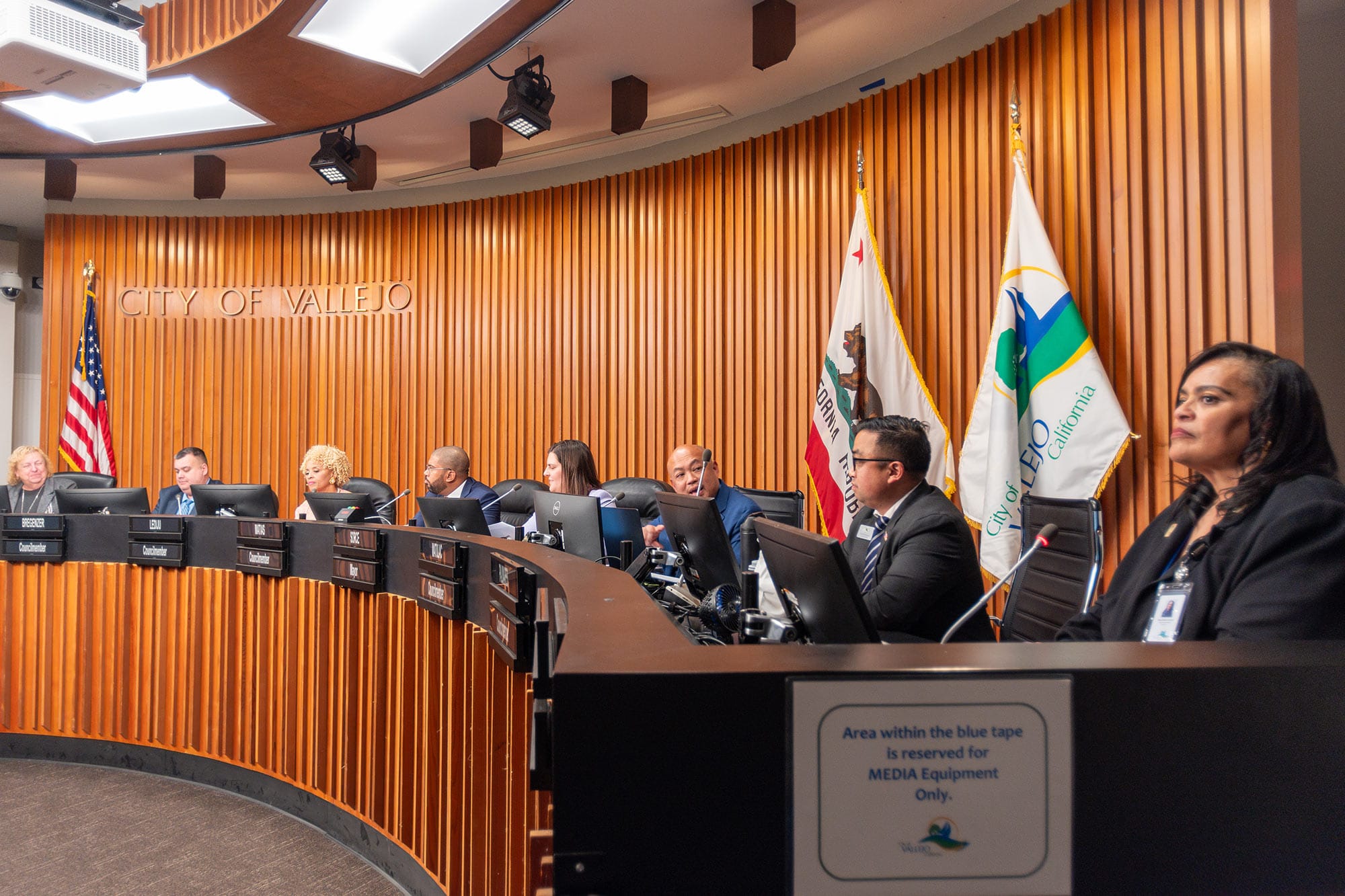

VALLEJO – The Vallejo City Council approved an ordinance requiring residential development projects to include a certain percentage of affordable units at a meeting Tuesday, opting for a stronger version of the ordinance that would go into effect sooner.
City staff had recommended a scaled-down version of the ordinance based on a consultant firm’s findings that under current market conditions the inclusionary ordinance could discourage development in Vallejo.
The Vallejo Planning Commission reviewed ordinance options developed by the city and the consultant, Economic & Planning Systems Inc., at a Sept. 9 meeting but recommended a stronger version of the ordinance to the council.
The council voted 5-1 in favor of the Planning Commission’s recommendations, which had a lower project size threshold to include affordable units. The council also modified the ordinance to take effect 90 days after the council’s final approval.
Councilmember Diosdado “J.R.” Matulac entered the sole “no” vote, stating that he was concerned that staff may not have enough time to implement the ordinance. Mayor Andrea Source was not present for the vote.
Councilmember Alex Matias expressed interest in further customizing the ordinance to fit Vallejo but any major changes could have required the city to restart the two-step approval process and delay adoption.
“We have to make sure we devise programs and policies that are responsive to our city, not stuff in a vacuum, not stuff that we've got consultants from out of town putting together,” he said. “I'm also very bullish on our market, I think we're going to be doing well in a few years.”
Housing affordability groups have long advocated for the city to adopt an inclusionary ordinance. Vallejo’s Housing Element, a state mandated plan to increase the city’s housing availability, calls for the council to consider adopting an ordinance as part of the plan to meet the city’s housing needs.
“We can't adopt a version so narrow that it's just functioning as symbolic policy,” Vallejo Housing Justice Coalition director Cristal Gallegos said at the meeting. “The planning commission's recommendation is the only version that's going to move Vallejo towards compliance with state law and also towards a more equitable housing future.”
The city received a number of written comments on the ordinance from organizations and residents in support of a strong ordinance as well as several comments expressing concern that the ordinance would dampen overall development in the city.
“Under the current Vallejo market conditions, the ordinance will discourage new housing production, raise costs on projects that do move forward, and deliver few – if any – affordable units, while worsening the city’s overall housing shortage,” wrote Lisa Vorderbrueggen, director of East Bay Government Affairs for the Bay Area Building Industry Association.
The consultant firm’s analysis found that a developer would have to earn a 15% profit on units for sale or a 5.5% yield on cost for rental units in order for an inclusionary ordinance to be feasible. Otherwise, the ordinance would reduce a developer’s return to the degree that they would be unlikely to proceed with a project.
Of the five housing project types studied, only single family detached homes met the threshold sale profit at 15.13%. According to the consultant’s report, the minimum profit and yield thresholds were developed based on the consultant’s own experience, research and feedback from developers in Solano County.
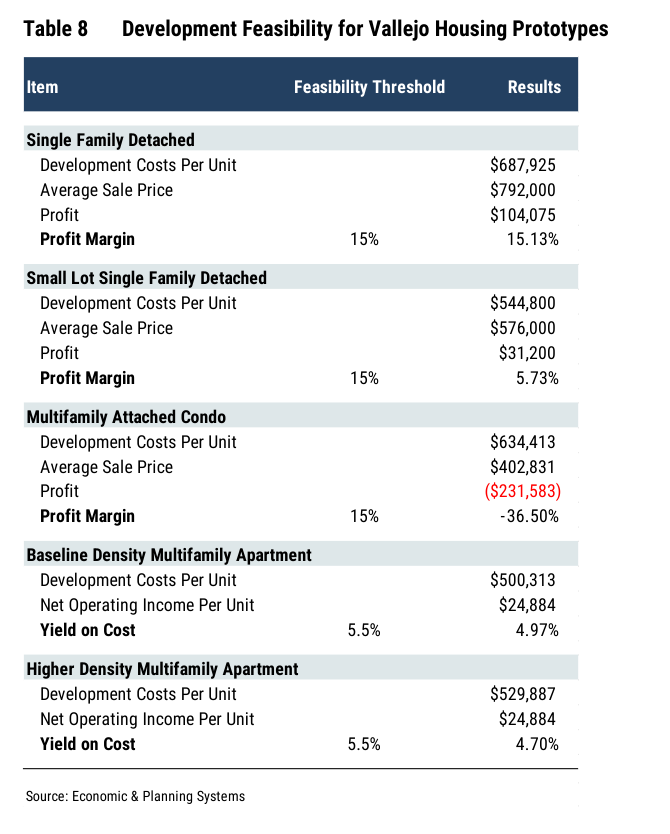
Based on this analysis and Bay Area market conditions, the consultant recommended that the city adopt a moderate ordinance, phase the ordinance in over time or wait for market conditions to improve before adoption.
The Planning Commission reviewed three ordinance models developed by the city and consultant that offered a range of affordability requirements.
The commission selected the mid-range option, which requires developers of rental properties with 20-100 units to designate 4% of those as affordable: 2% for very-low income households with a maximum income of $61,850, and 2% for low-income households with a maximum income of $98,950.
Under this option, projects involving homes built for purchase with 20-100 units require 7% of those units to be affordable and projects with more than 100 units require 10% of those units to be affordable. However, these projects only require units that are affordable for low-income households and moderate income households with a maximum income of $134,550.
The commission recommended lowering the threshold at which a project is subject to the ordinance from 20 units to 10 units. The commission also recommended that staff conduct an biannual feasibility study, with annual reporting requirements, once the ordinance is adopted.
City staff recommended an option with the lower affordability requirements for projects intended for sale: 5% for 20-100 units and 8% for 100 and up. The staff recommendation offered a slightly higher affordability requirement for rental projects at 5% for 20 units and up, maintaining the project size threshold.
Councilmember Tonia Lediju said that many cities have ordinances with lower project size thresholds ranging from 3 to 10 units. She asked city staff members why they recommend the higher threshold.
Planning and Development Services Director Kristin Pollot said that Vallejo gets a fair number of small residential infill projects. “I think the thought was, if we kept the threshold a little bit higher then maybe we can help keep it simple for the people that want to do smaller projects.” She later added that the majority of units built in the city come from larger scale projects.
Lediju said that she would like to see a clearer analysis of the number of units that small scale infill projects could provide across the city. She noted that the city is behind on fulfilling its affordable housing numbers for this housing element cycle.
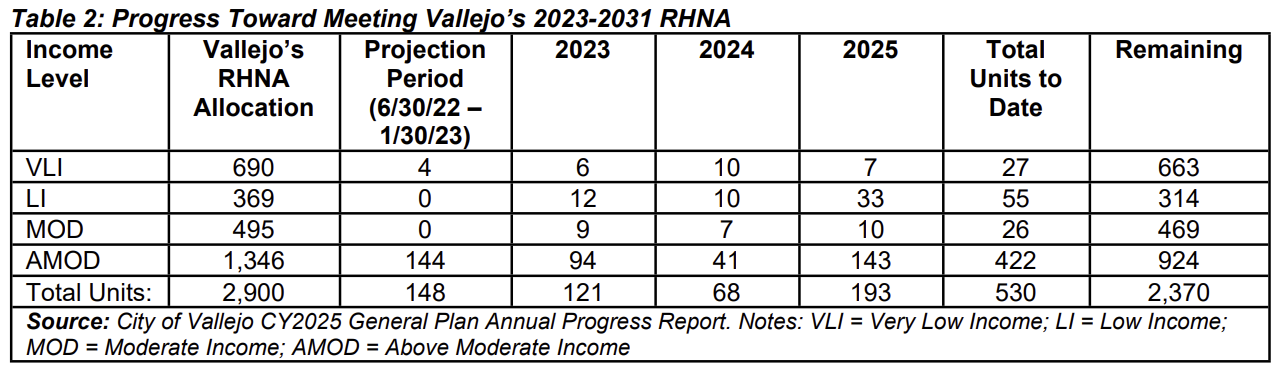
According to the staff report, 108 affordable units have been built in the city since the beginning of the current housing element cycle in 2023. But the city still needs 1,446 affordable units, including 314 low income units and 663 very low income units, to meet the city’s share of the regional housing need by 2031.
“We have been, for lack of better word, a dumping ground,” Lediju said. “A place where people can move out of San Francisco and other places and come here and buy and live and begin to displace our families that have lived here for many years.”
Lediju said that she would consider a project threshold of around 5 units based on how far the city is behind on building affordable housing.
Councilmember Charles Palmares said that he is concerned about losing projects when developers are just at the edge of profitability. He suggested that staff use all the tools at their disposal to help a project “pencil out” if it is close.
Matulac said that the ordinance places requirements on developers but it does not offer any incentives to build projects in Vallejo.
Planning Manager Hector Rojas said that the city has been transitioning from providing incentives and urging developers to voluntarily build affordable units to a hardline requirement. But he said that if the developer community is having a hard time meeting the ordinance requirements, the city could offer things like project streamlining or modified building permit fees to provide some relief.
The ordinance is designed to work with an in-lieu fee, which allows the developer to pay into a city fund for affordable housing instead of building the affordable units. Rojas said that the city could set the in-lieu fees higher if they wanted to encourage developers to build the units rather than pay into the fund. City staff plans to bring the in-lieu fee schedule to the council for approval as a separate resolution.
Both the Planning Commission and the staff’s recommendations included a provision that the ordinance would not become effective until 180 days after the council passes the ordinance. Rojas said that this allows the city time to implement the ordinance, notify developers and to complete development projects currently in the pipeline without revisions. He added that any application submitted before the ordinance goes into effect would not be subject to the ordinance.
Councilmember Helen-Marie Gordon said that when certain communities or developers only build market rate housing and above it is a form of discrimination. “I know that 180 days may not be much for you, but it's a lot for the community, especially with everything that’s coming up. Something doesn't sit right with me about that,” she said.
Councilmember Peter Bregenzer agreed with Gordon.“180 days gives me a lot of heartburn, in that it's a very long time,” he said. He said that depending on when the ordinance can be scheduled for final approval, the 180-day provision could push the effective date out until mid-summer. He recommended a 90-day period instead.
The council will take a second vote at an upcoming meeting to formally adopt the ordinance.
Independent local news depends on you
The Vallejo Sun is supported by readers who value reliable, in-depth local news. Your support helps us continue investigating important issues and keeping Vallejo informed.
Become a member today