BENICIA – The Bay Area Air District announced $40 million in grant funding for the city of Benicia and the Benicia Unified School District at a press conference on Thursday morning at the Benicia Community Center.
The funds were awarded to the city and the school district from an $82 million fine levied on the Valero Refining Company in 2024 for nearly two decades of toxic emissions releases in Benicia that exceeded legal limits. It’s still the largest penalty ever assessed by the air district.
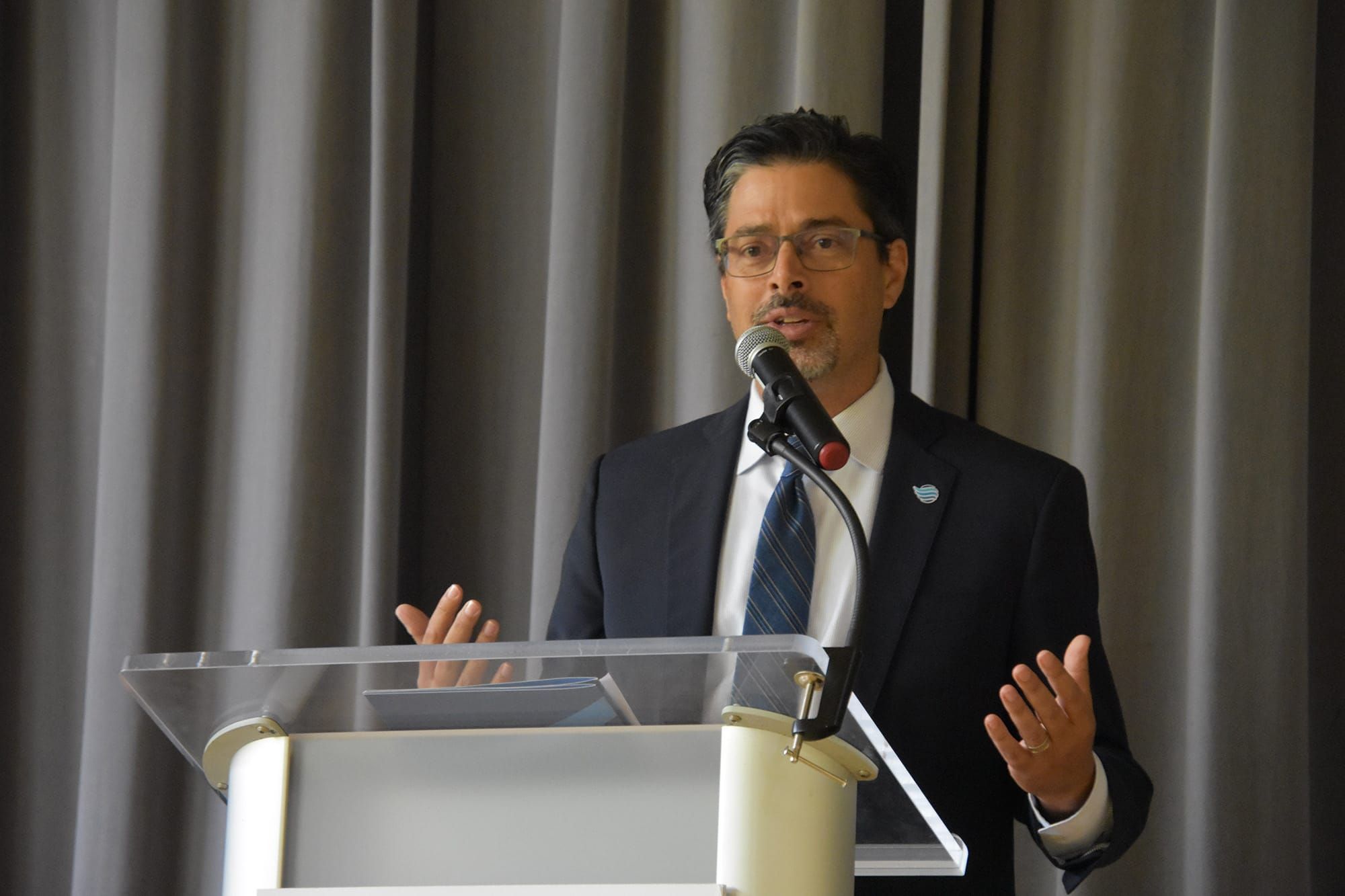
“This is the first award that the air district is making under our groundbreaking policy that ensures that penalty funds from air quality violations go back into the community where they can have a meaningful local benefit,” said Bay Area Air District Executive Officer Philip Fine. “The City of Benicia and Benicia Unified know their communities better than we can ever know them and understand their needs. And this grant program is specifically designed to put that local knowledge to work for this community.”
Fine said that historically, a big penalty would go into the Air District’s general fund. But the May 2024 creation of the Local Community Benefits Fund means the money can now be reinvested into health and sustainability projects in cities impacted by poor air quality, like Benicia, Vallejo, and Richmond. The $40 million is part of a total $132 million fund generated from enforcement actions.
The Benicia funding will be broken into two segments: $30 million for the city and $10 million for the school district. The city will use the funds to expand clean energy and public EV charging, improve parks and shoreline access, plant more trees, fuel job creation, and improve wildfire resilience.
The school district will use the funds to replace gas-powered systems in school buildings with electric systems, seal air leaks, improve air filters, plant more trees and greenery for shade and cooling, and create healthier schools for students.
Mayor Steve Young said it’s important to understand that the grant money will not go into the city’s general fund, meaning these funds will not be available to pay for any city operations like funding the police and fire departments, or maintaining the library or the city pool. As a result of Valero leaving, the city is still facing $7.5 to $8 million in reduced revenue next year.
“It’s important for people to understand what we can and cannot do with this money,” Young said. “I think there are some in the community who feel like, well, we've got plenty of money, our problems are over. Not the case. We still have real work ahead of us.”
Still, Young said this was a “significant investment in the future of Benicia” as the city continues to prepare for the economic and operational impacts associated with the refinery’s closure. He said these funds will help the city transition away from a “petrochemical economy to something new” in the 2030s and 2040s.
“That’s important in government, that we’re always planning for the future,” Young said.
He also said that it’s “especially meaningful and appropriate that these penalty funds are coming back to Benicia, as we are the ones who suffered for more than a decade from unreported toxic emissions from the refinery.”
According to 2020 data from the California Department of Public Health, 22% of the total population of Solano County has asthma, compared to 15% of the population of California. Though it’s difficult to draw a direct line from refinery emissions to the rates of asthma, researchers have found that living close to a refinery and breathing in its contaminants raises one's risk of developing it, along with other respiratory diseases and even cancer.
Young also thanked Valero for dealing with the issue promptly. “They could have fought this, and I actually expected them to fight this,” said Young. “But instead, they agreed to the settlement and funded the account … We're very grateful for the resources that are being brought to our community through this action.”
School district Superintendent Chris Calabrese said that a volunteer team of 12 staff members and parents got together to submit three proposals for how the school district would use the funds. He said they originally asked for $15 million, but the $10 million will still go a long way toward improving the seven schools in the district.
“We’re going to have to make some adjustments, but we’re going to start with our oldest facilities, as far as air conditioning and heating pumps are concerned,” said Calabrese, noting that schools like Mary Farmar Elementary and Liberty High School are in particular need for these upgrades.
City Councilmember Terry Scott said this was a huge day for the city and the school district. The grant “shows that the air district was willing to listen to the local needs of the community,” Scott said. “We're setting a model right now on what happens when a refinery leaves a community.”
The air district said that the grants for the other project applicants will be awarded in the fall, and the grant agreements will be finalized in late 2026 to early 2027.
Independent local news depends on you
The Vallejo Sun is supported by readers who value reliable, in-depth local news. Your support helps us continue investigating important issues and keeping Vallejo informed.
Become a member today- government

- environment
- education
- Benicia
- Bay Area Air District
- Phillip Fine
- Valero
- Steve Young
- Terry Scott
- Benicia Unified School District
- Chris Calabrese
Gretchen Smail
Gretchen Smail is a fellow with the California Local News Fellowship program. She grew up in Vallejo and focuses on health and science reporting.
follow me :