

VALLEJO – White Slough is a large tidal wetland full of brackish water from the Napa River that flows into the city of Vallejo from under Highway 37. The land serves as a flood control basin and a critical habitat for several endangered species, including the California clapper rail, California black rail, salt marsh harvest mouse and California red-legged frog.
It’s also home to the city’s largest homeless encampment, where dozens of people live on a narrow strip of fill that juts out into a portion of the swampy wetland west of Sonoma Boulevard, known by residents as the Island.
Since October 2023, a large portion of the Island has belonged to Robert Laron Bell, who has lived for four years at a camp along the shoreline.
Bell, 40, grew up in Vallejo and has lived there most of his life, aside from stints in jail or prison. Owning the 52-acre property, which is assessed at $17,136, has a special meaning to him. “I have not had anything my entire life, the property gives me a chance to build something besides a criminal history,” he said in an interview.
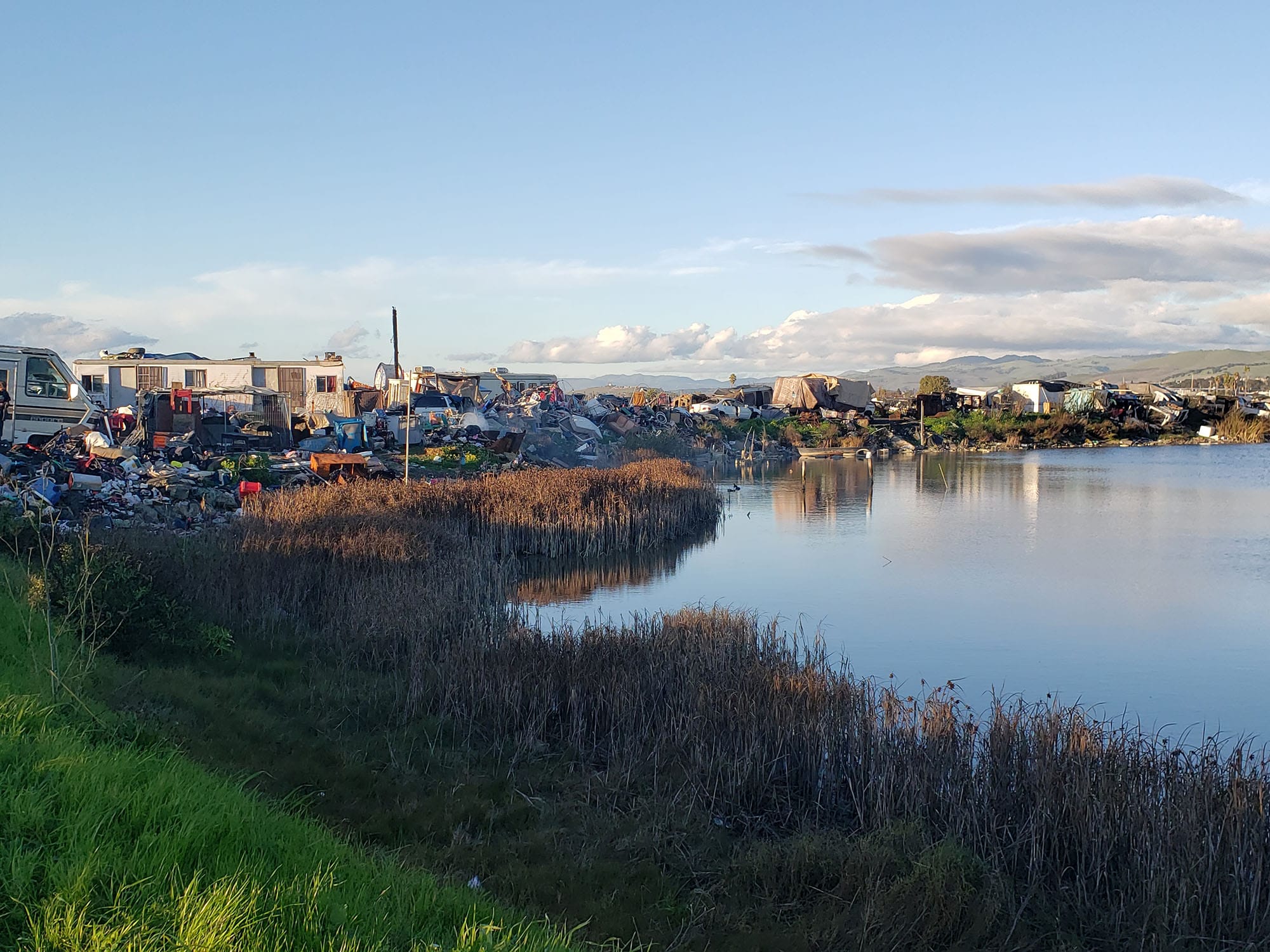
But, under pressure from the city and state regulators, Bell is now seeking to clear the people living on the Island. On Saturday, he passed out eviction notices at various camps on his property. The notice demands that encampment residents leave within three days or “they will be lawfully removed.”
“I thought that I was going to be able to make a stand but I really don’t have anything to stand on,” Bell said. “My options are to clear people off or lose the property.”
Facing lawsuit, landowner gave the land to homeless resident
The city of Vallejo sued the landowners of two privately owned parcels that make up the White Slough area in 2023 failing to address code violations related to accumulation of materials and debris.
The land was once used for farming, but after several levee failures in the 1970s, the U.S. Army Corps of Engineers allowed it to return to a tidal basin.
According to the city’s lawsuit against the owner of the larger of the two properties, it was previously owned by a company called Revolting Development Inc., which was owned by George Gianulias, whose family members still own the smaller parcel.
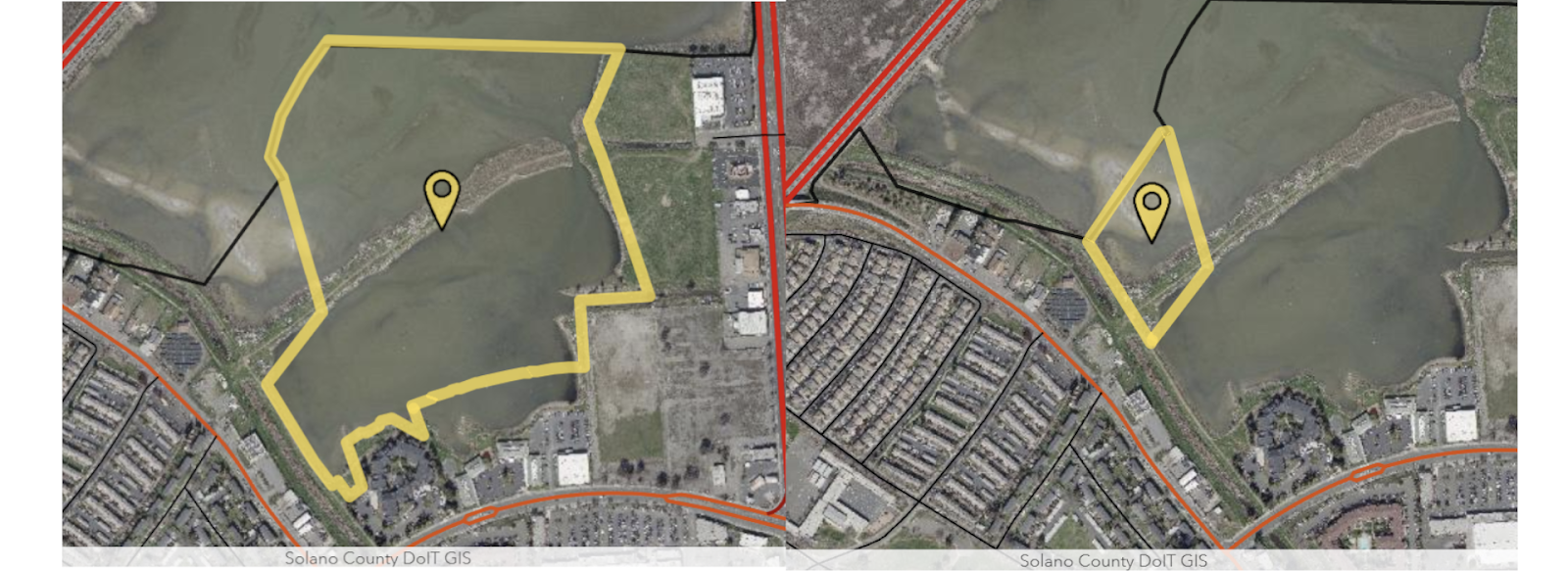
In 1980, the San Francisco Bay Conservation and Development Commission took legal action against Gianulias for filling in portions of the inundated land without a permit.
According to the case record, when Gianulias encountered a commission staff member photographing the fill areas, he punched the staff member, broke the camera and destroyed the film.
Gianulias argued that the agency did not have jurisdiction over the land because the shoreline had changed due to the levee failure. But a state appeals court confirmed BCDC’s jurisdiction over any land “subject to tidal action,” despite changes to the shoreline.
The southern basin was a largely stagnant body of water for years, but in 2002, the Corps of Engineers and Caltrans built a new culvert and tide gate. According to the city’s lawsuits, people have camped on the properties as far back as 2006.
Revolting Development suggested building tiny homes on the property for the residents living there, and the city paused their enforcement actions to consider the proposal, but found it was not feasible. Revolting Development then transferred the property to Guadalupe Mendez about two months before the city filed the lawsuit.
Then, Mendez approached Bell to give him the land.
“He just walked up, and I was like, ‘Who is you?’ and he said ‘I’m the owner,’” Bell recalled.
Mendez told Bell that the city wanted him to make the residents move off the property but he did not have it in his heart to do that and would rather give it away.
According to Bell, he was one of the only residents with identification handy; Mendez took him to Fairfield and paid the fees and transferred the property to him in October 2023.
Mendez told Bell that there was a pending lawsuit over code violations on the property but, for Bell, ownership of the land was an opportunity too unusual to turn down.
Bell has had few opportunities. He has encountered violent tragedy throughout his life, and later struggled with homelessness and legal issues.
When Bell was three years old, his mother was shot and killed by her boyfriend. Bell was right behind her when the shooting occurred and said that officers found him running around the crime scene when they arrived. Bell still has dreams about the incident, where he always finds a way to prevent the tragedy.
After his mother’s death, he went to live with his aunt, who had a son just a year older than him. Years later, in 2015, tragedy struck the family again when Bell’s cousin, whom he had grown up with like a brother, was killed in a shooting on Indiana Street and Sonoma Boulevard. Bell said that it is hard for him to visit family because it brings up so many bad memories.
In 2003, not long after he turned 18, Bell was convicted of robbery charges and sentenced to six months in jail.
Then in 2007, he was convicted of assault with a firearm and sentenced to six years in prison.
After his release from prison, he was arrested twice on charges of possession of a firearm with a prior felony conviction. His case is still pending for the latest charge and he hopes that he will not have to do more time.
When the property came into Bell’s hands, it felt like an opportunity for him to begin turning things around. He said he wants to attend school to become a barber and he thought that ownership of the land could offer him and other encampment residents the stability and security they need to begin putting their lives back together.
He scratched the money together to pay the first year’s property taxes and some of the initial fines. But then a friend who was fresh out of prison and staying at a nearby camp overdosed on fentanyl and died while tending a fire. The fire spread and burned Bell’s camp along with all his documents related to the property.
There have been a number of other safety issues on the property. In May, a gunman fatally shot two men and critically injured a third victim. Then in August, a man and a woman suffered non-fatal injuries when they were hit by a shotgun blast fired by a man who claimed that one of the camp’s dogs had bit him.
Fire Department spokesperson Kevin Brown said that there have been periods where the department gets daily calls related to fires on the Island. The fire trucks cannot access the peninsula so firefighters walk in carrying portable gear.
Brown said that sometimes firefighters work with encampment residents to form bucket brigades to control a fire, but they have also encountered encampment residents with weapons. “You have to pay attention to the fire and keep an eye out for the guy on the perimeter with a machete,” he said. Due to these safety risks the fire department is supposed to have a police escort when responding to fires on the Island, said Brown.
Legal challenges mount
At first, Bell said that city officials were interested in working with him to clean up his parcel. But the city wanted to ensure that encampment residents would not return after the removal of the materials and debris.
Bell felt that his ownership of the property might offer some leverage to help those living at the camp to get the mental health services and housing programs that they need.
“What I am trying to do is get it cleaned up and then I can talk to the city and some way, somehow, get them to understand – houses – don’t just move us around and create a problem elsewhere,” he said.
But recently, the pressure of mounting fines and his ongoing criminal case has Bell feeling like his choices are limited.
According to Bell, his ownership of the property came up in court proceedings for his criminal case. Bell said that he is potentially facing three years in prison for possession of a firearm as a convicted felon but his public defender is trying to get the punishment reduced to probation only.
Bell said that the judge in his criminal case told him that he drives by the White Slough area every day and the property is an eyesore. To Bell, this suggested that his decisions about the property may have an impact on the outcome of his criminal case.
Meanwhile, the city’s actions have led to even more people living on the property.
The city of Vallejo significantly increased encampment evictions following the June 2024 U.S. Supreme Court decision in Grants Pass v. Johnson, which allowed cities and counties to enforce camping bans on public property even when there are no shelter beds available.
In the second half of 2024, the city enforced an average of 2.6 encampment clean-up or removal actions per month. And in 2025, the city averaged 3.9 encampment removals per month, according to notices provided on the city’s website.
The increased encampment clearings on public property have forced many unhoused Vallejo residents to move to the private properties in White Slough as one of the last remaining encampments that has not been subject to repeated sweeps.
“Everybody is coming over here now,” Bell said. “Because they know it’s my property and they see that everybody has been here and they are not messing with people. But at the end of the day I am the one they are gonna be messing with, I’m the one their target is on.”
In its lawsuit, the city is seeking $250 a day for code violations as well as attorney fees. The code violations have been outstanding for two years, which could amount to nearly $200,000 in fines depending on the outcome of the case.
The city of Vallejo is not the only government entity that is stacking up fines on the properties. The San Francisco Bay Conservation and Development Commission is also pursuing an enforcement action for violations related to unpermitted fill or items in the water and on land along the shoreline and construction of a bridge without a permit, according to a notice obtained through a public records request.
The unpermitted bridge provides a crossing from the end of the peninsula to land along Sonoma Boulevard and was constructed to attempt to mitigate environmental concerns.
Encampment resident Carl Randolf Gernux said that when he started camping in the area, the water passage between the end of the peninsula and the east shore of the slough was choked with debris that people had thrown into the water.
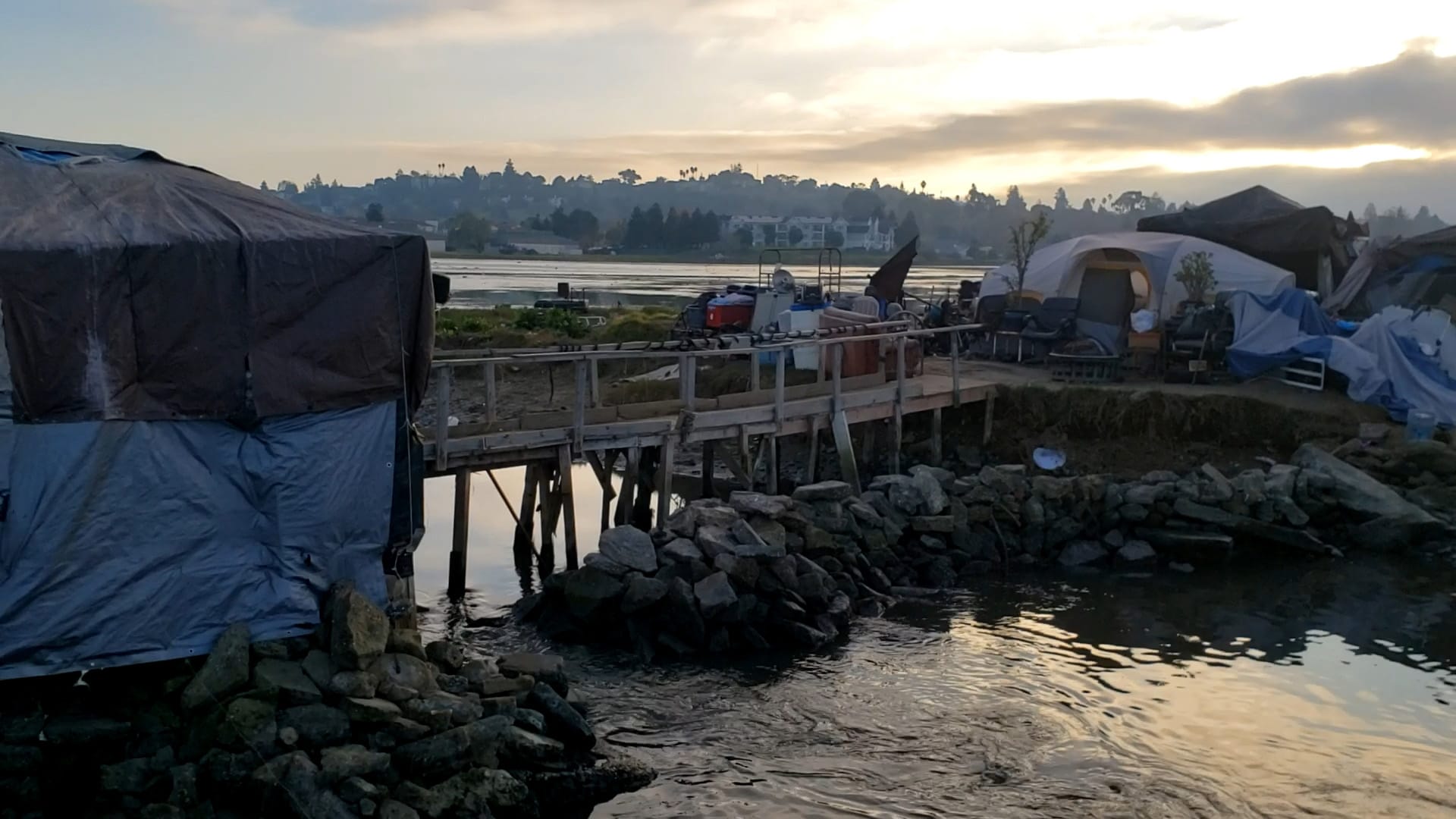
“All the fish were stopping right there, and it was real dirty water, mucky and just dead water coming out,” Gernux said. “So I made it where there's a flow going that keeps it clean. Otherwise it just gets clogged up and it gets all mucky and stinky.”
The bridge has sturdy hand rails and a small shelter built alongside it, where Gernux lives with his dog Traci. He has stacked concrete in the water to create a deeper channel where the water moves quickly in and out with the tide.
“I’ve seen 70% more fish come in now, it's good for all the birds and it keeps the water clean,“ Gernux said. “It’s something that is more meaningful than anything that I have done in a long time.”
Gernux does not have formal training in environmental restoration. He said that he learned from his grandfather who was a harbor master in Long Beach and from his own observations.
The commission allows 125 days for the property owner to settle the case by addressing the violations and paying applicable fines, but that date has long since passed. The next step is a formal commission hearing, which could involve fines from $10 to $2,000 per day up to a maximum of $30,000 per violation.
Bell wants to find a way to address the violations but he is unemployed and does not have the means to pay. He was keeping up with the correspondence from the court and commission but he said that friends who were passing along his mail moved from that address so he has not been getting the notices.
The future of White Slough

Much of “the Island” is lined with vehicles, trailers and RVs. Several vehicles are burned out or have been stripped down to the frame and there are piles of charred rubble from camps that caught fire.
Bell said he is planning to partner with a metal recycler to remove the vehicles and recyclable materials from the property.
But first, he plans to remove everyone living on the property and distributed an eviction notice on Saturday that cites state and municipal private property codes.
Some of the encampment residents question the validity of the notice. “It does not have an address or identify the property in any way,” said one resident, who preferred to remain anonymous. “Also, there are no signs that say ‘No Trespassing’ and no fenceline or anything to mark where the area is that you are not supposed to go.”
Other residents are worried that three days is not enough time to move their belongings.
Christina Quint, who moved to the property after she was evicted from Vallejo’s boat launch two years ago, said that in three days she might be able to pack up the bare necessities but she would have to leave a lot of her belongings behind.
Ashlee Oriente said that she has had to move seven times in the past two years because of encampment sweeps. “Everytime I touch down somewhere, I get a notice that I have to leave,” she said.
Denise Bouwsman, 67, who has lived on the property for over a year, said that she hopes that a friend with a truck will be able to help, otherwise she has no idea how she will be able to move before Tuesday.
Meanwhile, the San Francisco Bay Conservation and Development Commission is pressuring Vallejo and Solano County to complete a decades-old restoration plan of the area.
In 1990, the state enacted the White Slough Protection and Development Act, which required the city and Solano County to develop the White Slough Specific Area Plan. The plan was drafted and approved by the city in 1995. It laid out a number of improvements for the broader White Slough area, which includes wetlands on the north side of Highway 37. But in large part, the plan focuses on southern White Slough, where the Island is located.
Commission senior enforcement officer Anne Usher said that the agency is preparing to bring an enforcement action related to aspects of the plan that were never completed by the city and county.
The plans for southern White Slough include improvements like building a trail that circumnavigates the north and south lagoons with viewing points on the north, south and east shore. The plan also called for the removal of fill to create breaks in the privately owned peninsula to improve habitat and allow increased tidal flows across the slough.
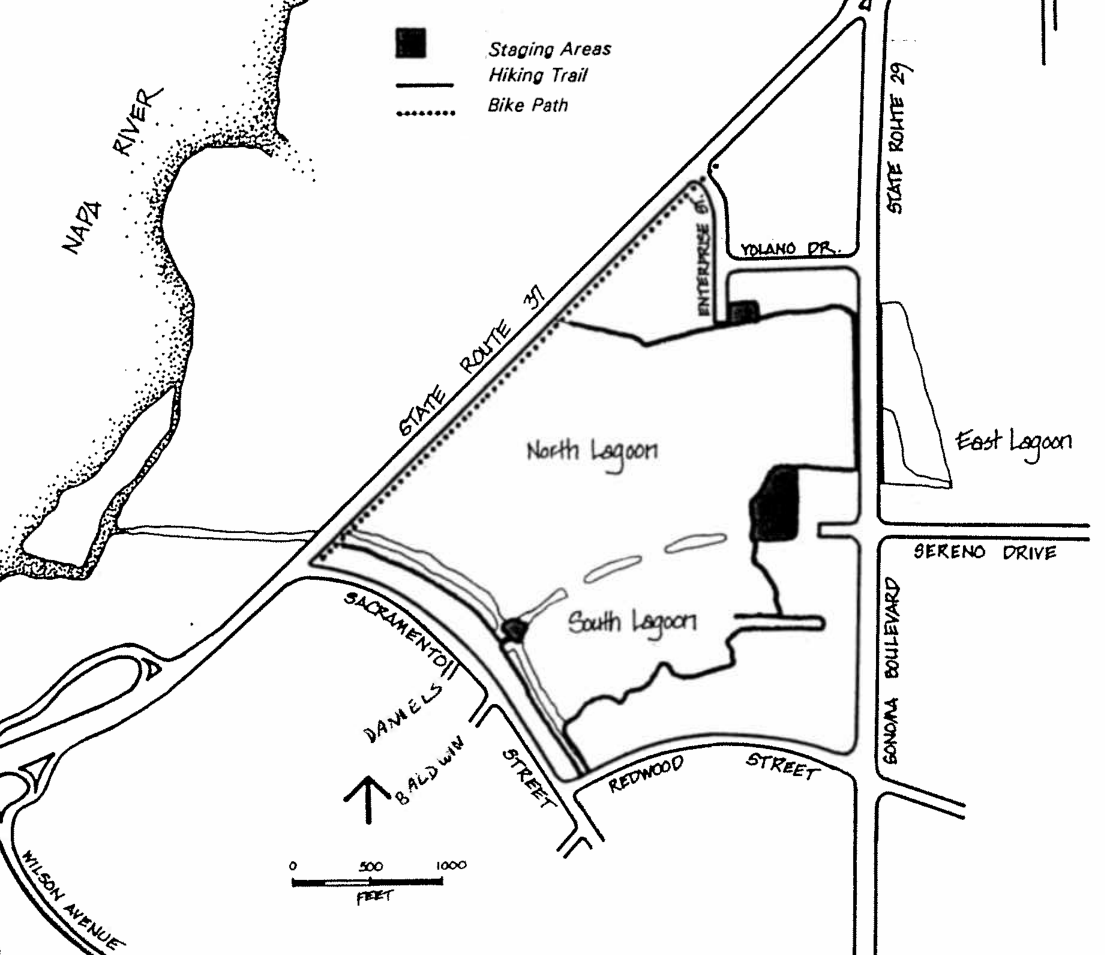
According to the commission’s White Slough fact sheet, the plan intended for private parcels to be purchased through a cooperative effort between the city, the county and state agencies so the wetland area could be permanently preserved. Usher said that the peninsula should not be in private hands today.
Bell has envisioned the land as a bird sanctuary and a place to create educational opportunities for youth. He said that he has had discussions with city officials about transferring the property for this purpose. This idea is in line with the objectives of the White Slough Specific Plan as well the city’s apparent interests in finding a land trust to serve as a steward.
However, Bell said he would like to get something in exchange for the property. “Maybe they would be willing to trade me for property that I can build on,” he said.
Before you go...
It’s expensive to produce the kind of high-quality journalism we do at the Vallejo Sun. And we rely on reader support so we can keep publishing.
If you enjoy our regular beat reporting, in-depth investigations, and deep-dive podcast episodes, chip in so we can keep doing this work and bringing you the journalism you rely on.
Click here to become a sustaining member of our newsroom.
THE VALLEJO SUN NEWSLETTER
Investigative reporting, regular updates, events and more
- Housing
- homelessness
- courts
- crime
- environment
- Vallejo
- White Slough
- Robert Laron Bell
- U.S. Army Corps of Engineers
- San Francisco Bay Conservation and Development Commission
- George Gianulias
- Revolting Developments
- Grants Pass v Johnson
- Carl Randolf Gernux
- Christina Quint
- Ashlee Oriente
- Denise Bouwsman
- Victor Meno