VALLEJO – The Vallejo City Unified School District Board of Education appears to have violated state open meeting law by discussing school closures in private before voting to close three schools in a public meeting on Dec. 17, according to text messages obtained by the Vallejo Sun.
The text messages, which the Vallejo Sun obtained through a public records request, show a conversation between Superintendent Rubén Aurelio and board Trustee Glenn Amboy on Dec. 15, two days before the board announced its decision. It appears to show them agreeing to discuss the pending school closure decision in private before the public meeting.
In the text exchange, Aurelio said he didn’t think the board was on the same page in regards to school closures. Amboy responded by expressing concerns that the board might face a stalemate and asked how early the board could meet before the public meeting to “hash this out.” Aurelio suggested that the board discuss the matter in a closed session meeting during his performance evaluation, and Amboy responded by liking the message.
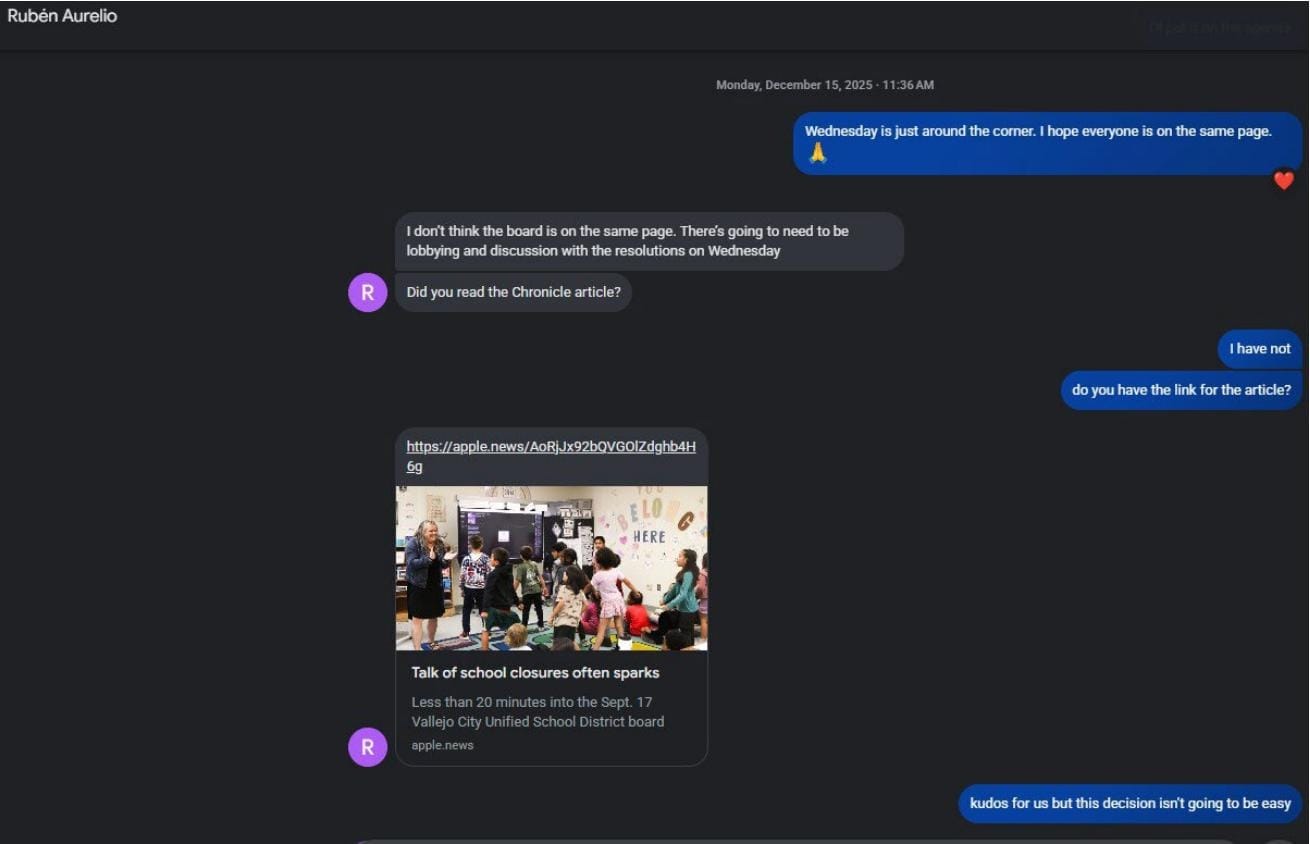
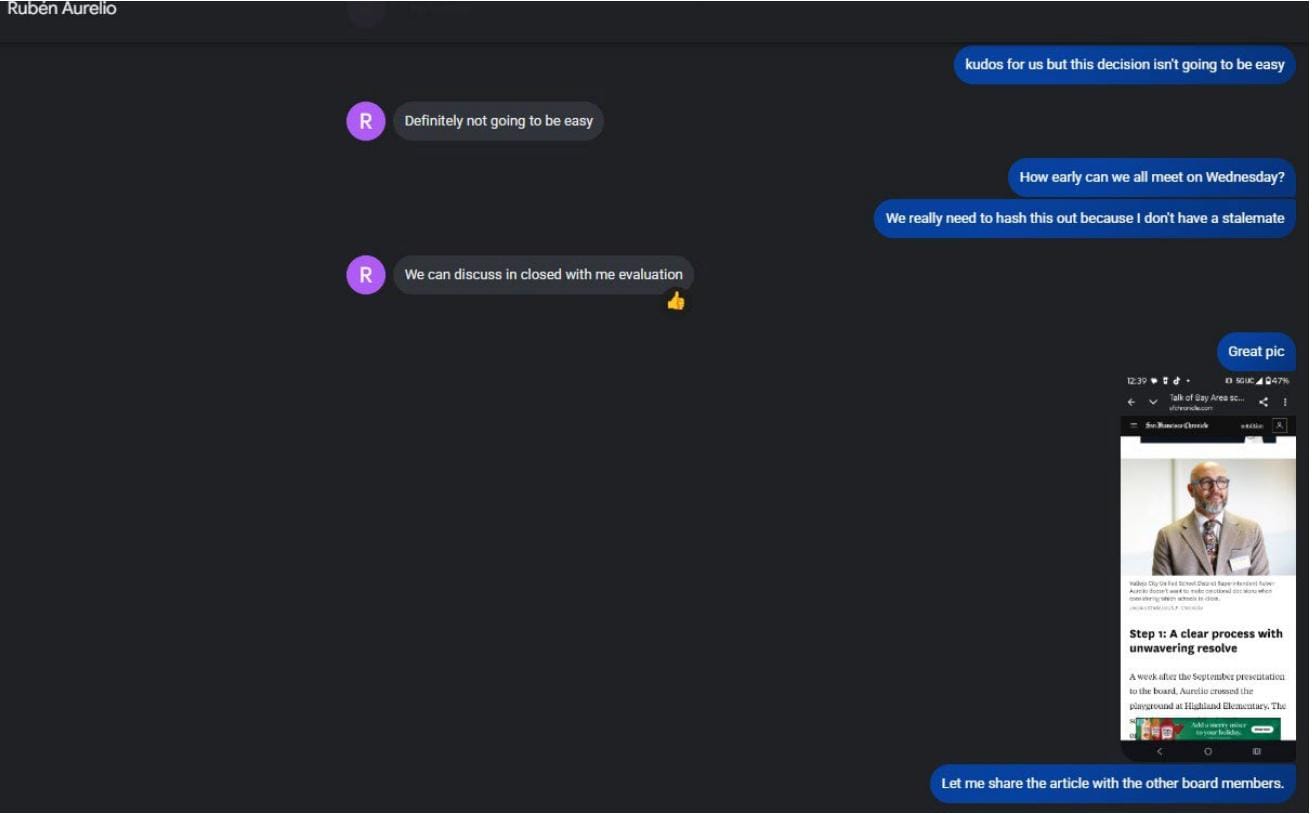
Dec. 15 text messages between Superintendent Rubén Aurelio and board Trustee Glenn Amboy appear to show them agreeing to discuss school closures during a closed session meeting prior to a public vote. Screenshots obtained via public records request.
Closed session meetings, which only board members, legal council, and school district leaders are allowed to attend, are designed to discuss private matters, such as employee evaluations, student expulsion and readmittance decisions, and legal matters covered by attorney-client privilege.
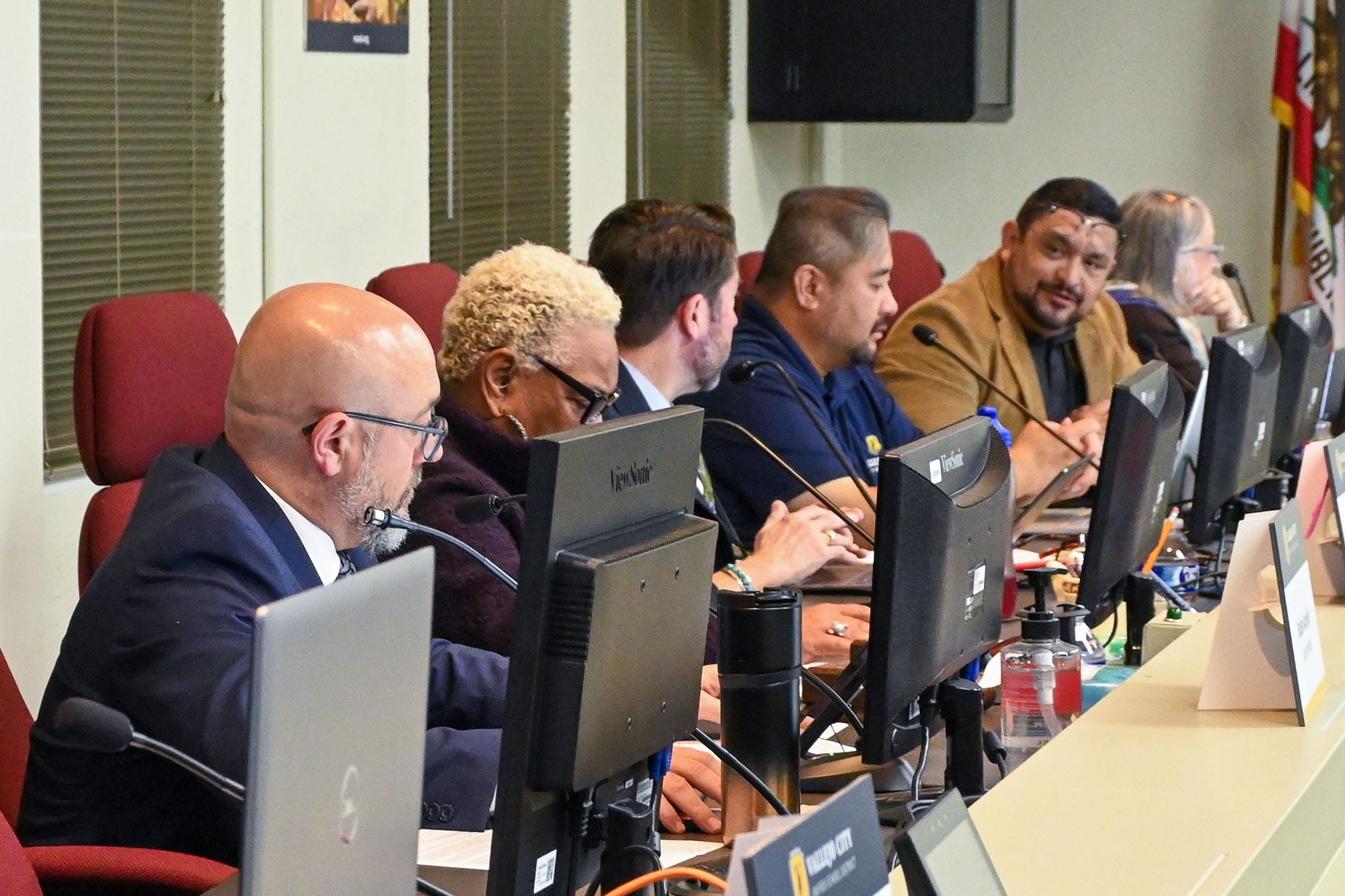
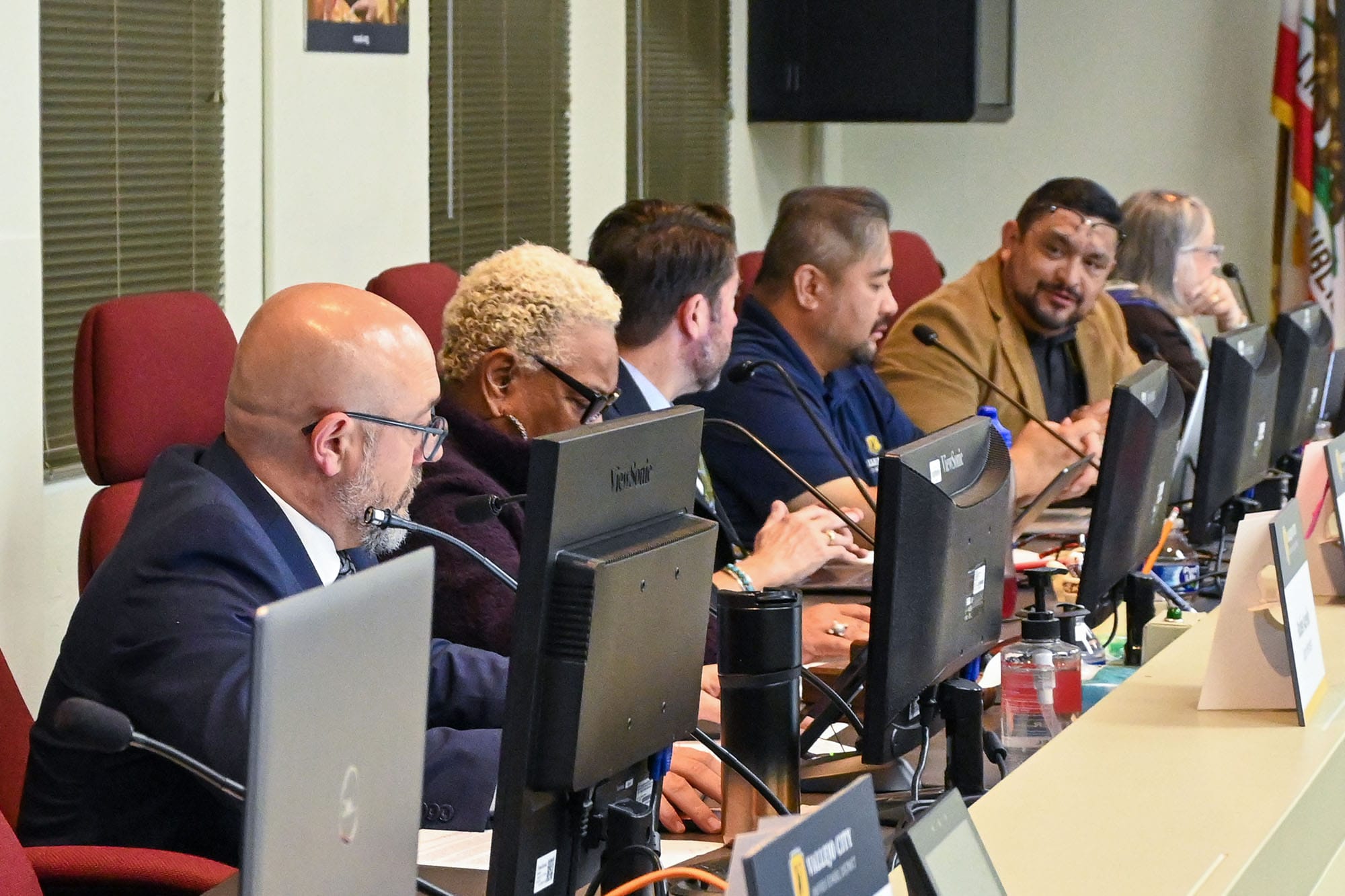
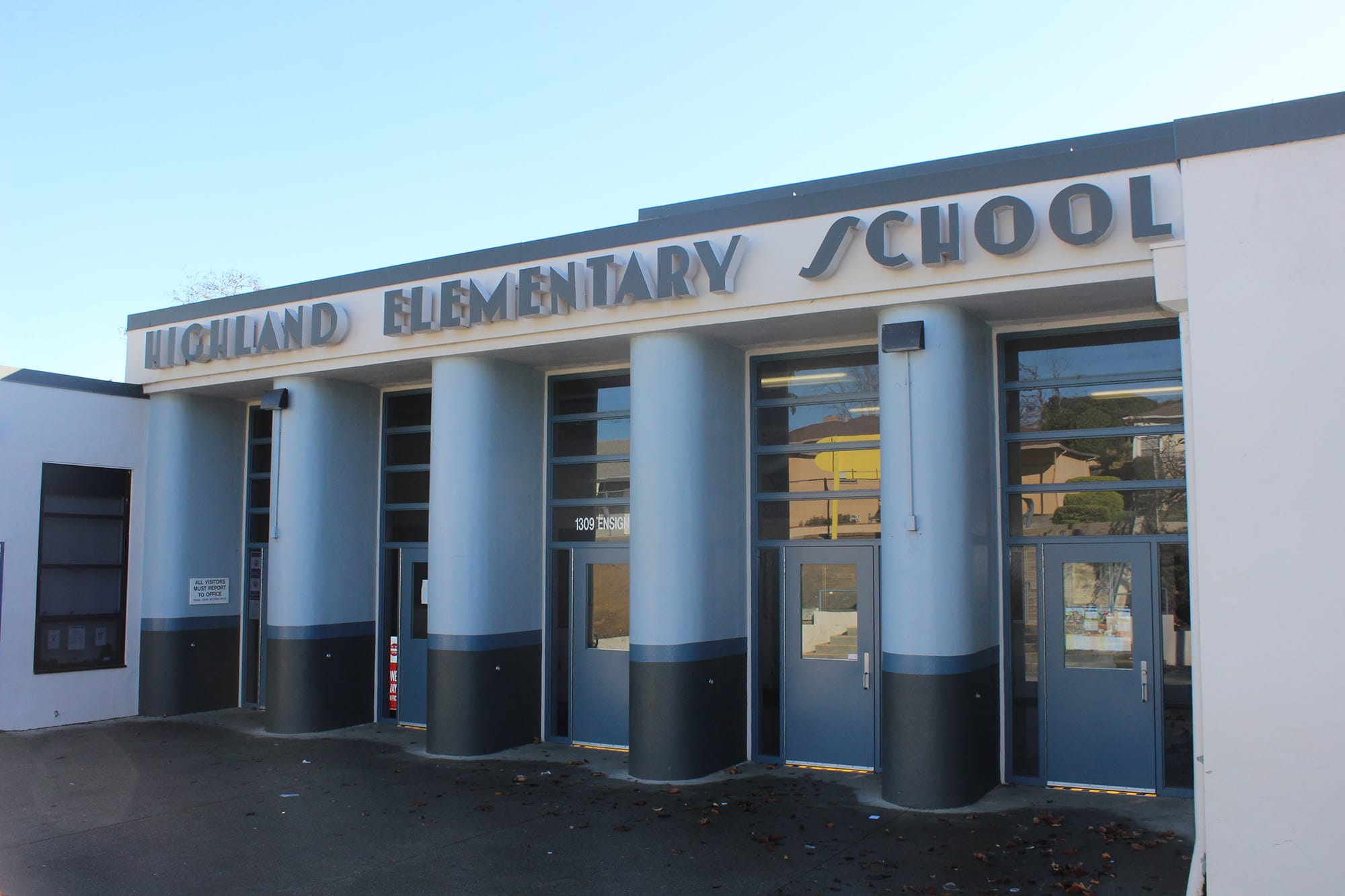
During the Dec. 17 public meeting, the five-member board unanimously voted to close Highland, Lincoln, and Pennycook elementary schools. The decision to close Highland Elementary surprised the community. Aurelio had recommended closing Lincoln and Pennycook in previous meetings, but had discouraged the board from closing Highland. Additionally, when a district committee was tasked with ranking six schools in terms of closure priority in the summer, it ranked Highland last.
Yet by the day of the meeting, the board had reached a consensus on closing Highland without discussing the matter during the public meeting at all before casting their votes.
In an emailed statement, Amboy said the board “takes seriously its legal and moral obligation to provide transparent and legally compliant governance” and that the final decision to close the schools was made in a public meeting. The Vallejo Sun asked Amboy and Aurelio if the board discussed the matter privately before the public meeting, but neither answered.
David Loy, legal director of the First Amendment Coalition, reviewed the text messages and said that the lack of board discussion, coupled with the texts between Aurelio and Amboy, is “strong circumstantial evidence” that the district and the board may have violated the law.
“I understand the board voted to close a couple of schools but didn’t really discuss or debate it in open session,” Loy said. “So the concern is: was this decision precooked in closed session? As a matter of law, if the board did discuss closing schools in closed session, that could well have been a violation of the Brown Act.”
The Ralph M. Brown Act is a California law passed 1953 in response to public concerns over undisclosed meetings of elected officials. The law requires that local public agencies, including school boards, discuss most matters in public, and bans discussion, outside of certain exempt private matters, by a majority of a legislative body outside of the public eye.
“The purpose of the Brown Act is to ensure access and transparency so the public can see how the sausage is made, so to speak,” Loy said, “how their elected public officials are making decisions that impact their lives, and to have an opportunity to see and hear how they vote and discuss it, and also to address them and have public input.”
According to Loy, the Brown act allows the public to have a better understanding of why elected officials make the decisions that they do. He said “it’s not possible to hold elected officials accountable unless they state their reasoning publicly.”
For several months preceding the vote to close the three schools, the board discussed the possibility of school closures in public meetings, where the members of the public commented on the matter, and public study sessions. The district also hosted three town halls, including one in Spanish, in which the district gave a presentation about school closures and allowed the public to both make comments and ask questions. In the summer, a district appointed committee discussed closures and made recommendations in public meetings.
But Loy said that these previous events don’t negate a violation that might have occurred if they discussed school closures in closed session.
“Whatever else they did or did not do is irrelevant to the question of whether they violated the Brown Act by holding an improper closed session,” Loy said. “A Brown act violation is not erased by holding other meetings at other times.”
While Loy told the Vallejo Sun that Aurelio’s suggestion of discussing school closures in private and the board’s lack of discussion on the matter in the public meeting was the biggest red flag, it wasn’t the only matter he was concerned with.
In the text exchange between Aurelio and Amboy, they discussed an article published in the San Francisco Chronicle that outlined how discussions of school closures in Vallejo’s school district tended to occur with less pushback from community members than in surrounding cities, like Oakland and San Francisco. In the exchange, Amboy said he would share the article with other board members.
Loy said that if more than two of the five board members discussed the article, that would have been a Brown Act violation. Additionally, Loy said that the Brown Act bans serial meetings, meaning that if a one board member shared with another board member what a third board member thought of the article, that would also violate the law. From only seeing the text messages, Loy said there was not conclusive proof that any board members had broken the law, but he called Amboy’s stated decision to share the article a red flag.
“A majority of board members should not be exchanging or discussing information related to a board meeting, it may seem innocuous but the article relates to board business, so if a majority discussed it outside of a public meeting, it’s a Brown Act violation,” Loy said. “My position is they should be airing on the side of caution and should not be texting and talking about school board business outside of a public meeting to avoid even the appearance of a problem.”
Intentionally violating the act is a misdemeanor. And Loy said that, theoretically, the board could have to reconsider its closure decision in public, as a Brown Act violation can void an agency’s decision. But this can only occur if a member of the public submits a written demand to cure or correct an alleged violation within 90 days of its occurrence, and the agency admits its violation or a judge determines it violated the act.
Loy said that even a proven Brown act violation though, doesn’t require a board to change their decision.
Loy said he was troubled with the signs he saw that the district and the board may not have been transparent in how they handled the decision to close the schools.
“The Brown act largely depends on trust and violations can be hard to prove,” Loy said. “I can’t say they definitively violated the act but there’s a number of red flags here.”
Before you go...
It’s expensive to produce the kind of high-quality journalism we do at the Vallejo Sun. And we rely on reader support so we can keep publishing.
If you enjoy our regular beat reporting, in-depth investigations, and deep-dive podcast episodes, chip in so we can keep doing this work and bringing you the journalism you rely on.
Click here to become a sustaining member of our newsroom.
THE VALLEJO SUN NEWSLETTER
Investigative reporting, regular updates, events and more