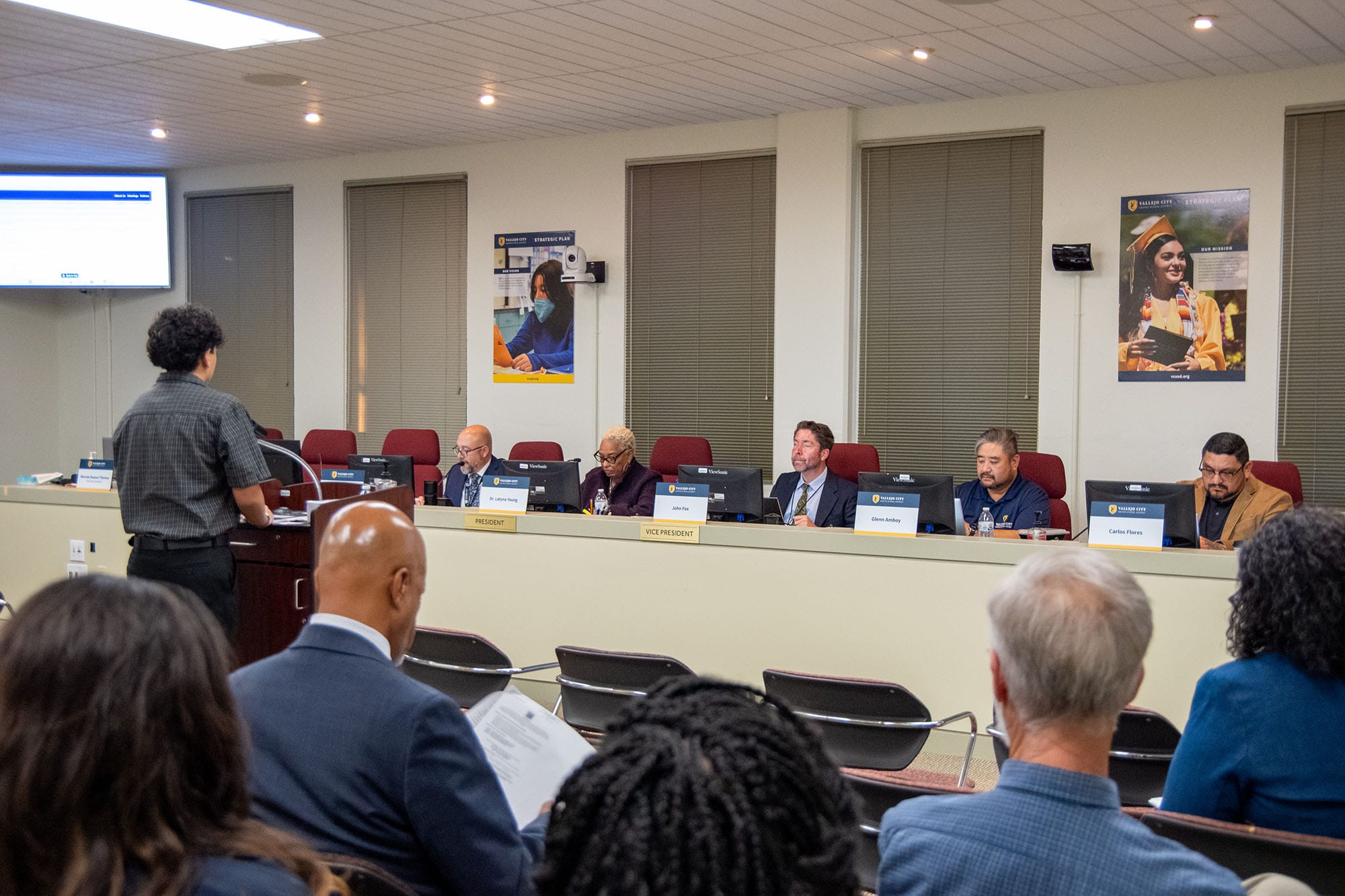
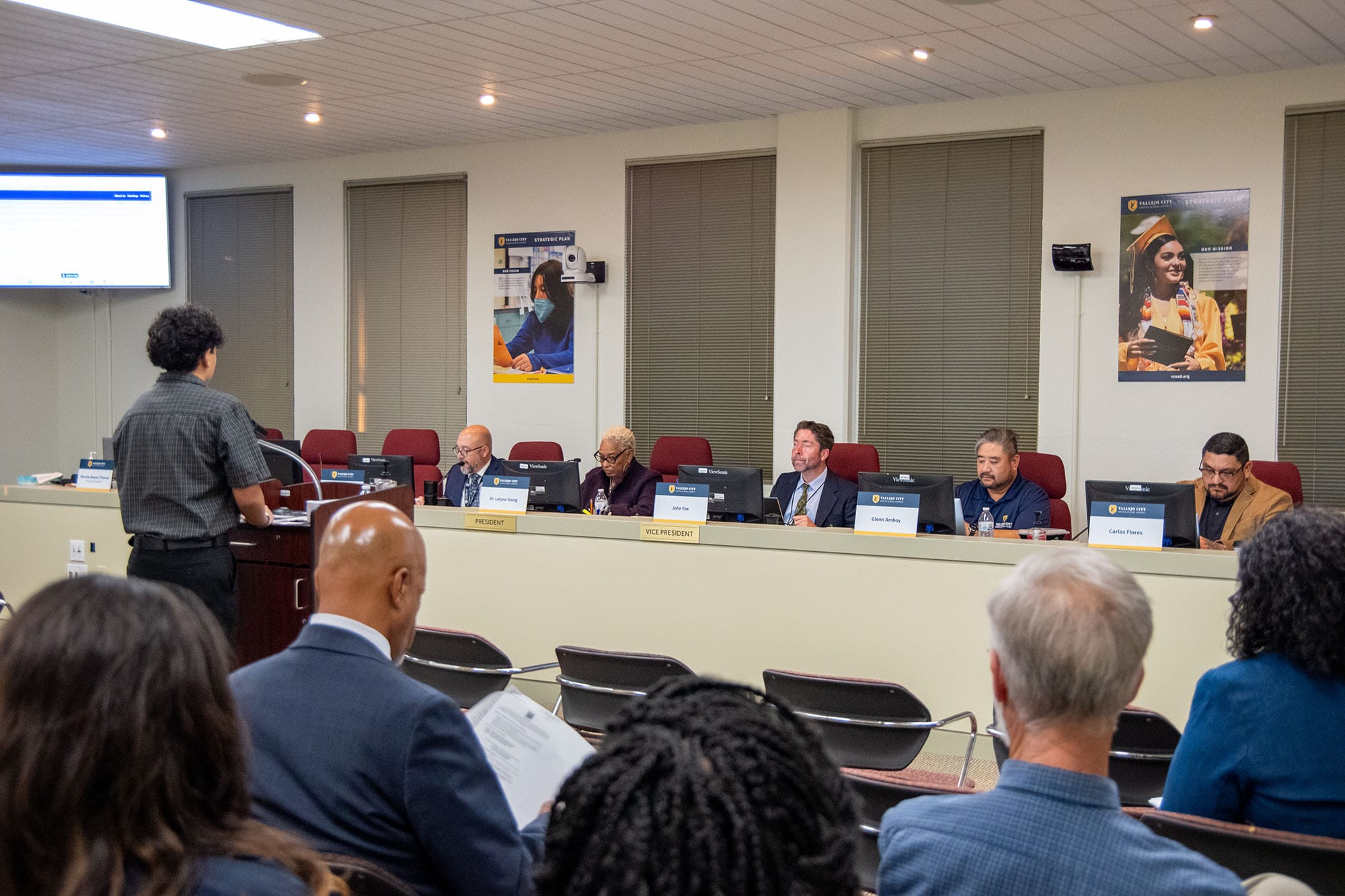
VALLEJO – The Vallejo City Unified School District Board of Education plans to re-vote on its decision to close three schools during its next meeting following revelations that the initial vote may have violated state open meeting law.
The decision to take another vote months later came after the Vallejo Sun reported that text messages between district officials appeared to show that the board illegally discussed the issue in closed session prior to the vote. A school district union president then formally accused the board of violating state open meeting law.
Vallejo’s school board voted unanimously to close Lincoln, Pennycook and Highland elementary schools on Dec. 17 in an effort to become more fiscally solvent. The board voted without discussion or debate, and surprised some community members with its decision to close Highland, a school not recommended for closure.
The Vallejo Sun obtained text messages between board Trustee Glenn Amboy and Superintendent Rubén Aurelio through a public records request that appeared to show them agreeing to discuss school closures with the entire board in a private closed session meeting just hours before the board voted to close the schools.
California School Employees Association Vallejo Chapter #199 President Kathleen ‘Kat’ Salas-Teitgen then sent a letter to the board earlier this month that said the union believes the manner in which the board reached its consensus was a “substantial violation of the Ralph M. Brown Act” because there’s evidence the board met in private to discuss the matter before it voted publicly.
The Brown Act is a California law which requires local public agencies to discuss most matters in public, and bans discussion, outside of certain exempt private matters, by a majority of a legislative body outside of the public eye.
The Brown Act allows any member of the public to submit a letter demanding the agency reconsider a decision that they believe violated the act, as a violation can void an agency’s decision. The agency can respond by deciding to cure and correct the violation through reconsidering the decision in public. If the agency refuses, it can be sued, and a judge can then decide whether or not the agency must reconsider the decision.
The act does not require a public agency to change its decision, it just forces the agency to reconsider it in public.
In her letter, Salas-Teirgen demanded the board reconsider the closure decision and said if the board didn’t, the union may ask Solano County District Attorney Krishna A. Abrams and Attorney General Rob Bonta to have their offices “investigate whether the VCUSD Trustees intended to deprive the public of information about its school closure deliberations” in violation of the law.
In a letter responding to Salas-Teitgen, Superintendent Rubén Aurelio denied that the board violated the Brown Act, but said that board would agree to reconsider the closure decision anyway, in an effort to be transparent in its decision making.
“While the District disagrees with the assertions and assumptions made in your letter that the Board violated the Brown Act, the District remains laser-focused on protecting the public's trust in our organization,” Aurelio said. “To that end, the District will agree to place an item on the agenda for the next regularly-scheduled Board meeting on April 1, 2026 to ‘cure and correct’ the alleged Brown Act violations.”
California School Employees Association Labor Relations Representative Jeremy Arnold said in an interview that the union believes the way in which the board initially came to its closure decision prevented community members from meaningfully commenting on the matter. As the board has agreed to re-vote on the closures, the public will have another opportunity to comment on the proposed closures.
“For all the community members who were cut out of the process,” Arnold said, “this is their opportunity to come fight and keep their school open.”
Aurelio said in his letter that the public was given opportunities to engage in the closure decision through several meetings and town halls.
But Salas-Teitgen said that the board was not transparent with its decision, as it didn’t publicly discuss important facets of it, specifically the closure of Highland.
“The trustees had not discussed or debated which schools to close,” Salas-Teitgan wrote in her letter.
She also wrote that trustees did not explain why they chose to close Highland, when a district committee and Aurelio had both recommended against prioritizing Highland for closure.
While members of the public regularly spoke out against the closures of Lincoln and Pennycook in meetings ahead of the board’s December decision, none spoke out against Highland’s closure.
The decision to close Highland shocked the community. During a board meeting in March, Peaslee DuMont, the father of a Highland kindergarten teacher, expressed his surprise.
“It was my understanding that Highland was the lowest school prioritized for closure and suddenly it jumped to amongst those that were finally closed,” DuMont said. “For me, this was very short notice, and I am distressed at that.”
Given the text messages made public by the Vallejo Sun, Salas-Teitgen said the board “violated its obligation to meet and conduct its business in public.”
Public agencies regularly hold closed session meetings before public meetings in order to discuss private matters, such as personnel decisions and legal strategy that’s protected by attorney-client privilege. But Salas-Teitgen said that the “decision to close or consolidate schools does not qualify for any of the narrow exceptions to the VCUSD Board’s obligation to conduct its affairs and deliberations in public.”
In addition to accusing the board of illegally discussing public matters during closed session, Salas-Teitgen also accused the board of violating the Brown Act by conducting a serial meeting. Serial meetings, which the Brown Act forbids, occur when the majority of a public agency’s board discuss public matters at different times and locations in private. In a five-member board, if one member discusses with another member what a third board member communicated to them about a public matter, a serial meeting has occurred.
The text messages published by the Vallejo Sun show Amboy discussing a San Francisco Chronicle article with Aurelio about how school closures in Vallejo had received less public outcry than other Bay Area school districts. Amboy said he would share the article with other board members. Salas-Teitgen characterized these actions as a serial meeting in her letter.
Aurelio argued in his letter that the district has been transparent in its decisions on school closures.
“The District has been steadfast in its commitment to a transparent closure process-recognizing that these decisions are extremely sensitive, emotional, and difficult for all stakeholders,” Aurelio said.
But Salas-Teitgen disagreed and demanded that the district change.
“Going forward, the VCUSD must refrain from conducting serial meetings or holding discussion, deliberation, or decision-making on any item of business within their jurisdiction outside a properly noticed public meeting,” Salas-Teitgen wrote.
Before you go...
It’s expensive to produce the kind of high-quality journalism we do at the Vallejo Sun. And we rely on reader support so we can keep publishing.
If you enjoy our regular beat reporting, in-depth investigations, and deep-dive podcast episodes, chip in so we can keep doing this work and bringing you the journalism you rely on.
Click here to become a sustaining member of our newsroom.
THE VALLEJO SUN NEWSLETTER
Investigative reporting, regular updates, events and more
- education
- Vallejo
- Vallejo City Unified School District
- Lincoln Elementary School
- Pennycook Elementary School
- Highland Elementary School
- Ruben Aurelio
- Glenn Amboy
- Brown Act
- Kat Salas-Teitgen
- California School Employees Association
- San Francisco Chronicle
- Peaslee DuMont
Zack Haber
Zack Haber is an Oakland journalist and poet who covers labor, housing, schools, arts and more. They have written for the Oakland Post, Oaklandside and the Appeal.
follow me :