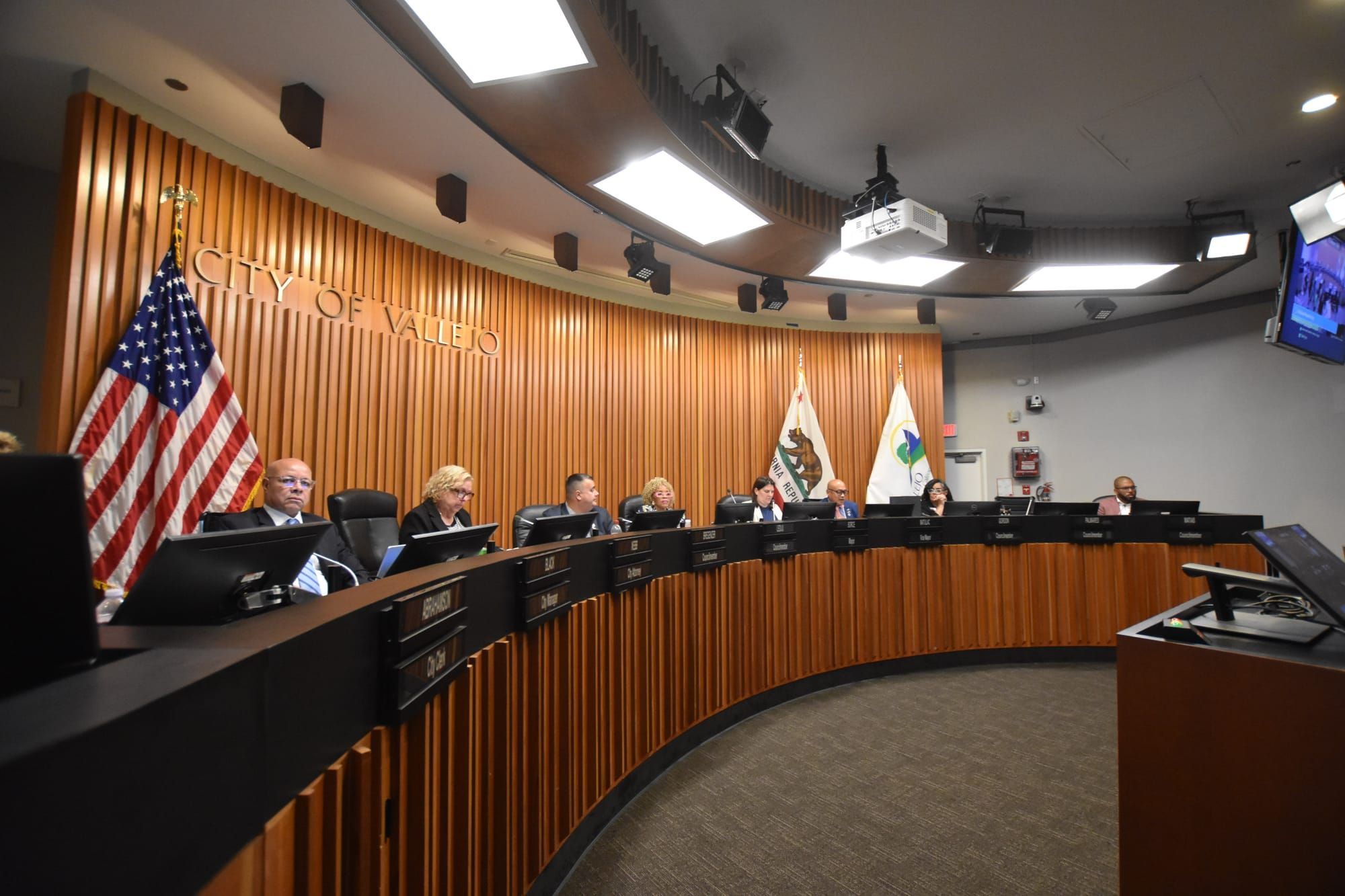
VALLEJO – Vallejo’s ongoing need for more revenue moved the City Council to adjust fees across several cash-strapped departments on Tuesday night.
The council voted unanimously — with Councilmembers Peter Bregenzer and Charles Palmares absent — to adopt newly adjusted fee schedules for the Building, Planning, Fire and Water departments. Such fees are typically implemented by cities to subsidize other services or address various costs.
Once the adjusted fees are implemented, the Building and Planning departments together stand to recover about $600,000 in the first year and up to $900,00 by the second year. Staff estimated the adjustments will also bring in $468,000 per year for fire prevention and $45,000 for water.
These fee adjustments are intended to create more revenue for the city and have been under consideration since last year. The adjustments largely followed the recommendations from consulting firm MGT, which the city hired to conduct a fee study amid mounting economic uncertainty. MGT last year found that at current rates, Vallejo recovers only 60% of its overall costs in these departments.
The council in September was concerned about how the study was designed. Mayor Andrea Sorce on Tuesday repeated previous concerns she raised last fall about whether fee increases could have unintended consequences for the most vulnerable residents.
“If you raise fees and people can’t afford those fees, they’re more likely to go and sidestep … and do un-permitted work,” said Sorce.
Interim City Manager Harry Black said the fees must be adjusted because the city’s cost recovery rate is already low, which means the general fund must absorb the difference.
“If we were a restaurant or a convenience store we’d probably be out of business, because we’re not covering our costs,” Black said.
Resident Melvin Cohen said in public comment that he was concerned about how the building and planning fee adjustments could affect future development proposals, given that the city already struggles to attract housing proposals and developers may spend years in administrative processes before constructing new projects. Cohen noted the state has already made it clear that cities should reduce administrative burdens and streamline development processes.
“I recommend the city evaluate development costs cumulatively, rather than department by department,” Cohen said.
Following the fee discussion, the council unanimously approved — with Bregenzer and Palmares still absent — a request from staff to apply to earn California’s Prohousing Designation, as part of different approaches to increase affordable housing development and fulfill the city’s Housing Element for 2023-2031. The Housing Element is a state mandated plan to increase the city’s housing availability.
Cities which earn the state designation may receive priority processing when applying for several funding programs, including affordable housing and infill infrastructure grants. Other nearby Bay Area cities which already have this designation include Benicia, Fairfield and Napa. The city of Vacaville is also currently seeking it.
Long-range planning manager Hector Rojas said the application for the designation would require a public review and would have to be presented to the council again before the California Department of Housing & Community Development reviews it.
In public comment, Vallejo Homeless Union member Eli Smith said she is concerned that the city is not in compliance with the state’s requirements on how it addresses homelessness because she said the city’s "brutal abatement policies” violate unhoused people’s constitutional rights. The state requires that cities show they will follow the United States Interagency Council on Homelessness’ “7 Principles for Addressing Encampments.”
“People are dying monthly,” Smith said. “There is no proportionate response. There’s no needs assessment, no data, no consistency. People are frequently given 20 minutes of verbal notice, no paper notice. There’s no meaningful coordination of resources.”
Councilmember Alexander Matias, in response to these comments, asked staff for an update on the package of housing-related ordinances underway including on renter protections and an inclusionary housing ordinance to require developers to include a portion of affordable units in new large housing developments or pay a fee.
Rojas said the city is “stuck on identification language” in negotiations with a consultant to handle the scope of the work, and a memo on the options comparing Vallejo to other cities will soon be ready to help the council draft the ordinances. He said he thinks the city can earn the designation despite not having finished those ordinances.
Matias said the California Department of Housing & Community Development will give the city feedback on its efforts toward housing goals, and he encouraged more residents to provide feedback.
“We need this designation to be more competitive for funding and to be accountable for our goals around homelessness,” Matias said.
Councilmember Diosdado Matulac noted how developers in the past have struggled to garner financing to properly cover housing projects, saying a developer who planned to build hundreds of homes in North Vallejo at the former Walmart site pulled out due to lack of funding. He said he hopes they can take advantage of new state housing laws to help more affordable housing projects with “finally penciling out.”
Councilmember Tonia Lediju said while the designation is important, the city must have a good strategy for encouraging housing production to make use of it and must not continue delaying drafting of the housing ordinance package.
“We’ve made so many promises on some very critical policies that keep people housed, our most impacted communities,” Lediju said. “We can’t have economic development when we miss deadlines and can’t get it together for ourselves. If we can’t move the ball, something’s wrong.”
Before you go...
It’s expensive to produce this kind of high-quality journalism we do at the Vallejo Sun. And we rely on reader support so we can keep publishing.
If you enjoy our regular beat reporting, in-depth investigations, and arts and entertainment calendar, chip in so we can keep doing this work and bringing you the journalism you rely on.
Click here to become a sustaining member of our newsroom.
THE VALLEJO SUN NEWSLETTER
Investigative reporting, regular updates, events and more
- government
- Vallejo City Council
- Vallejo City Hall
- Andrea Sorce
- Harry Black
- housing element
- Housing
- homelessness
- Vallejo Homeless Union
- Eli Smith
- Alex Matias
- Hector Rojas
- Diosdado “J.R.” Matulac
- Tonia Lediju
Natalie Hanson
Natalie is an award-winning Bay Area-based journalist who reports on homelessness, education and criminal justice issues. She has written for Courthouse News, Richmondside, ChicoSol News, and more.
follow me :