VALLEJO – Around 6:30 a.m. on Jan. 29, residents sleepily shuffled into the Vallejo City Council chambers, grabbing donuts and coffee, filling out forms, and settling into chairs. They were all there to volunteer to count the number of unhoused people in the city.
It’s called the point-in-time count, intended to capture a snapshot of homelessness on a single morning. The count’s report was released this month and found that there were 1,543 people experiencing homelessness in the county that day, about a 10% decrease from the last count in 2024.
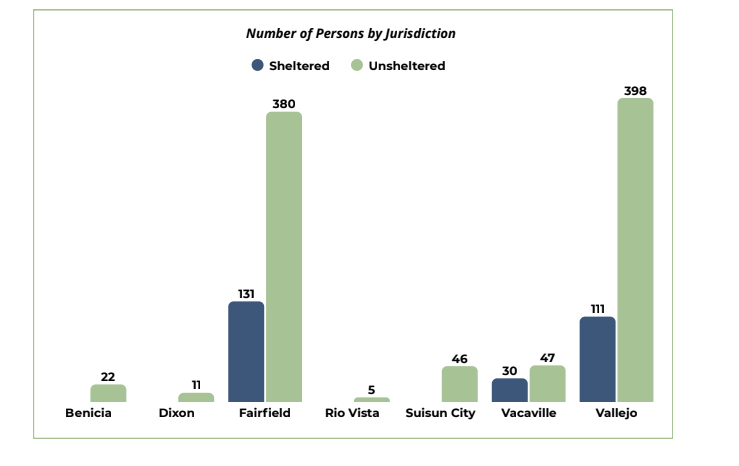
In Vallejo, volunteers counted 111 people living in shelters and 398 people living on the street or in a vehicle or tent — a 40% decrease in the number of people living outdoors compared to 2024.
Vallejo city spokesperson Robert Briseño said that while the count’s accuracy is hard to determine, it’s the best information available to the city. “As the city has mentioned in past counts, the numbers are only as good as the information received,” Briseño said. “We believe that the numbers are likely slightly undercounted, but do not believe that there is a significant difference in the total number.”
Solano’s point-in-time count is part of a nationwide census that attempts to capture how many homeless people are living in any given city, in order to guide where federal funds are allocated. This initiative is part of what’s called the Continuum of Care. In Vallejo, the Continuum of Care is carried out by the Community Action Partnership of Solano, Joint Powers Authority, a collaboration between each of Solano County’s seven cities and the county itself.
The Continuum of Care is overseen by the U.S. Department of Housing and Urban Development, which requires that each city holds a count in order to receive funding. The count must be conducted on a single morning between the hours of 5 a.m. and 12 p.m. every other year in January. The data is then analyzed and submitted to the federal government by the end of April.
Briseño said that 80 people volunteered for the count in Vallejo, but only about 40 people showed up. Briseño said that not knowing the final number of volunteers until that morning was the greatest difficulty they experienced this year, as they didn’t know if they’d have enough people to survey the whole city.
Each group was assigned an area and given printed maps that showed where the borders of their area ended and where there might be encampments, based on past counts and sweeps. The goal was to drive through each map and survey any individual they saw who appeared to be homeless or living in a structure, tent, or vehicle. If speaking to an individual was impossible — because they were on the move, or didn’t answer calls or knocks — only the structure could be noted. All of this information was recorded using an app.
The count has two components: sheltered and unsheltered. Sheltered people are those living in navigational centers and transitional housing like the Solano Dream Center, and are counted by the shelter staff. The unsheltered count refers to anyone living on the street who is counted by the volunteers.
Compared to 2024 count, the number of unhoused people living in shelters in Vallejo rose by 79%. The city credits that to the opening of a 125-bed navigation center last year.
Other counties in the Bay Area have also seen an increase in shelter use, said Ryan Finnigan, the deputy director of research for UC Berkeley’s Terner Center for Housing Innovation, which works on improving housing and homelessness policies.
Alameda County, for example, has seen a 76% increase in shelter use since 2019, while San Francisco reported its highest shelter use rate to date. Finnigan said this is because many counties have used state funding to build more shelters.
Solano’s report found that health and disability play a major role in housing instability. People surveyed cited various health issues: 28% said they had mental health issues; 26% had a substance use disorder; 24% had a chronic illness; and 21% had a physical disability. Nearly 34% of people surveyed said they have at least one disability that prevents them from obtaining a job and maintaining permanent housing.
Despite these challenges, the report found that less than a quarter of respondents said they received disability benefits, highlighting how difficult it is to access social services while homeless.
A 2024 National Health Care for the Homeless Council report estimated that unhoused people die 20 years earlier than housed people, with the lack of access to medical care being a major issue.
The point-in-time count also found that over 28% of people in Solano County slept directly on the street, while about 25% slept in a car, RV, or van. About 13% slept in a tent — a belonging that is often lost during encampment sweeps, homeless residents have told the Sun.
The report also notes that there’s been an increase in homeless veterans — up 35% — but a 33% decrease in families living on the street.
The largest racial group of unhoused individuals in the county were white, followed by Black and Hispanic/Latino residents. The people surveyed were 62% men, and most respondents were in their 30s and 40s.
Homeless advocates said these counts often only paint part of the picture.
“The numbers don’t feel accurate. I don’t think they’ve ever felt that accurate,” said Jackie Jones, the board president of Vallejo Together, a nonprofit that works with unhoused residents. In her opinion, the 398 unsheltered people in Vallejo is “a very low number.”
Jones, who volunteered for the count, said that it’s difficult to count people because unhoused individuals are often on the move, and the maps given to volunteers only showed past encampments. Though the city paused encampment sweeps in the lead-up to the count, Jones said she heard some volunteers struggled to find anyone in the marked areas.
“I could go out tonight and people will be at a particular location, but then they’ve moved by the next day,” said Jones. “It sometimes takes us a few days to find out where they are, or before they surface again.”
Jones said that the Vallejo Together team went out for a week following the count, and several unhoused people they talked to said they weren’t surveyed at all. Jones said that their team asked the county representatives if there was any leniency in adding people who they knew weren’t counted, but they were told that the federal regulations stipulated they could only count those surveyed during the specific counting period.
The Sun reached out to the county but did not hear back before publication.
Eli Smith from the Vallejo Homeless Union said that the early morning hours are also an issue.
“The point in time count is based on who you can see, but it’s in a time period where most people are not awake and don’t want to be intruded upon,” Smith said. “And then you have people who are sleeping on the street, but they get up early because they have jobs.”
Conducting county-wide counts has always been difficult, said Finnigan, but currently there’s not a lot of practical alternatives.
“Even with the best designed count, there’s a lot of difficulty in terms of having enough staff, careful training, consistent approaches, and judgement calls that are needed by the people doing the counts,” said Finnigan.
Finnigan said the major limitation of the point-in-time count is that it’s only looking at very visible homelessness. “If there are people who are really hidden because they’re in vehicles or tucked away and hard to see, the unsheltered count is going to miss them,” he said.
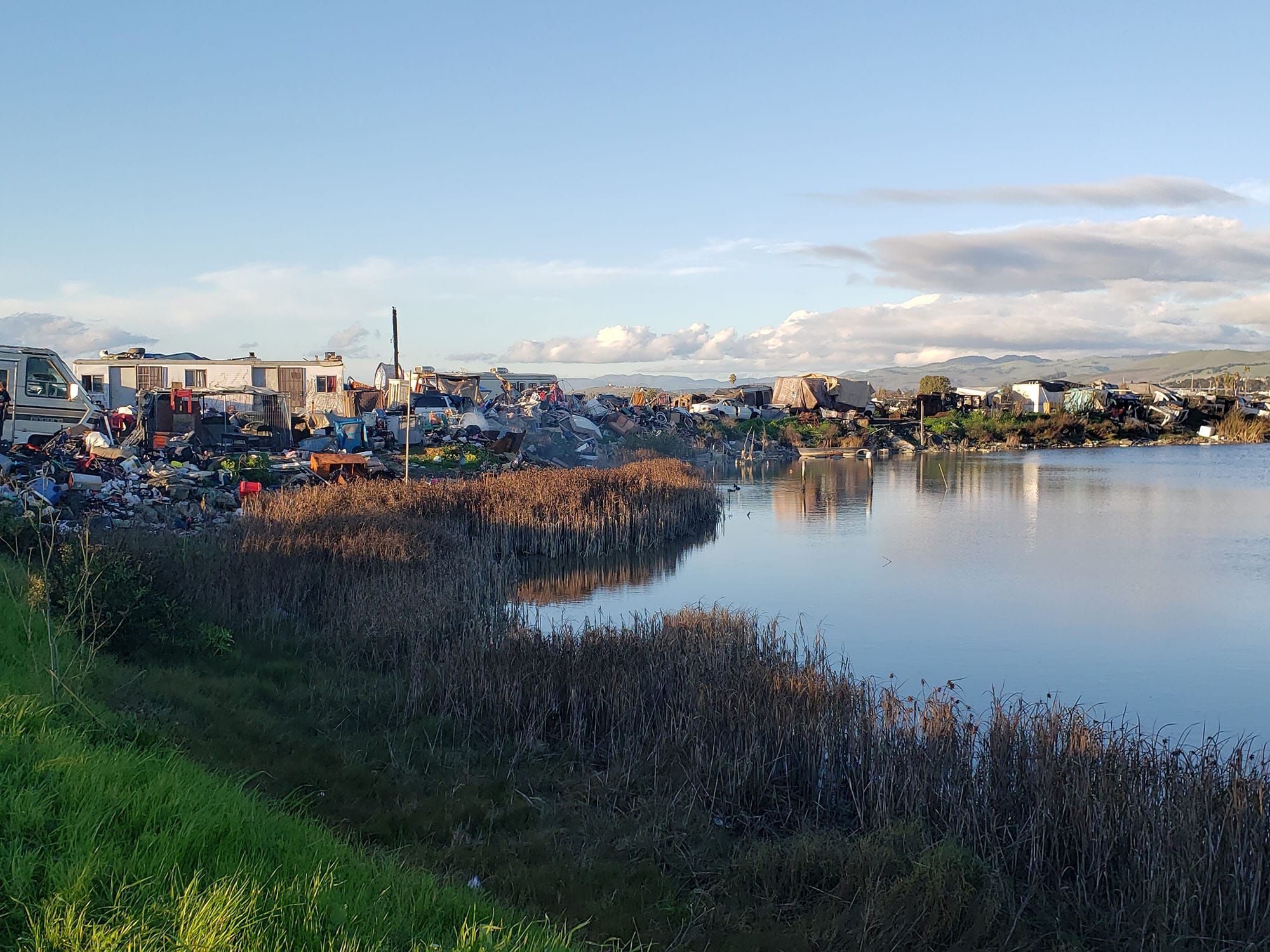
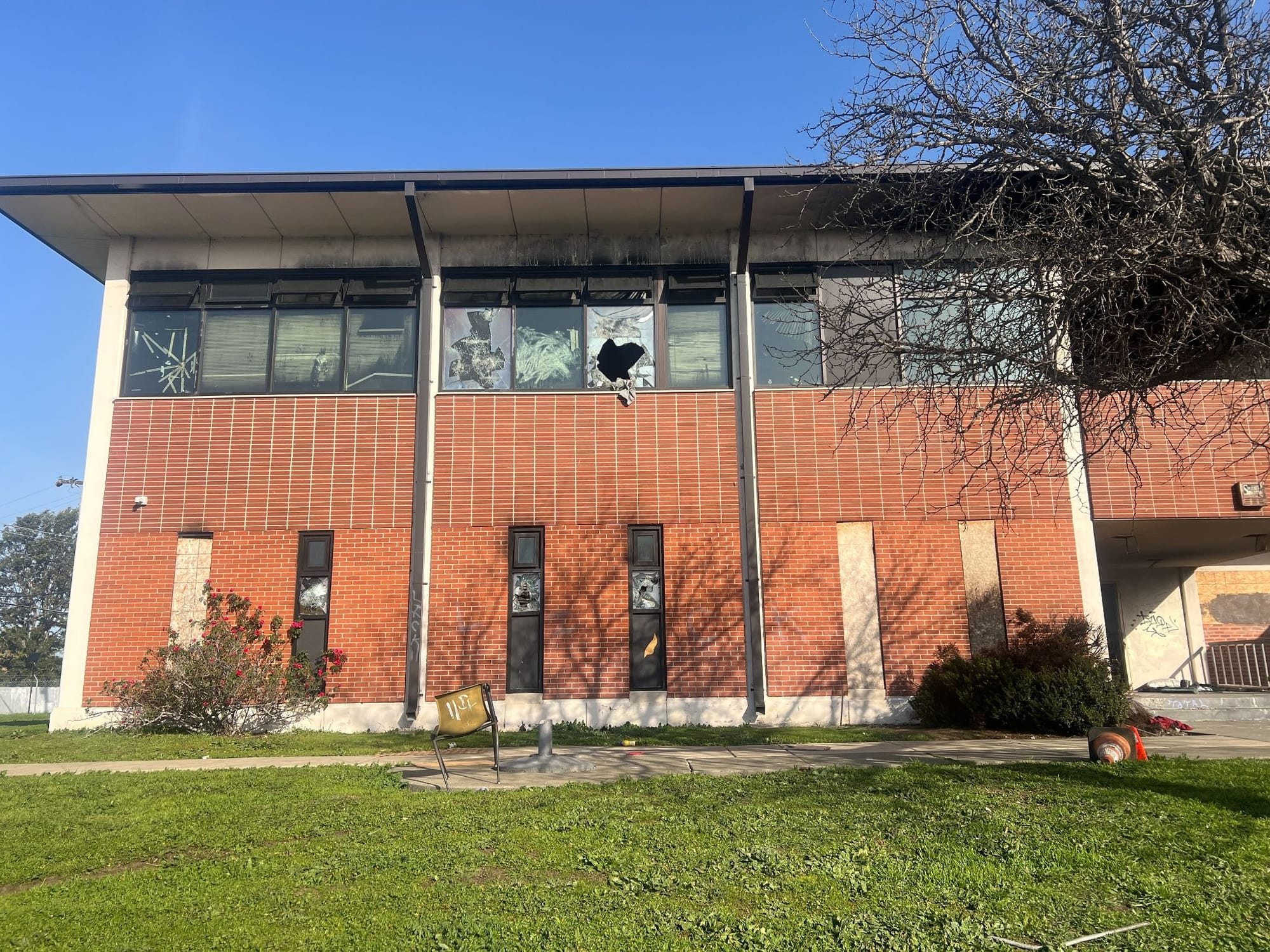
Volunteers sent to survey an encampment at the former U.S. Army Reserve base in Vallejo were advised by homeless residents not to enter the main building, for example, because it was recently burned out and navigating inside could be dangerous. But those living in the parking lot estimated there were at least a dozen people living in the building.
Smith said that something similar happened at another large encampment at “the Island” — what residents call a strip of land in White Slough near Highway 37. Representatives from the Vallejo Homeless Union who were monitoring the count noticed that point-in-time count volunteers only counted a dozen or so residents in one section. “But there are more than 75 people living there at least part-time in that one area,” said Smith. “So that gives you an idea of how potentially undercounted it might be.”
The point-in-time count also doesn’t include people who are couch surfing with friends or family because that doesn’t fall into HUD’s defined categories of homelessness.
“But the way people experience homelessness, they could be couch surfing one night, in a shelter the next night, and in a park the night after that before going back to someone’s couch,” said Finnigan.
The report notes that the homeless youth count is likely inaccurate because that particular demographic tends to couch surf. The 2026 count found that there were just 26 unaccompanied homeless youth living in Solano County.
For comparison, 2025 data from the Vallejo City Unified School District found that there were 504 students in Vallejo who were living “doubled up” in homes with extended family or friends. State data shows that Solano County has 2,153 homeless students.
But Finnegan said that even with these inaccuracies, these counts are still useful for tracking trends, as long as the county ensures it’s using the same counting method year to year. He added that he’s done counts in several counties, and Solano County appears to be using the best technology and statistical sampling approaches available.
“If you see more people reporting disabilities or who are over the age of 60, or see changes in the ethnicities of participants, that gives you a signal that maybe there’s something going on in terms of who’s getting pushed into homelessness,” said Finnigan.
He also said that collecting this data, even knowing it might be an undercount, is especially important now because the Continuum of Care program has been undergoing “significant changes” under the Trump Administration.
In the past, the federal Continuum of Care grant program would typically automatically renew contracts with cities and counties, which would then fund supportive housing programs and health and social service programs for the community.
But Finnigan said it’s become more difficult for cities to renew their federal grants as the Trump Administration aims to shift $1.2 billion away from long-term housing programs and into mental illness treatment and time-limited housing.
“The administration has been doing this across a lot of its programs, in their view to promote ‘self-sufficiency,’” said Finnigan. He said while there is a percentage of unhoused individuals who experience mental illness or a substance use disorder, evidence does not suggest those health issues actually drive an increase in homelessness.
“It’s a more complicated issue than that, and it depends a lot on housing costs,” Finnigan said.
Smith agreed that the point-in-time count is just supposed to be a starting point for local governments to develop plans to address homelessness.
“People forget that these numbers are supposed to be used to develop solutions … and I think that unfortunately, the count has not been used productively in the city, regardless of how accurate it is,” said Smith. Rather than using it as a “tool for public dialog and arguing about the moralities of homelessness, we need to really just focus on what we are going to do about this issue.”
Independent local news depends on you
The Vallejo Sun is supported by readers who value reliable, in-depth local news. Your support helps us continue investigating important issues and keeping Vallejo informed.
Become a member today