
VALLEJO – A Solano County Superior Court Judge ruled yesterday that the city of Vallejo violated the California Public Records Act when the city denied requests by the Vallejo Sun for the release of video and audio recordings related to a controversial police shooting.
The ruling, issued by Judge Stephen Gizzi, orders the City of Vallejo to release all vehicle dashcam and bodycam video of the Aug. 29 shooting of 24-year-old Alexander Schumann, who pointed a non-functioning pellet gun at officers but turned away just before officers fired.
The decision is the latest order in a lawsuit against the City of Vallejo filed by the Vallejo Sun with representation from the First Amendment Coalition, a non-profit organization committed to promoting free speech and free press.
Gizzi found that an edited montage of video and audio recordings released by the City of Vallejo at a public meeting were insufficient for the public to fully contextualize the incident, and that the city had improperly blurred the faces of officers in the video.
As part of the court proceedings, Gizzi reviewed all of the city’s audio and video recordings related to the incident. To guide his ruling, Gizzi looked at a similar 2025 court case where a local TV station asked for bodycam and dashboard video from the Roseville Police Department.
The other case made it “abundantly clear how important it is to provide context both before and after a ‘critical incident,’ rather than the mere seconds of the incident itself,” Gizzi wrote in his analysis. "Listening to the PD dispatch and the officer conversations minutes before arriving at the scene provided an invaluable perspective on officer expectations upon arrival.”
Gizzi said that without that information, citizens might be “left to wonder why things escalated so quickly” and “why the officers were in such a hurry to pull their guns out” against Schumann.
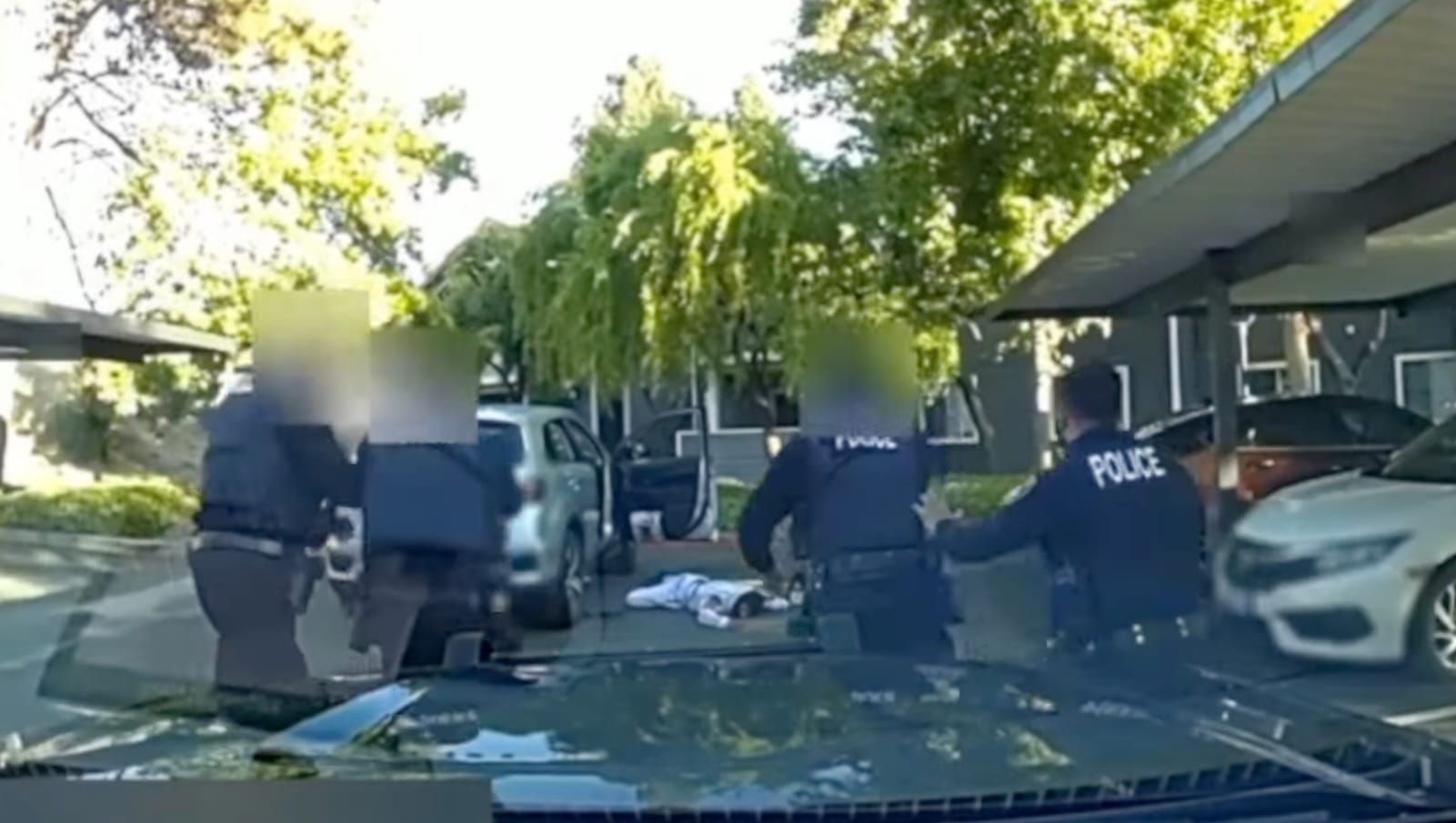
Dash camera video released last year of the Aug. 29, 2025 Vallejo police shooting. Via Vallejo Police Department.
On Aug. 29, police responded to several 911 calls describing a man wearing a ski mask and standing on top of the hood of a moving vehicle at the 2000 block of Ascot Park Road. A later call described a man with a similar description vandalizing an SUV in front of an apartment building at Blue Rock Village.
A 911 caller who knew Schumann said he appeared to be in mental distress, and that he had said that he wanted police to shoot him. The last call placed shortly before police encountered Schumann reported a man firing a weapon, but that information turned out to be inaccurate.
Schumann suffered gunshot wounds to his back, hip and foot. He was transported to the hospital by helicopter and survived with life-saving treatment.
On Sept. 5, the editor of the Vallejo Sun, Scott Morris, and reporter Sebastien Bridonneau filed a public records request with the city of Vallejo for any video related to the officer-involved shooting.
While the city was processing that request, the Vallejo Police Department held a required public meeting at which they played the montage of short clips limited to footage that began at the initial encounter and ended a few moments after officers discharged their weapons. The montage only showed dash camera video from one of the police vehicles at the scene.
The presentation also included several clips of partially redacted 911 calls and dispatch communications with officers.
After the presentation, the Vallejo Sun requested unedited footage of the whole incident but Vallejo police refused, offering only a link to the meeting.
During litigation, Aaron Field, senior staff attorney with the First Amendment Coalition, argued that the clips provided at the meeting did not include video showing the sequence of events leading up to and following the shooting that he said were crucial to understanding the circumstances of law enforcement’s response to the incident.
Field noted that at the public meeting, Schumann’s father asked about attempts to de-escalate the situation.
Police spokesperson Rashad Hollis replied to Schumann’s father at the meeting that officers made multiple attempts to de-escalate: “The officers, one, used time, distance, and communicated with each other. They staged on-scene and they contacted each other just to make sure that we have enough officers there.”
Field then pointed out the footage selected by the city does not show any of the de-escalation attempts that the department claims to have engaged in.
The city of Vallejo argued that they are not required to release all recordings related to the incident because administrative and criminal investigations were still in progress. But Gizzi’s ruling stated that an active investigation does not, in itself, justify withholding records, and the city had failed to provide documentation or reasons why disclosure would interfere with the investigations.
The city also argued that the dash camera footage that had been released was basically the same as the unreleased footage from other police vehicles. But Gizzi ruledthat multiple perspectives are necessary to understand an event and ordered all duplicative or overlapping recordings to be produced.
Additionally, the city argued that it had the right to blur the faces of the officers, referencing a separate legislation related to peace officer records. Gizzi stated that the separate legislation was not applicable to officer-involved shootings, and only victims and citizen witnesses are entitled to a reasonable expectation of privacy.
Morris said that the ruling will help ensure transparency and accountability in the most serious cases of police uses of force.
“The Vallejo Sun relies on multiple video angles and video of the events leading up to a police shooting incident to tell as complete a story as possible, but the city of Vallejo has sought to release only select portions of this material, leaving numerous unanswered questions,” Morris said in a statement. “The city has also sought to withhold the identity of officers who respond to a shooting incident, improperly categorizing them as witnesses. We’re grateful that the court recognized the city was in violation of California public records law and for our counsel at the First Amendment Coalition who argued the case.”
The First Amendment Coalition also hailed the ruling as a victory for police transparency.
“When police officers use force against a member of the public that could be lethal, the public needs prompt and complete access to recordings that show what happened,” Field said in a statement. “The Legislature recognized this when it passed AB 748. We are pleased that the Court’s ruling recognizes this, too, and requires the City of Vallejo to disclose much more about this incident.”
Gizzi’s ruling called for the city to produce the full, unedited recordings, redacting only identifying information of 911 callers, victims and non-officer witnesses.
“Recordings must be produced from the earliest possible time – at call-in and/or dispatch, where possible, through and including the time when the injured is removed from the scene,” Gizzi’s ruling stated.
Barring any modifications, the ruling requires the city of Vallejo to release the additional video and audio recordings by September 24.
Independent local news depends on you
The Vallejo Sun is supported by readers who value reliable, in-depth local news. Your support helps us continue investigating important issues and keeping Vallejo informed.
Become a member today- policing
- government
- Alexander Schumann
- First Amendment Coalition
- James Schumann
- Stephen Gizzi
- Aaron Field
- Rashad Hollis
Ryan Geller
Ryan Geller writes about transitions in food, health, housing, environment, and agriculture.
follow me :