VALLEJO – The weather is warming up but winter illnesses are still hanging around in Vallejo, according to data collected from the wastewater treatment plant by WastewaterSCAN, a public database that tests sewage to track infectious diseases.
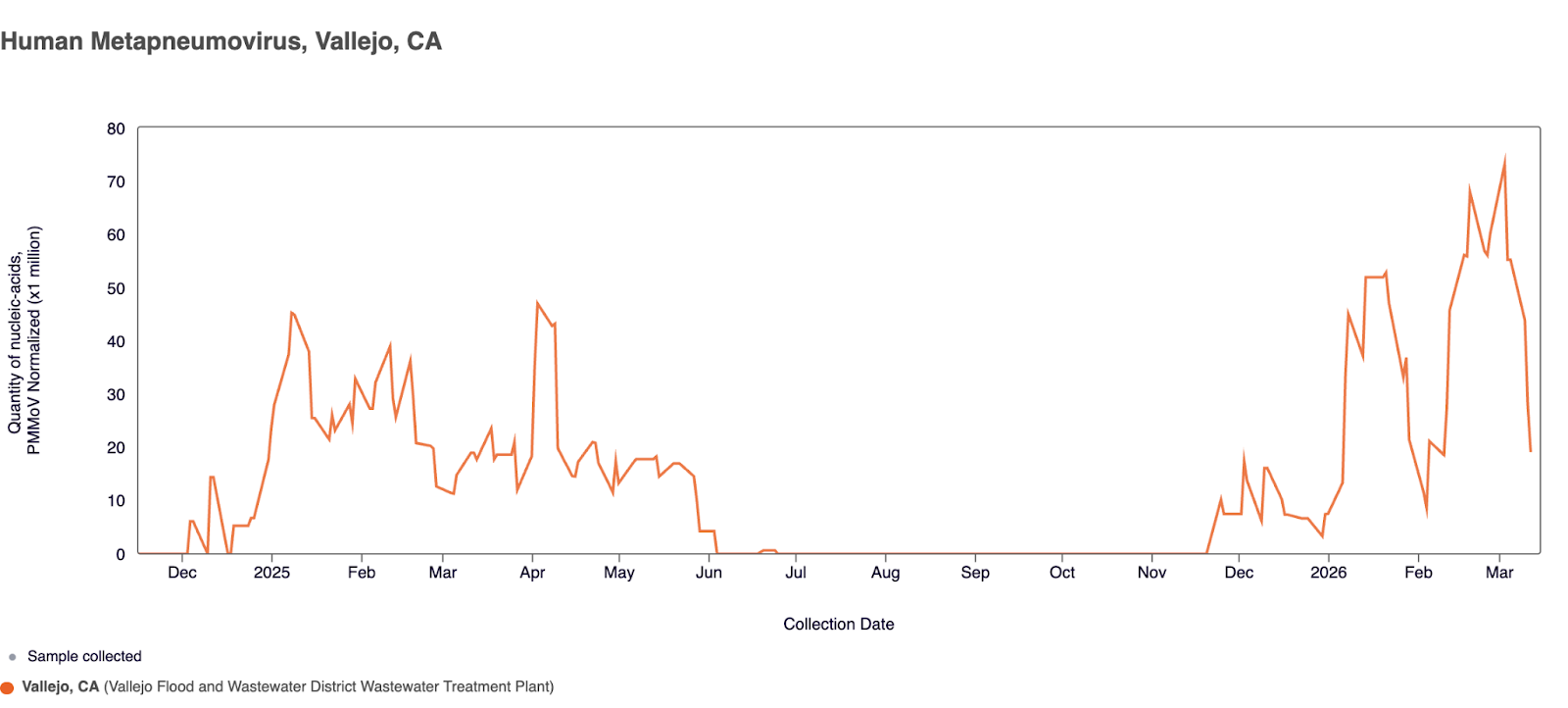
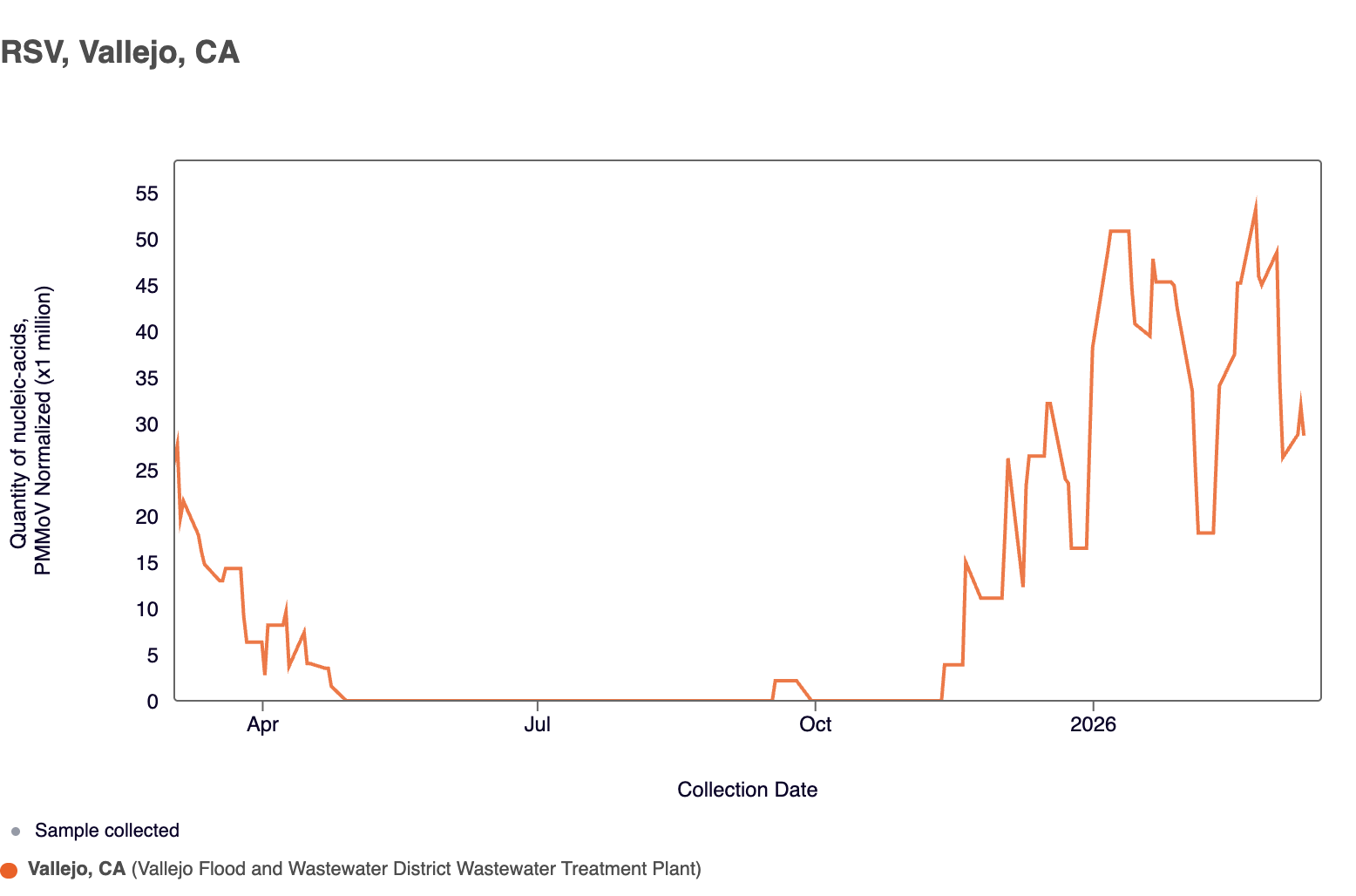
At the Vallejo Flood and Wastewater District Treatment Plant, data shows that two viruses are spreading through the population: respiratory syncytial virus, or RSV, and a less familiar-sounding virus called human metapneumovirus, or HMPV.
Amanda Bidwell, a scientific program manager with WastewaterSCAN, said that as of March 12, Vallejo is still in the “high” wastewater category for both viruses due to high concentrations of them appearing in samples over the last three weeks.
In comparison, the COVID-19 virus has a low concentration, and influenza, or the flu, has a medium concentration.
Bidwell noted that there are elevated levels of HMPV and RSV all across the Bay Area right now, and RSV is trending higher this year in the Bay Area compared to this time last year.
HMPV, meanwhile, has similar concentration levels in Vallejo as last March, said Bidwell. The data shows that infections in Vallejo seem to be trending downward, but WastewaterSCAN monitors for changes several times a week. In 2025, wastewater concentrations of HMPV in Vallejo appeared to drop in late March before rising again in early April.
Dr. Dean Blumberg, chief of the Division of Pediatric Infectious Diseases at UC Davis, said that RSV and HMPV infections tend to rise every winter and peak in the spring because of temperature and humidity.
“For RSV and HMPV, the colder weather really favors their survival,” said Blumberg. “Whereas in the summer we see other viruses … there’s always something circulating.”
So what’s the best way to avoid getting sick?
“Stay away from sick people, but of course that’s easier said than done,” said Blumberg.
Both RSV and HMPV are respiratory viruses, which means that they’re transmitted by breathing in droplets after a sick person sneezes or coughs. They can also be transmitted by touching your own nose, mouth, or eyes after touching a surface that a sick person has sneezed or coughed on, like their own hand, a door handle, or a gas pump.
“If you’re in close contact with somebody sick, masking still helps prevent infection,” Blumberg said. He also advised frequent hand washing.
Blumberg noted that it can be difficult to tell whether someone has RSV, HMPV, the cold, or even the flu, as many of their symptoms overlap.
The flu tends to have “a very sudden onset” where “you go into work and then at two o’clock, all of a sudden, you feel like you were hit by a train,” said Blumberg. In comparison, RSV, HMPV, or a cold might feel more mild in a healthy adult.
But “none of them are good to have,” Blumberg said.
He noted that younger children, along with the elderly and immunocompromised, are at a higher risk of developing complications from these viruses, making prevention important.
What is HMPV?
Although it’s not as well-known of a virus like RSV or COVID-19, HMPV has been around since 2001, according to the U.S. Centers for Disease Control and Prevention.
HMPV is a respiratory virus that can cause a runny nose, cough, fever, sore throat, and wheezing. Infections can last a few days to over a week.
The symptoms can feel similar to a cold, but more vulnerable populations are at risk of developing more serious illnesses. Blumberg said children under five are at risk of developing bronchiolitis — a lung infection that causes a high-pitched wheeze, rapid breathing, and coughing. Elderly and immunocompromised people could also develop pneumonia.
There’s currently no vaccine for HMPV. Blumberg said that most people manage symptoms at home by resting and staying hydrated. But he advised that a person should go to the emergency room if they’re having trouble breathing.
What is RSV?
RSV is also a respiratory virus that can cause a profusely runny nose, watery eyes, sneezing, and a low-grade fever. In healthy individuals, Blumberg said the infection only lasts for a few days and symptoms can be mild.
But in children younger than two years old, RSV can also cause more severe symptoms like coughing, wheezing, and shallow or rapid breathing. Blumberg said a person should take their child to the emergency room if they’re experiencing difficulty breathing or have a blue tinge to their skin.
Unlike HMPV, RSV does have a vaccine. One is available for pregnant women, and it passes the antibodies on to the fetus. There is also one that is available for infants and adults over 65 years old.
Why do we monitor wastewater?
Wastewater monitoring became popular in the early days of the COVID-19 pandemic, when scientists noticed that large spikes of the COVID-19 virus in the wastewater would then lead to a wave of infections and emergency room visits a week or two later.
The U.S. Centers for Disease Control and Prevention launched a wastewater monitoring program in September 2020, and now wastewater sampling is used to track viruses like RSV and even pathogens like measles or polio that “might pose a danger to others in that community,” said Blumberg.
While Blumberg said it can be unpleasant to think about scientists sampling our sewage, it’s a reliable way of seeing “what viruses are circulating in a large population without actually having to go and swab individuals.”
“Wastewater data is really interesting because it gives communities a heads up that something might be headed their way,” said Blumberg. “That’s what public health is most interested in: we see when it's on the upswing, and when it’s on the down swing, it’s like a sigh of relief.”
Before you go...
It’s expensive to produce the kind of high-quality journalism we do at the Vallejo Sun. And we rely on reader support so we can keep publishing.
If you enjoy our regular beat reporting, in-depth investigations, and deep-dive podcast episodes, chip in so we can keep doing this work and bringing you the journalism you rely on.
Click here to become a sustaining member of our newsroom.
THE VALLEJO SUN NEWSLETTER
Investigative reporting, regular updates, events and more