VALLEJO – Vallejo housing reform advocates, tenants and elected officials discussed how housing policy reform could address decades of inequality in Vallejo, while presenting new research into conditions faced by Vallejo renters during a community forum earlier this month.
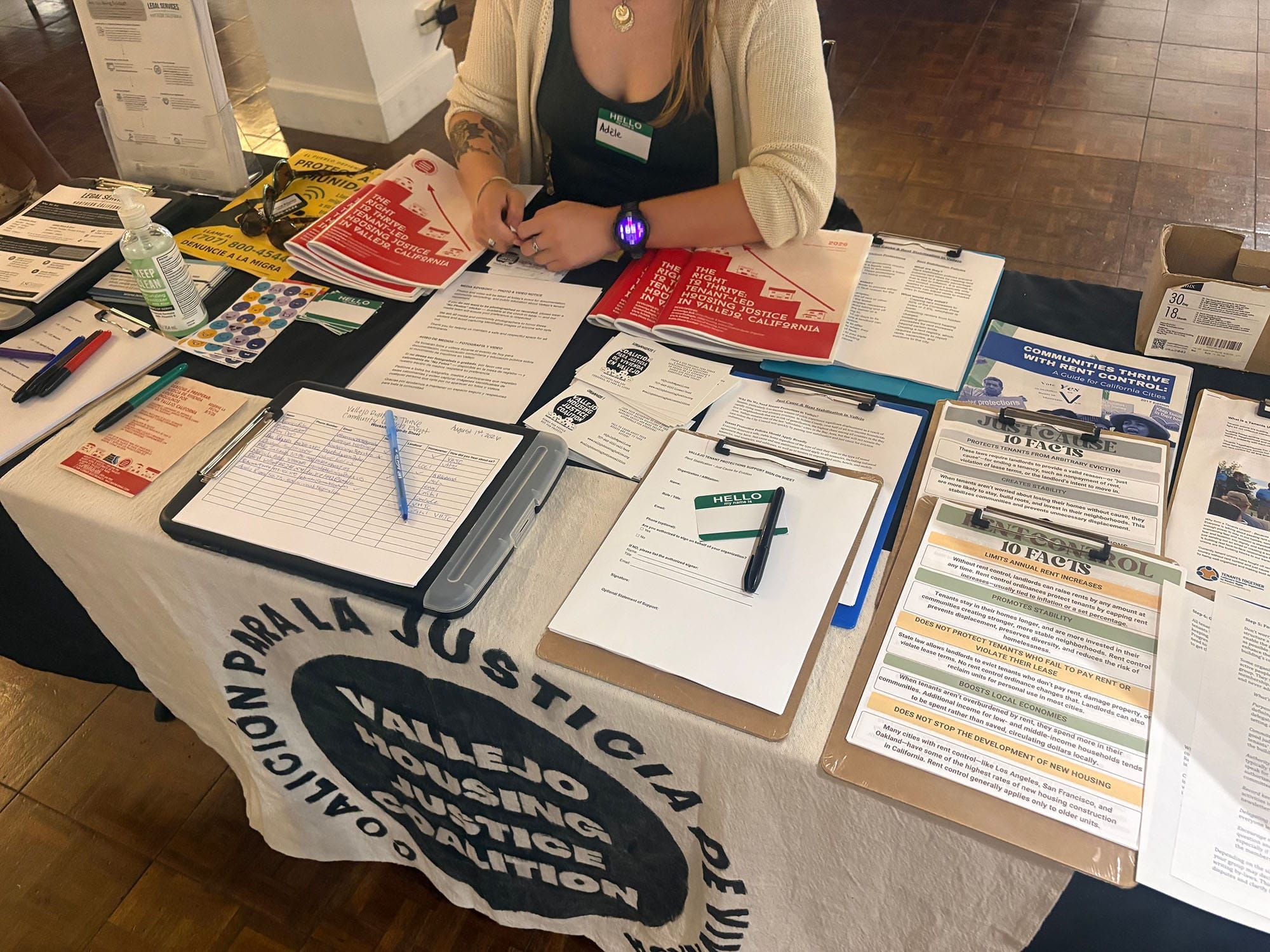
Members of the Vallejo Housing Justice Coalition advocated for the city to adopt new policies to protect renters and improve affordable housing availability at a forum Aug. 1 at the Vallejo Naval & Historical Museum. The organization presented its report on the historic development of Vallejo and the results of a recent survey of tenants, which was published with the non-profit advocacy group Urban Habitat.
“We’re here to claim what tenants already know: Vallejo needs strong renter protections now,” Housing Justice Coalition Executive Director Cristal Gallegos said.
The report comes as Vallejo faces a deepening affordable housing crisis, in part because it is behind on mandated affordable housing construction goals. Vallejo produced only seven homes for very low-income people in 2025, and appears to be far from the goal to produce hundreds more that are needed for low-income residents, according to its housing needs allocation.
The City Council is expected this fall to consider adopting a slate of new policies, which may include rent stabilization, just cause eviction, anti-harassment and tenants’right to counsel. The Housing Justice Coalition said these policies are being considered or have already been adopted in other Bay Area cities as rising housing rates and living expenses drive people to move to more affordable areas.
The report, authored by Urban Habitat planner and researcher Anteeniya Bell, analyzed surveys of more than 300 tenants performed by the Vallejo Housing Justice Coalition between late 2023 to summer 2024.
The survey garnered 319 responses, from both online and in-person participants. About 86% were renters, with the remaining number being homeowners or in unstable living conditions, including couch surfing or being recently evicted. Most earned household incomes between $1,000 to $5,000 per month, with the majority or 46.5% earning at least $2,500 per month.
The report noted the cost of rent in Vallejo compared to the median household income. The average apartment price in Vallejo is $2,100, which dropped from $2,200 in August 2025, while the median household income was $90,000 in 2025, according to the latest U.S. Census Bureau data. About 12% of the city lived in poverty that year, and 57% of the city lived in a home they owned, according to the Bureau.
Many tenants said they have faced steep rent increases. Those renting apartments or homes faced on average 19% annual rental increases, while people renting a room in a home experienced on average a 10% increase.
More than half of all surveyed reported living with substandard conditions such as pests, mold, leaks, broken heating or air conditioning or illegal activity, including thefts. About 74% of tenants wanted increased public safety services, while about 70% want affordable housing strategies like community land trusts and 55% want tenant associations.
Bell said that of those surveyed, more than 70% want rent control policies, 80% want a just cause eviction policy and 80% want community land trusts and right to legal counsel.
The report also details how Vallejo’s present housing, with persistently low availability of affordable homes for low- and moderate-income households, was shaped by past policies. Bell noted Vallejo is one of the Bay’s most racially diverse cities, with ratios of Black, Asian-American, Hispanic and White residents closer in proportion than in most other Bay Area municipalities.
Like nearby cities, Vallejo has also dealt with a long history of segregation in housing development. The report notes how redlining – a practice which began in the 1930s which denied people of color’s access to mortgages and financial pathways to homeownership – impacts communities of particularly Black residents today.
Vallejo also saw race-restricted covenants on property deeds which explicitly blocked the sale or rental of homes to people of color until the Supreme Court ruling Shelley v. Kraemer in 1948. Before 1960, Vallejo was about 80% white, with Black families restricted to areas such as the Country Club Crest neighborhood in north Vallejo.
While those policies no longer exist, the report said persistent wealth gaps continue in areas which were once designated on redlining maps, along with the impacts of the 2008 recession which particularly impacted Black, Latino and Asian households.
Today, “Vallejo has the largest proportion of Black renters and yet is one of the most underfunded and under-researched cities,” Bell said.
Bell said she thinks the community must address what she called persistent and troubling “anti-Blackness” in order to properly organize if they want changes to city policies, recommending a multiracial collective bargaining group.
Veronica Reilly, a renter for more than 30 years, spoke during the forum of her childhood coming from San Francisco. She remembered a Vallejo full of low-income workers with “two bowling alleys,” community gathering spaces “close to where we lived,” and a community so tight-knit that neighbors all knew her grandmother, down to the eyeglasses she wore.
“I remember the people who didn’t have much,” Reilly said. “You could cuss someone out one day, and they would help you out the next. We knew who we were, and we knew the ties to the land we were in. The community understood that the collective responsibility is on us to make sure you are secure.”
Reilly described how her mother spent nearly four decades working outside the city to afford the home they owned. “Several jobs were needed to keep her here, taking care of me and my grandmother,” Reilly said. “I wondered, when did she have time to build community?”
As a tenant in South Vallejo at one point, Reilly said she remembered discovering the same continued to be true for most of her neighbors, many of whom were rarely home as they spent their days working elsewhere in the Bay Area. She said she learned how to talk to people in a similar housing situation, as she spent $2,400 per month on a two-bedroom apartment “with black mold on the ceilings.”
The renter protections being asked of the city are not “radical,” she added. “There are other cities out there that are doing the same thing.”
Kim DeOcampo, a resident for more than 60 years, told the Vallejo Sun she attended the forum because she is very concerned about annual rent increases, properties being sold and displacements of longtime Vallejans.
DeOcampo is a retired case worker with the California Tribal Temporary Assistance for Needy Families program, which provides cash aid, job training and support services to eligible Native American families. She has always been a renter.
“Growing up here, I never saw unhoused people,” she said in an interview. “Everybody had somewhere to be. We can’t force landlords to change their attitudes, but I’m here for answers. We’re at the mercy of someone else all the time.”
She said if the council approves the package of housing policy reforms, “It’s a step in the right direction.”
“But their hands are full because we have so many people living outside, and they just keep getting swept everywhere,” she added. “Give them a place to stay.”
Solano County Supervisor Cassandra James shared how her family’s displacement from San Francisco public housing shaped her life and her worldview as a committed Vallejoan today. She said she grew up with other women as role models fighting for elected officials to invest in the Fillmore and Bayview neighborhoods, from which her family left with an emergency housing voucher.
“We still lived with uncertainty,” James said. “There were days my mom couldn’t even pay the water bill.”
She said as an adult, she once spent months sleeping in her car while waiting for stable housing to attend university in New Orleans after Hurricane Katrina. She later came to South Vallejo and faced ever-increasing rents, and said her family was only able to buy a home thanks to her grandmother’s veterans voucher under the GI bill.
After 16 years, now rooted in the Country Club Crest neighborhood, she said she supports the report’s vision for housing by using what tenants say they need.
“Housing is about dignity and safety and justice,” James said, adding that the report “challenges all of us to move beyond reacting to the crisis and creating systems that build long-term housing stability.”
She also called for other elected officials to listen closely to the community. “When the government listens and leads with courage, we can build policies that create lasting change,” she said.
Vallejo Councilmembers Diosdado Matulac, Tonia Lediju, Charles Palmares and Alexander Matias attended the forum.
Matulac, in an interview after the forum, said he thought it was an important community education opportunity.
As his background is in real estate and development, Matulac said he appreciated hearing from tenants with different experiences than his. He said he hopes there can be more city workshops where community members can hear “from all sides” including from landlords and developers.
“It’s been challenging for developers to have affordable housing developments pencil out, to be financially capable for them to do that,” he said. “The landlords also need to be more educated on what they’re capable of doing.”
Independent local news depends on you
The Vallejo Sun is supported by readers who value reliable, in-depth local news. Your support helps us continue investigating important issues and keeping Vallejo informed.
Become a member today- Housing
- government
- Vallejo
- Urban Habit
- Vallejo Housing Justice Coalition
- Vallejo Naval and Historical Museum
- Cristal Gallegos
- Vallejo City Council
- Anteeniya Bell
- Veronica Reilly
- Kim DeOcampo
- Cassandra James
- Diosdado “J.R.” Matulac

Natalie Hanson
Natalie is an award-winning Bay Area-based journalist who reports on homelessness, education and criminal justice issues. She has written for Courthouse News, Richmondside, ChicoSol News, and more.
follow me :