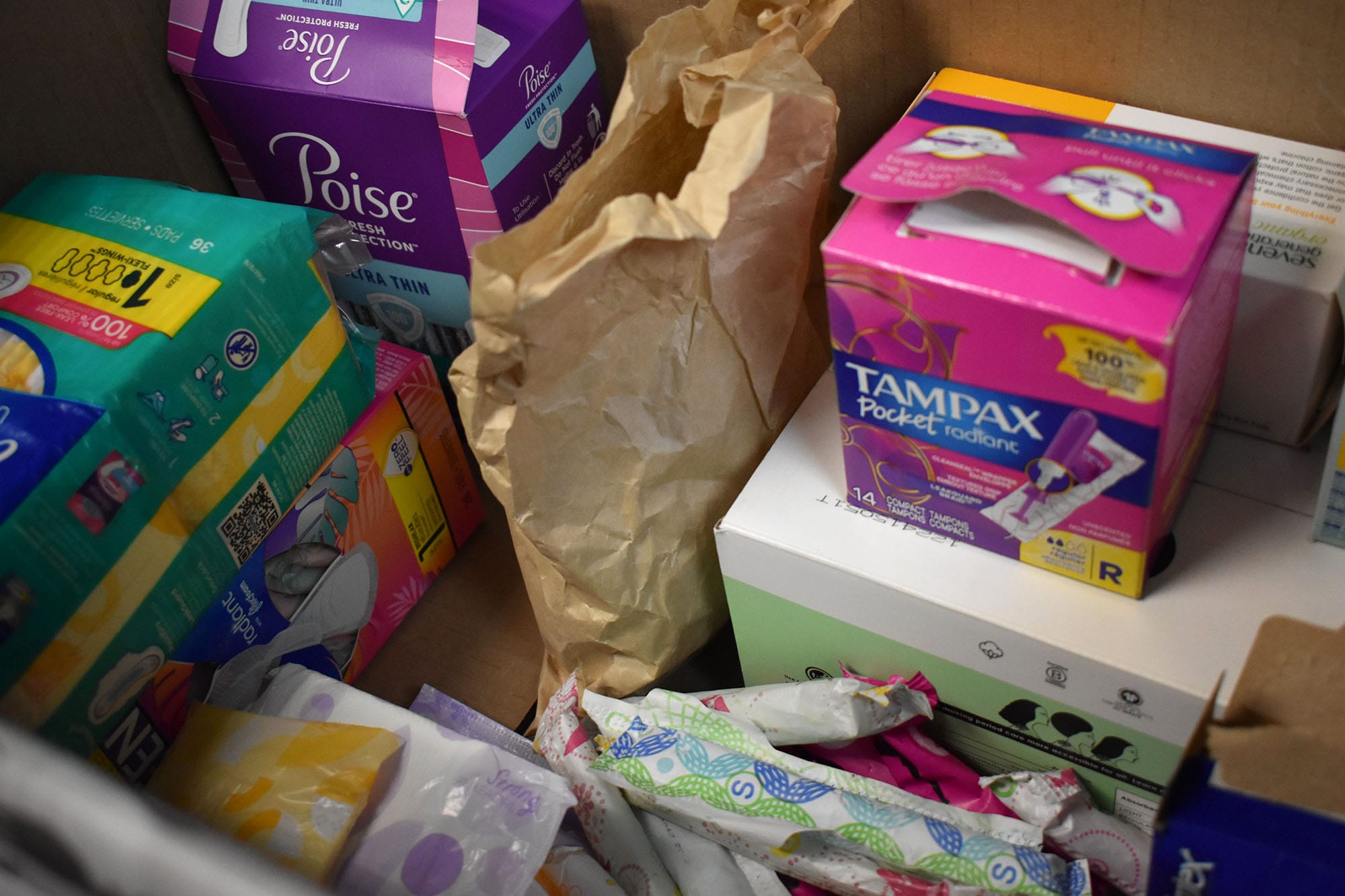
VALLEJO – A Vallejo resident is holding a donation drive to collect unused menstrual items like sanitary pads, tampons, and period underwear to donate to the Vallejo navigation center and the Solano Dream Center.
Donation boxes will be at the Springstowne and John F. Kennedy libraries until Jan. 30.
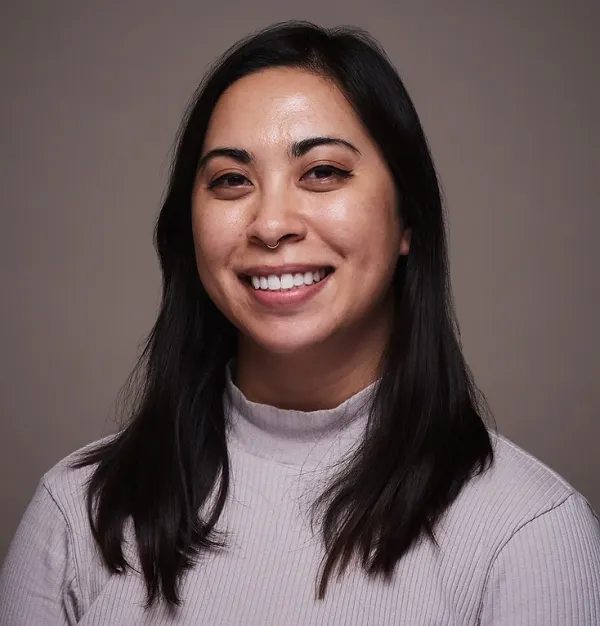
The drive was organized by Manpreet Nirwan, who was born and raised in Vallejo. “Everyone should have access to these products, and no one should be shamed or face any discrimination for menstruating,” said Nirwan.
Nirwan is an ambassador with The Pad Project, an international nonprofit that was founded in 2013 by a Los Angeles teacher and her students after they learned that girls in developing countries often drop out of school because they can’t afford pads. Their efforts to bring a machine that manufactures low-cost pads to a small village in India was the focus of the 2019 Academy Award-winning short documentary “Period. End of Sentence.”
Though Nirwan has a background in psychology and environmental global policy, she has long been passionate about reproductive health and equity. When she watched the documentary, she decided to get involved with the nonprofit.
As part of the ambassador program, Nirwan was tasked with creating a project rooted in her community that focuses on combating period poverty and advancing menstrual equity.
Period poverty refers to the inability to afford pads and tampons and even access basic hygiene facilities like toilets, making it difficult and even distressing to manage a period. Menstrual equity is the idea that because having a period is a normal bodily function for cisgender women and some transgender and nonbinary people, the products used to deal with it should not be treated like a luxury.
Yet they often are for a portion of the population. According to a 2023 study by period underwear manufacturer Thinx, a quarter of teens and a third of adults in the U.S. struggle to afford period products. The study also found that around 46% of the adults who were surveyed were afraid that their jobs could be negatively affected if they asked for accommodations due to their period; the report noted this worry was most common among low-income respondents.
Most bathrooms do not offer free pads and tampons, and they can't be purchased using SNAP benefits because they’re considered ineligible “hygiene items.” They’re also not covered by health insurance or Medicaid, and are only reimbursable if the person has a Flexible Spending Account or a Health Savings Account, which an unhoused or low-income person is unlikely to have.
There are no period poverty studies specifically for Vallejo or Solano County, but Nirwan said she concluded that the reports about the struggles that unhoused people face in managing their periods in other states were probably true here too.
“Like people using rags, clothing, towels, to collect the blood,” said Nirwan. “There’s also the lack of access to facilities to change their pads, or they have to walk around with blood-covered pants.”
She said there’s often a stigma associated with having a period, so these issues usually go “uncovered and unnoticed.”
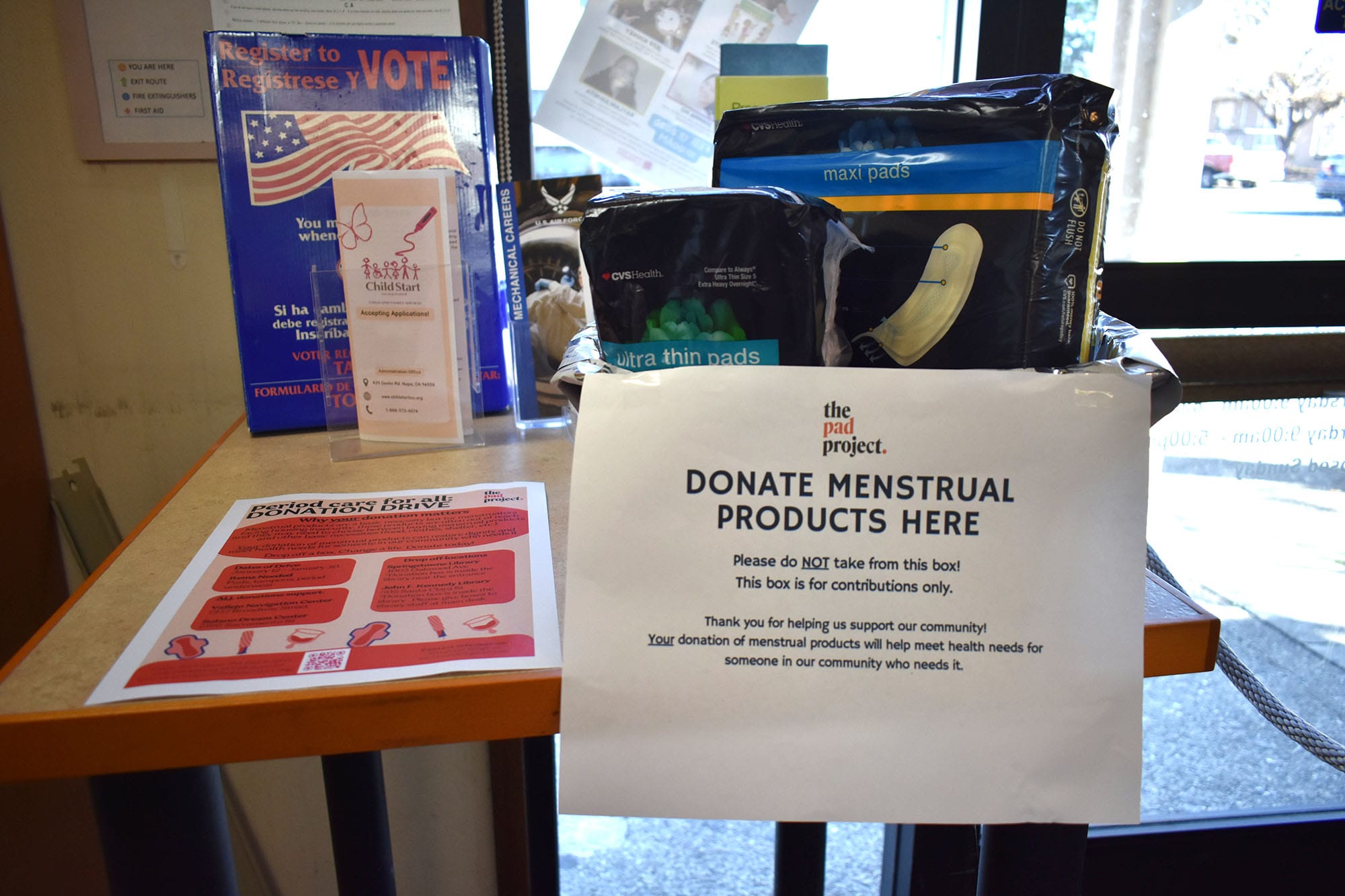
The area outside of the JFK library has been home to encampments in the past, and unhoused people often turn to the library for shelter and bathrooms, making Nirwan’s project a natural collaboration for them, explained Mark Flowers, the supervising librarian at JFK library.
“Reproductive health and equity is obviously an important issue,” said Flowers. “And very specifically here, we have a lot of unhoused people who can’t afford those sorts of products, so we’re happy to be able to do anything that we can do to support them in their struggles.”
Germaine Luciano-Hatchell, the executive administrator of Solano Dream Center, said the menstrual products will go a long way to help those living in the shelter.
“As a shelter that houses between 40 to 75 people, menstrual products are often a forgotten need,” said Luciano-Hatchell. “We have enough beds for around 25 women, and often these women come directly from the streets or from the hospitals with nothing but the clothes on their back. They often do not have the most basic hygiene products such as toothpaste, toothbrush, undergarments, let alone menstrual products.”
She added that any donations will help fill “a very real need” while also helping the unhoused residents “regain a portion of their dignity.”
Nirwan said if residents are interested in donating products after the drive is over, they can reach out directly to the navigation center and Solano Dream Center.
Luciano-Hatchell said other hygiene products that the Solano Dream Center is always looking for include underwear, adult diapers for older residents with incontinence, deodorant, toothpaste, and toothbrushes.
Before you go...
It’s expensive to produce the kind of high-quality journalism we do at the Vallejo Sun. And we rely on reader support so we can keep publishing.
If you enjoy our regular beat reporting, in-depth investigations, and deep-dive podcast episodes, chip in so we can keep doing this work and bringing you the journalism you rely on.
Click here to become a sustaining member of our newsroom.
THE VALLEJO SUN NEWSLETTER
Investigative reporting, regular updates, events and more