VALLEJO – A bicyclist who was struck by a car in Vallejo early Sunday morning suffered major injuries and remains in a hospital as of Thursday but is still alive, contrary to statements by the Vallejo Police Department.
Vallejo police issued a press release on Monday that said “despite medical efforts, the bicyclist was later pronounced deceased,” and called the incident Vallejo’s 11th traffic-related death this year.
The Solano County coroner's office disputed that Thursday morning and said the bicyclist was not deceased and was still in the hospital.
Police spokesperson Sgt. Rashad Hollis said Thursday that the bicyclist was indeed still alive but was not expected to make it.
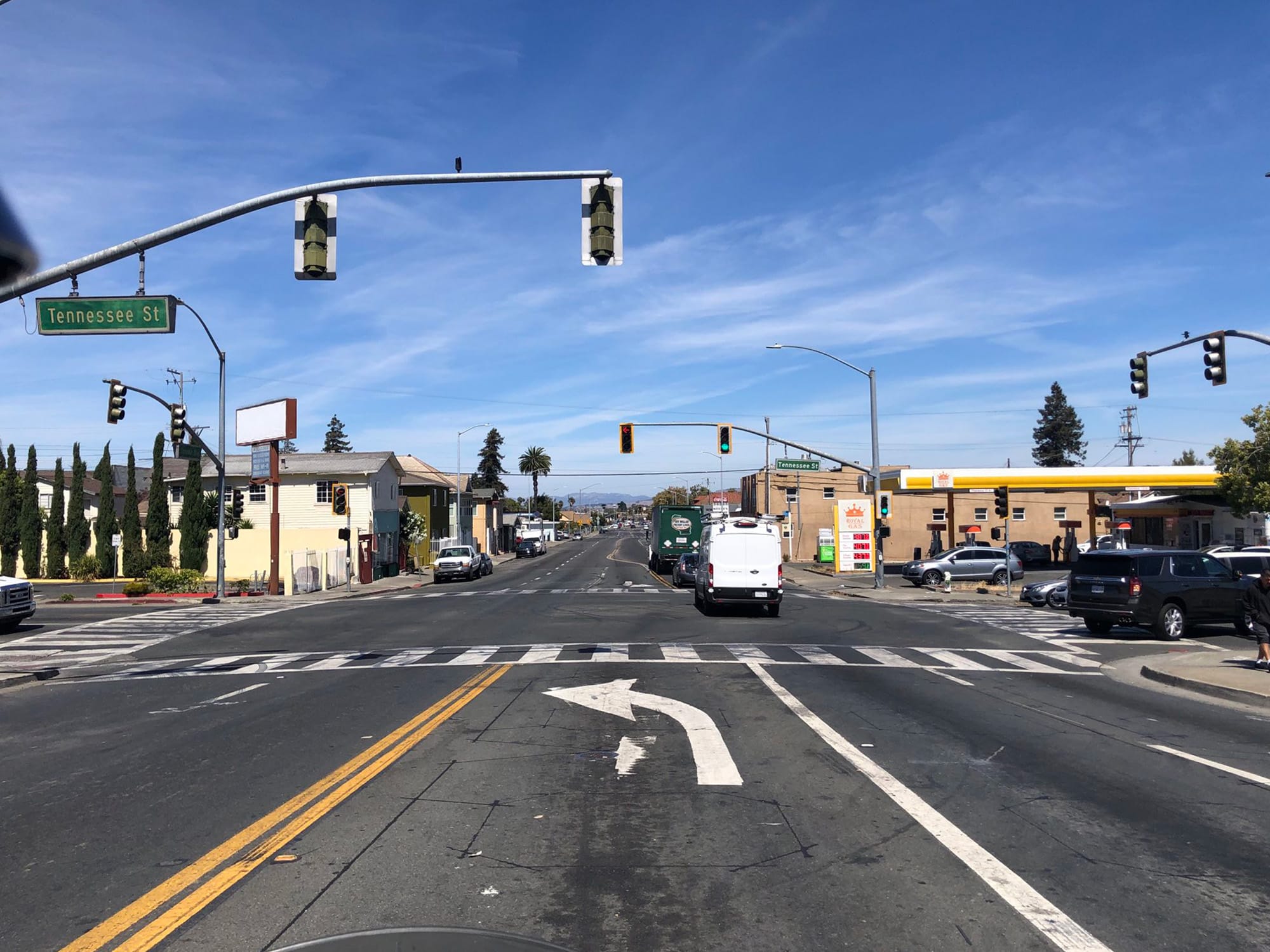
The bicyclist was struck at around 12:05 a.m. near the intersection of Sonoma Boulevard and Tennessee Street. Police said Monday that the driver who struck the cyclist did not appear to be intoxicated and that an autopsy will determine if the bicyclist was under the influence of alcohol or drugs.
Hollis said Thursday that the accident was still an ongoing investigation and did not disclose any further details. No arrests were made.
The latest incident occurred a month after a 12-year-old boy was seriously injured while riding his bicycle on Louisiana Street and Sacramento Street, only a couple of blocks away.
On Aug. 9 a pedestrian was killed in a fatal hit-and-run collision, also on Sonoma Boulevard.
Residents in the St. Vincent’s Hill neighborhood, close to all three accidents, have been asking for traffic calming measures for years and say that police presence is lacking. Residents as well as City Council members have been discussing how to implement traffic measures on Sonoma Boulevard for years.
In response to the bicycle accident involving the 12-year-old boy in July, City Manager Andrew Murray told residents in an email obtained by the Vallejo Sun that Vallejo Public Works would install yield to pedestrian signs, repaint all red curbs for visibility and install a set of speed cushions on the block of Louisiana.
Murray also said that Vallejo police will place a speed radar trailer in the area and have an officer conduct traffic enforcement.
Of all those promises, so far, only the curbs have been painted, said local resident Eli Smith. How that is meant to prevent traffic collisions remains unclear, she said.
Tim Weisberg, a spokesperson for the California Office of Traffic Safety, said that reducing vehicle accidents requires a “multi-layered approach."
“You're not going to build your way out of the problem, you're not going to educate your way out of the problem,” he said. “You're not going to be able to enforce your way out of the problem.”
Weisberg said that the best approach uses all three in order to shift behavior and make “safe driving the socially acceptable right thing to do.” He also stressed the need for enforcement, in order to hold people accountable.
“If enforcement is there, you see lights behind you, you have a natural reaction for, oh, wait, what did I do? It's a deterrent to the behavior if there's consequences,” said Weisberg.
Law enforcement officials said that they have increased patrols. “Our patrol department is aware and will be periodically conducting traffic enforcement along with our traffic division,” Hollis said. “And we’ve informed the highway patrol on some of the issues that we are facing.”
The most effective deterrent in speeding on the intersection of Louisiana and Sacramento street, local residents have said, has been the presence of the California Highway Patrol.
In an interview, CHP Officer Andrew Barclay said that various CHP officers are assigned to the Bay Area Crime Suppression team, which is tasked with patrolling cities and responding to traffic infractions when they witness them.
“The governor came out last week and announced not only that there would be more of these crime suppression teams now across the state, but also bolstering the ones that we have,” Barclay said. “So the California Highway Patrol is going to continue our patrols.”
Over a month ago, Murray told St. Vincent’s Hill residents that the city would reinitiate their program of intaking community member requests for neighborhood traffic calming measures.
“With a new appropriation from the City Council and new city staff assigned to the effort, that program has been restarted,” Murray said in an email to residents. “We will be publicizing the program, including how community members can request traffic calming for their neighborhood, soon.”
No information has yet been made public about the program.
The traffic division and public works did not request for comment at time of writing.
Weilberg said that changing the culture around driving “takes time. It takes building relationships, building trust. We did it with seat belts. Forty years ago, 20% of people were wearing seat belts. Most people wear them now.”
According to the California Office of Traffic Safety, in 2022, Vallejo ranked as one of the worst cities in the state for DUI and hit-and-run related vehicular accidents.
However, vehicle accident data analyzed by the UC Berkeley Transportation Injury Mapping System show that the number of accidents involving fatal or serious injury decreased from a record high of 70 in 2022 to 44 in 2024. Data also shows that vehicle accidents causing fatal or serious injury disproportionately affect Black people.
Before you go...
It’s expensive to produce the kind of high-quality journalism we do at the Vallejo Sun. And we rely on reader support so we can keep publishing.
If you enjoy our regular beat reporting, in-depth investigations, and deep-dive podcast episodes, chip in so we can keep doing this work and bringing you the journalism you rely on.
Click here to become a sustaining member of our newsroom.
THE VALLEJO SUN NEWSLETTER
Investigative reporting, regular updates, events and more
- policing
- transportation
- crime
- Vallejo
- Rashad Hollis
- Andrew Murray
- Eli Smith
- California Office of Traffic Safety
- Tim Weisberg
- California Highway Patrol
- Andrew Barclay
Sebastien K. Bridonneau
Sebastien Bridonneau is a Vallejo-based journalist and UC Berkeley graduate. He spent six months in Mexico City investigating violence against journalists, earning a UC award for his work.