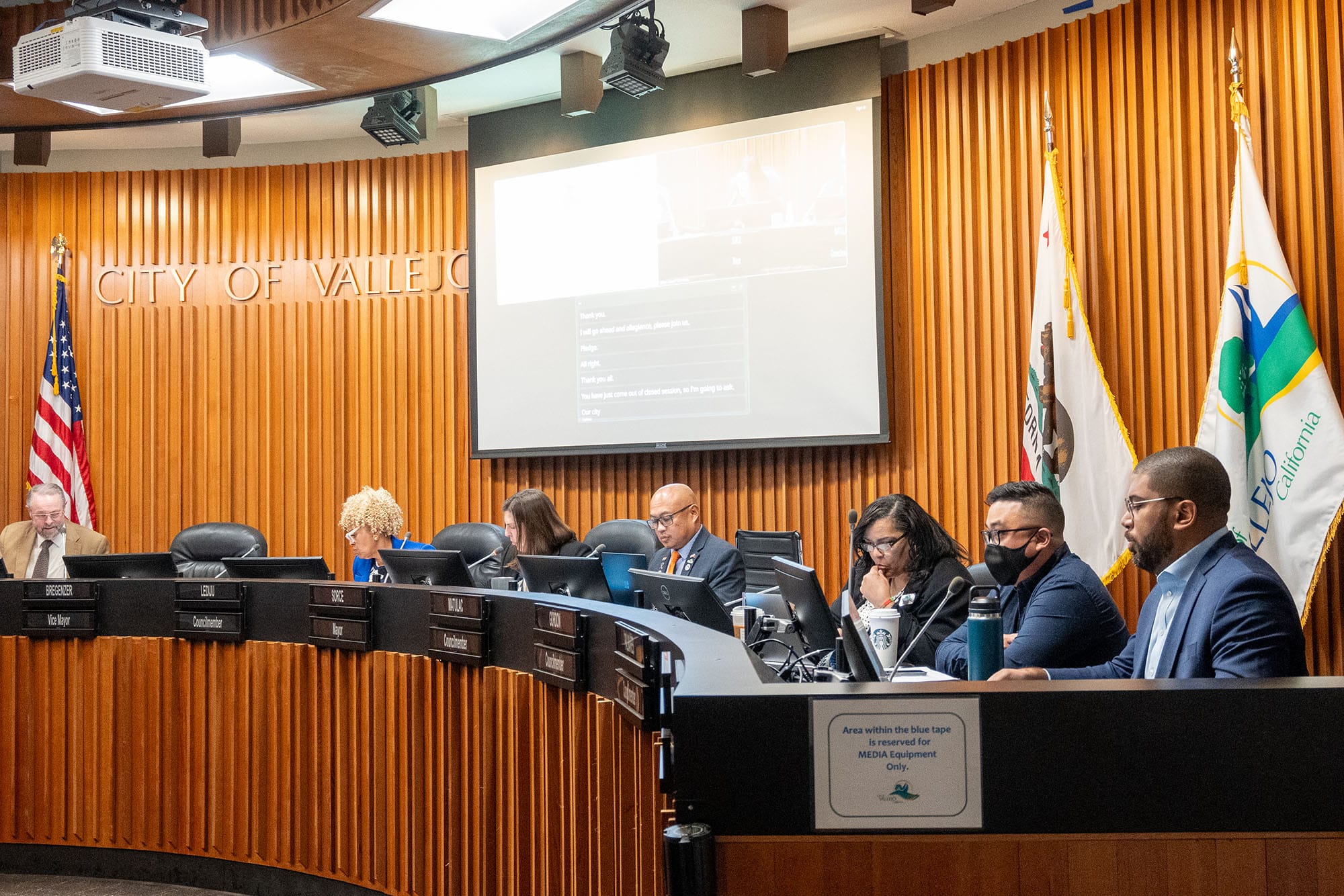
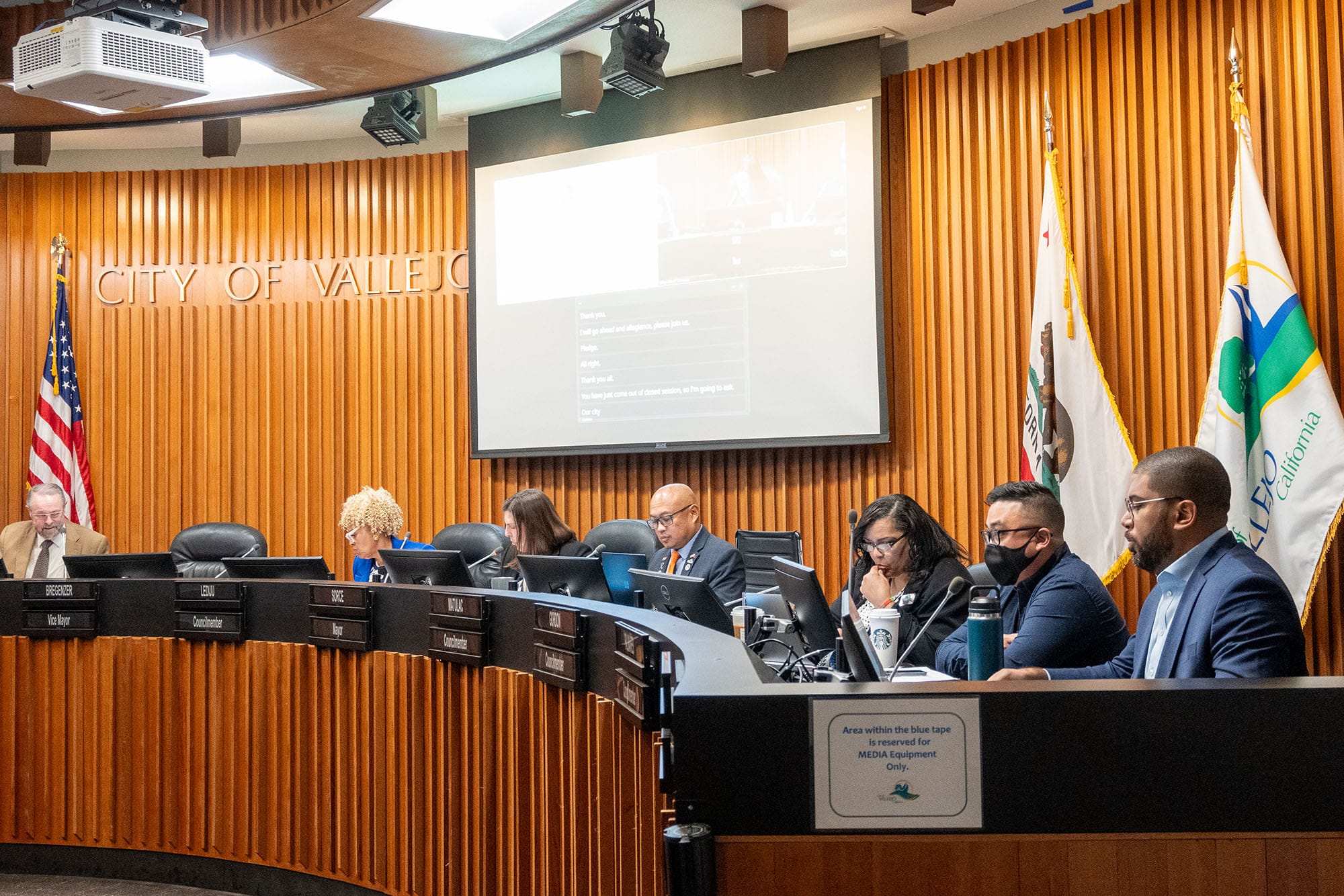
VALLEJO - The Vallejo City Council rejected city staff’s recommendations for most adjustments in the current budget on Tuesday amid uncertainty over how to handle a nearly $29 million projected shortfall in the coming year.
The City Council voted 6-1 on Tuesday night against city staff’s plan for making mid-year adjustments and handling the forecasted general fund budget shortfall for 2026-27, with only Councilmember Helen-Marie “Cookie” Gordon voting to approve.
Assistant city manager Nalungo Conley had reported on Feb. 24 that the city’s general fund shortfall next year will be approximately $20 million at the current rate, largely due to employing more staff than the city can afford to pay and declining revenues.
Conley told the council on Tuesday that the projected shortfall is nearing $29 million, as “For the most part, revenues are fairly flat.” She said that staff are researching balancing options such as eliminating positions, cutting overtime and new contributions to the city’s pension trust, seeking grant funding and paring down spending on services and supplies.
The mid-year adjustments sought by city staff included $300,000 because of higher than expected water usage at city-owned facilities, $450,000 to reimburse an account used to fund maintenance of fire hydrants, $500,000 to address “higher-than-anticipated” separation and leave cash-out costs, and $200,000 for a sex trafficking initiative. City staff had also sought to unfreeze positions in the finance, human resources, planning and economic development departments.
However, Mayor Andrea Sorce moved to make one mid-year adjustment: recommending that staff expedite hiring a full-time civilian position overseeing Vallejo Police Department reform efforts, which the city is legally bound to under an agreement with the California Department of Justice. The work has so far been done by a consultant who “is very expensive,” and having a full-time employee take over the job is supported by the police department, she said.
Although staff could not provide an estimate of how much the city would save by hiring for this role, Sorce said, “This position is an investment that will bear dividends going forward allowing us to accelerate the speed of reforms, hopefully get through the reforms in a timely manner … and it will be cheaper than the current consultant we’re using.”
Gordon said she worried that other city departments would feel slighted by focusing on one role rather than considering their needs as well. However, she voted in favor of the motion, which passed 6-1 with Councilmember Alexander Matias voting no.
The challenges in the budget are largely because sales tax revenue is projected to decline by approximately $983,000, due to reduced spending and the closure of three grocery stores in the city. Meanwhile, the economy is challenging overall because of inflation and interest rates, labor costs and price volatility in taxable goods.
Councilmember Tonia Lediju said the council has several times raised concerns about the city’s structural imbalance, asking City Manager Andrew Murray to find possibilities to improve it. She noted the ongoing request from staff to reinstate some city positions which were frozen last year, amid more than $1 million in cuts the council made last spring in response to rising costs and stagnant revenue to avoid dipping into reserves and heavily relying on 2022’s Measure P sales tax measure.
Conley told Lediju that those “four to five” positions would be eliminated next year, and additional savings totaling $2.5 million could be garnered from cuts to overtime under the current plan for the next year.
However, Lediju said that when Murray and his staff made proposals last year for which staff positions to freeze, those proposals should have been vetted to determine if they were for “non-essential” positions.
“The goal was to get us through this year so that under your leadership, that could occur,” Lediju said to Murray. “Had you looked at the projected financial position, we already knew we were going to experience a deficit. And yet here we are, even though we‘re trending on those one-time projected allowances the council made purposely to get us through and make some long-term planning.”
Sorce said that the one-time fixes used last year were not sustainable, and she appreciated city staff presenting a report which was “years in the making.” She said Vallejo is not alone and is dealing with the same civic issues and financial struggles as many other cities.
However, Sorce said, “I still feel like we are in a position where it is irresponsible for us to unfreeze positions without knowing what we’re going to do with them in the coming year.”
Matias said that every year there have been cuts in services until the mid-year request for more funds. Staff must find a solution to end the trend and keep funding consistent, he said.
Matias called for changes such as more dedicated business and economic development and hiring another dedicated crime analyst to understand trends rather than “reacting” to concerns about public safety.
“We’re not really being smart, we’re just reacting to problems on the ground,” Matias said. “We’ve been focused on a ‘keep the lights on’ budget.”
Gordon agreed with the desire to support businesses in different neighborhoods and for staff to bring back more ideas to fund economic development. She said she remembers the activity from thriving businesses in years past, such as those which used to do well in the corridor from Sonoma Boulevard to the south Vallejo waterfront.
“Now, it’s just sitting there,” Gordon said. “I would really like to build up this college city. If there’s no money here, let’s go find it.”
Conley said Wednesday that she expects to bring back the mid-year request to a future council meeting. She said of the requests several councilmembers made “The City Manager and the finance team will reconvene and determine what form those reductions will take and what are the potential short- and long-term impacts to personnel and service delivery.”
In public comment, Yesica Martinez asked if the city is not submitting applications for all grants it’s qualified for and if members of the public could help with the grant writing process. Carol Heap agreed, saying that she thinks the city has missed grant funding opportunities which don’t have to take lots of time to apply for.
“There’s always been a reluctance by staff, and I think somehow we need to move beyond that … finding the grant resources and then drafting a proposal,” Heap said.
Before you go...
It’s expensive to produce the kind of high-quality journalism we do at the Vallejo Sun. And we rely on reader support so we can keep publishing.
If you enjoy our regular beat reporting, in-depth investigations, and deep-dive podcast episodes, chip in so we can keep doing this work and bringing you the journalism you rely on.
Click here to become a sustaining member of our newsroom.
THE VALLEJO SUN NEWSLETTER
Investigative reporting, regular updates, events and more
- government
- Vallejo
- Vallejo City Council
- Vallejo City Hall
- Nalungo Conley
- Andrea Sorce
- Helen-Marie Gordon
- Tonia Lediju
- Andrew Murray
- Yesica Martinez
- Carol Heap

Natalie Hanson
Natalie is an award-winning Bay Area-based journalist who reports on homelessness, education and criminal justice issues. She has written for Courthouse News, Richmondside, ChicoSol News, and more.
follow me :