VALLEJO – Last Friday, the Trump Administration announced that the Environmental Protection Agency was looking to permanently end a nationwide program that required refineries to report greenhouse gases emissions.
EPA Administrator Lee Zeldin described the program as harmful and expensive, and claimed that cutting it would save businesses billions in regulatory compliance. This is the latest in a series of environmental rollbacks from the administration. Recently, it also proposed to rescind a 2009 declaration that greenhouse gases pose a threat to public health.
“It's a big step backward,” said Bill Magavern, the policy director of the Coalition for Clean Air, a nonprofit focused on air quality and climate change in California. “Reporting should be the bare minimum of what we're doing to reduce greenhouse gas emissions, and that was agreed on a generation ago.”
The program was first established in 2009 and has long had bipartisan support. If the plan is finalized, more than 8,000 facilities across the country will no longer have any federal requirements to report how much they’re polluting. This would make it harder for citizens to keep track of how much local refineries are releasing greenhouse gases, which are the biggest drivers of climate change.
“If you don't have the data to say it's happening, how are you going to prove that it's happening? That’s absolutely critical when it comes to health,” said Lorene Allio, a member of the environmental justice group Fresh Air Vallejo. “Communities around the country won't necessarily be able to show how they're harmed, even if they are showing up at the hospital.”
Greenhouse gases are a major contributor to higher rates of asthma. Solano County has the highest rate of asthma emergency room visits in the Bay Area and the third highest in the state, according to the California Department of Public Health.
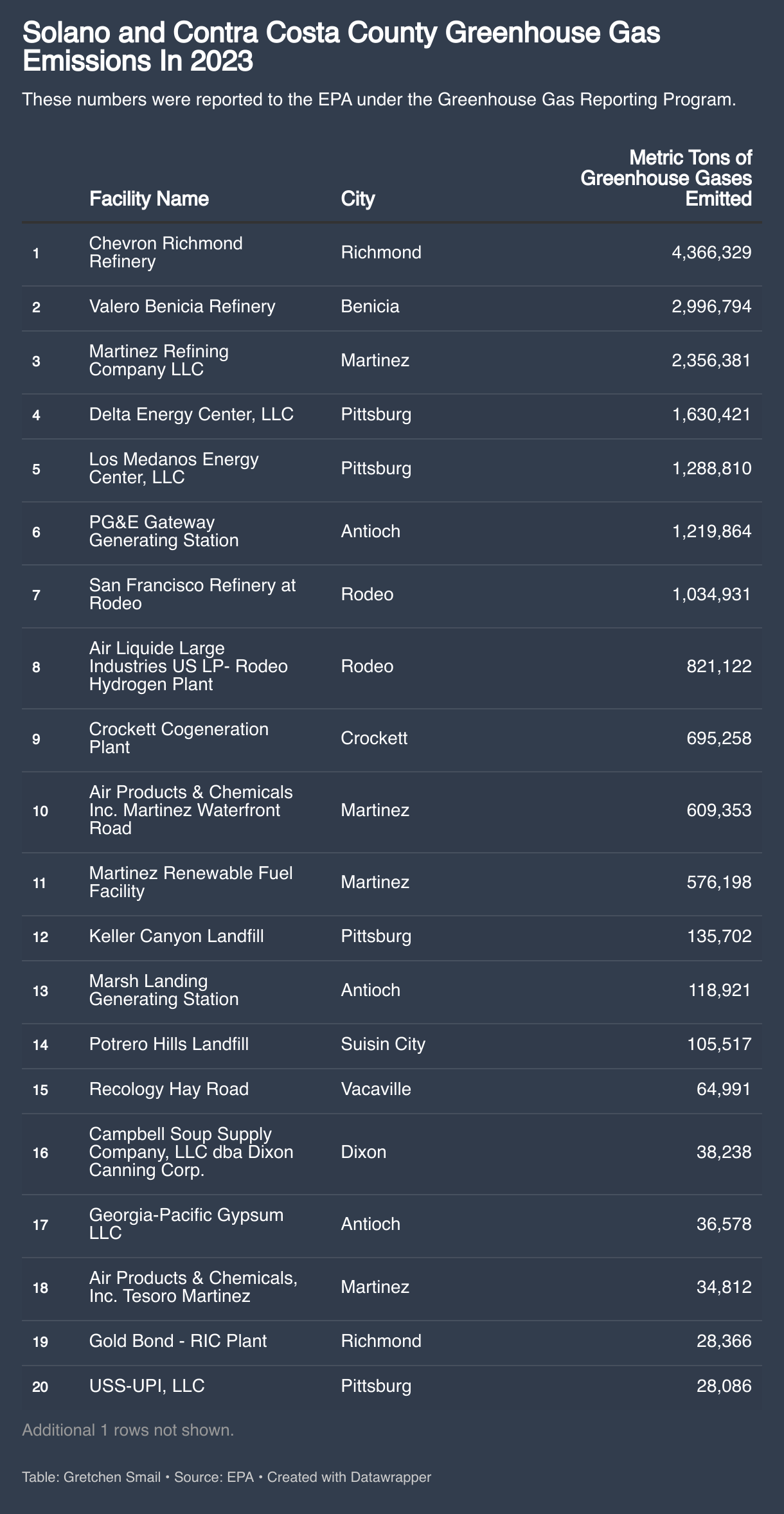
Currently, the EPA’s emission data is still on its website. The data shows that in 2023 in California, the Los Angeles Refinery was the biggest polluter in the state, emitting over 6 million metric tons of greenhouse gases. But in second place was the Chevron refinery in Richmond, emitting 4.3 million metric tons. In fourth and fifth places were Benicia’s Valero refinery and the Martinez refinery, emitting 2.9 and 2.3 metric tons, respectively.
There are a total of 21 sites — including refineries, power plants, and landfills — in Solano County and Contra Costa that reported their greenhouse gas emissions to the EPA in 2023.
A 2023 study found that having a reporting program in place prompted facilities across the country to reduce their emissions by over 7%.
But even though this program may be ending at the federal level, Magavern said that California is better positioned to weather this change compared to other states. The California Air Resources Board has a pollution mapping tool that residents can use to continue to track pollution. And it has “a full fledged climate program,” said Magavern. “It does require the large emitters of greenhouse gases to report, and more importantly, to reduce their emissions.”
This program is called cap-and-invest (formerly known as cap-and-trade) and Gov. Gavin Newsom extended it until 2045 on Friday.
In the Vallejo area, there are also local organizations like the Benicia Comunity Air Monitoring Program, which has set up their own monitors to keep track of the emissions around the Benicia Valero refinery.
“It’s a continuous monitoring system. The monitors run 24/7, and it's on the website immediately,” said Kathy Kerridge, a board member with the Benicia Community Air Monitoring Program. “It's publicly available information.”
Meanwhile in Vallejo, Allio said that announcements like these have only motivated their organization to take more action and push for more environmental justice policies at a state and local level.
“Data is part of democracy,” said Allio. “When you take away people's right to have information, to talk about information, to share information, it's a big problem.”
Before you go...
It’s expensive to produce the kind of high-quality journalism we do at the Vallejo Sun. And we rely on reader support so we can keep publishing.
If you enjoy our regular beat reporting, in-depth investigations, and deep-dive podcast episodes, chip in so we can keep doing this work and bringing you the journalism you rely on.
Click here to become a sustaining member of our newsroom.
THE VALLEJO SUN NEWSLETTER
Investigative reporting, regular updates, events and more