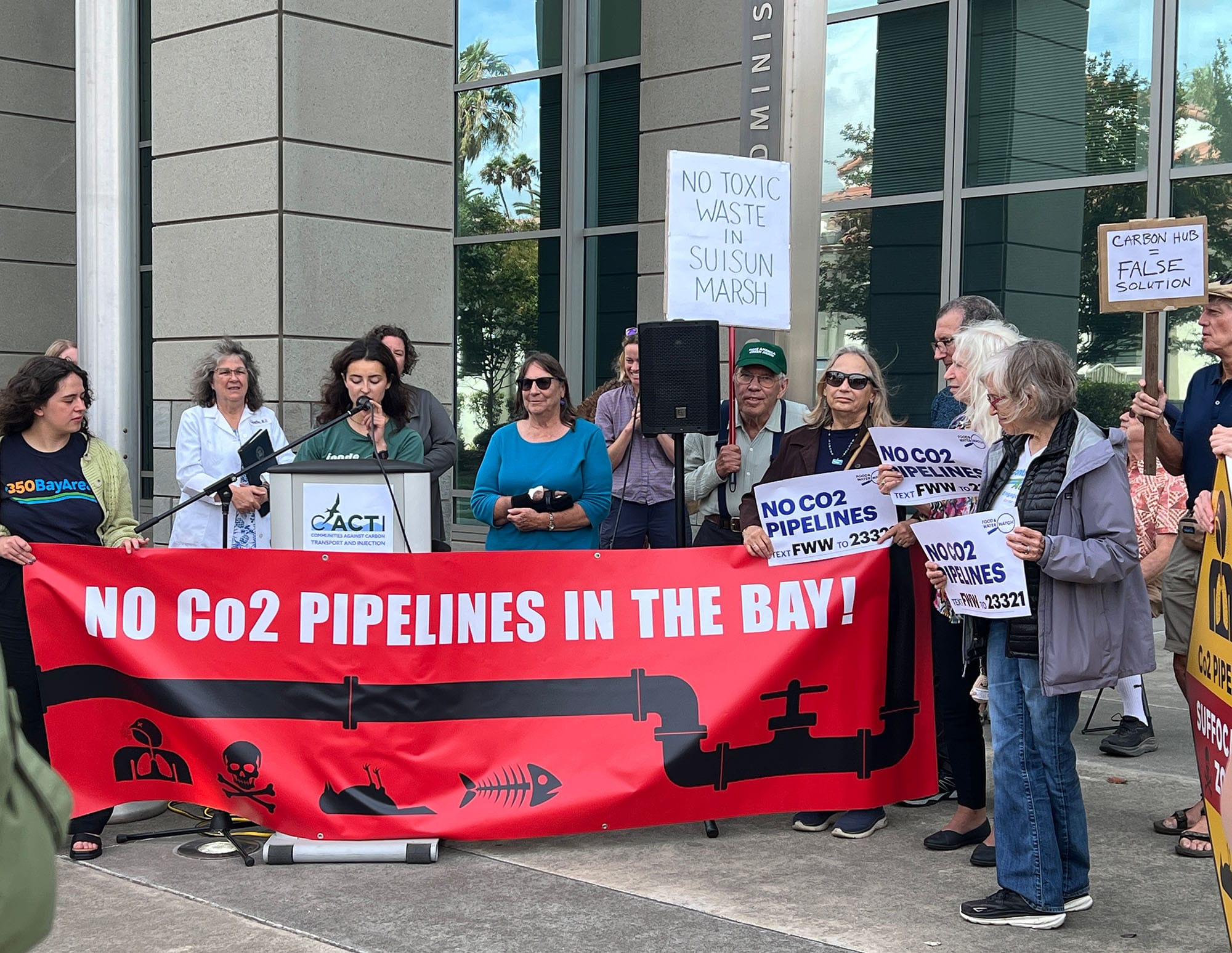
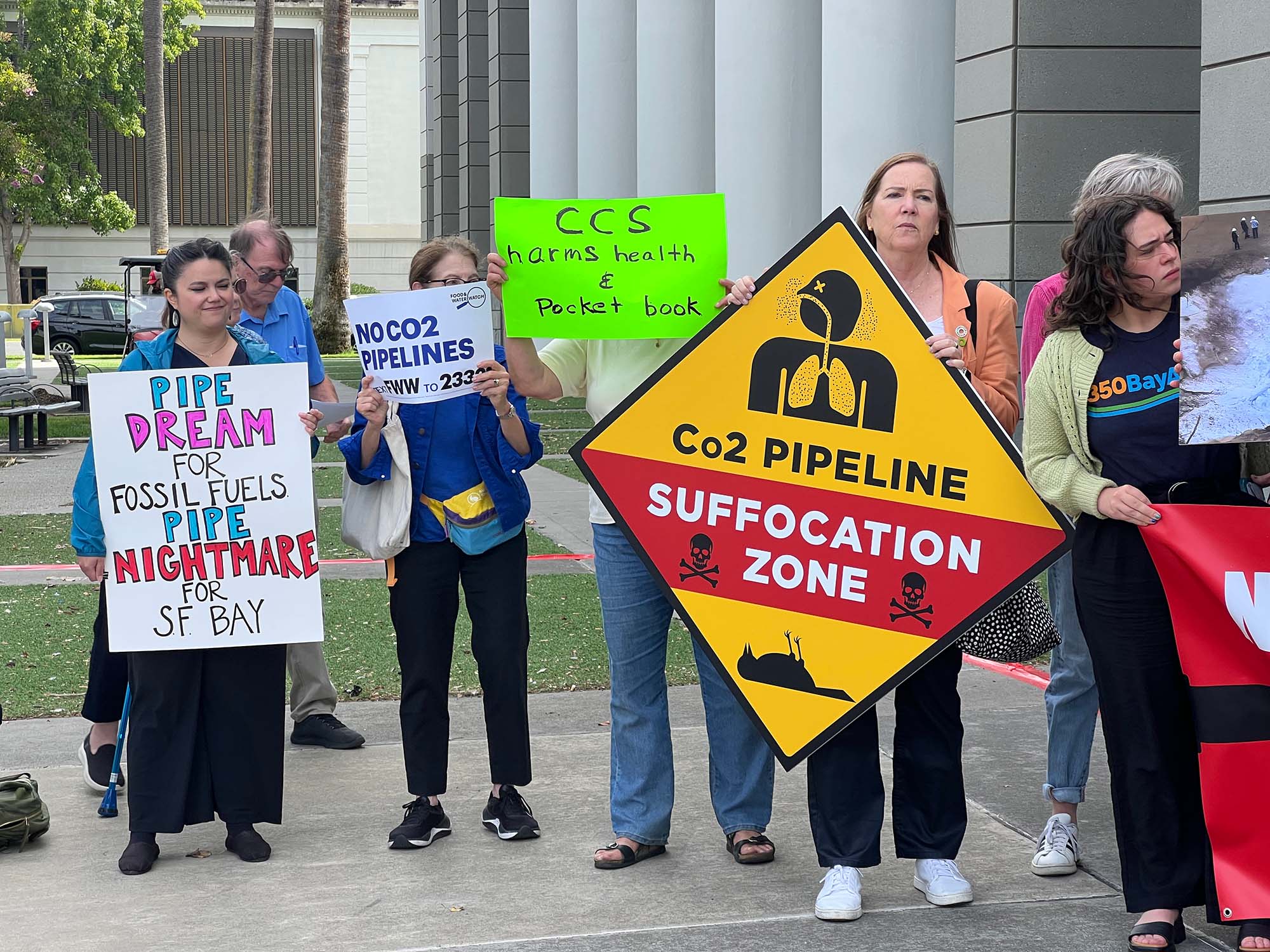
FAIRFIELD – A group of community organizers, residents, physicians, and scientists gathered to spread awareness about the potential dangers of a proposed carbon dioxide pipeline through Solano County at a rally in Fairfield on Tuesday.
“For too long, Solano County has been used as a dumping ground for fossil fuel pollution,” Isabel Penman, an organizer with Food & Water Watch, said at the rally. “Today, we are standing up together to say no to carbon dioxide pipelines in the bay and in our backyards.”
The project, called the Montezuma NorCal Carbon Sequestration Hub, is currently waiting on a permit from Solano County to build a test well. “We expect that process to proceed over the next few months,” said Jim Levine, the managing partner of Montezuma Carbon LLC.
If the county approves the project, it would be first of its kind in the Bay Area. It would involve building a 45-mile pipeline that would span the Carquinez Strait. The pipeline would transport carbon dioxide emissions from local plants, like the Richmond Chevron refinery and the Benicia Valero refinery, to a storage facility in the wetlands around Collinsville. There, they would inject the carbon dioxide over a mile into the ground, leaving it there permanently.
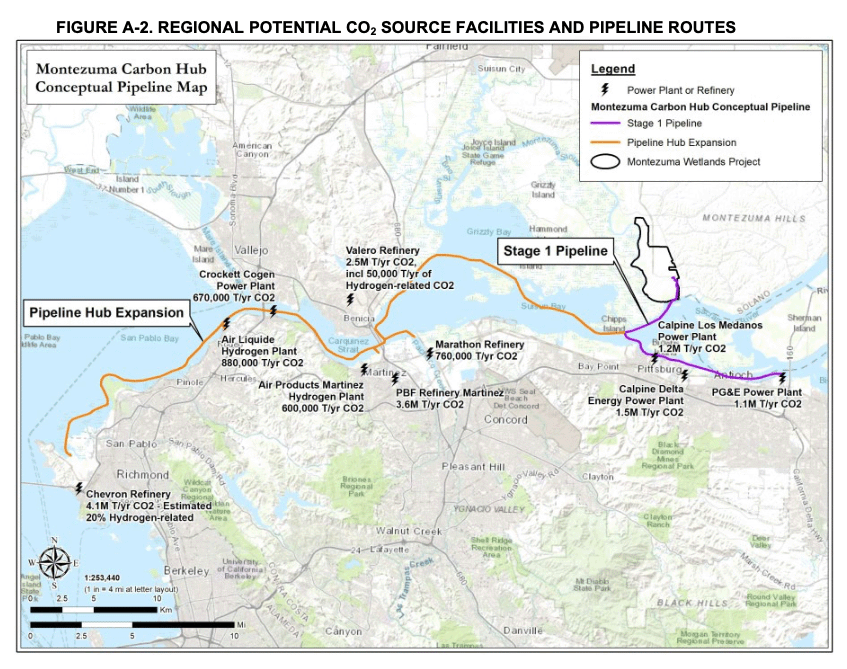
The company estimates that it would draw in and store 1 million tons of carbon dioxide a year for 40 years.
This method of dealing with greenhouse gases is called carbon capture and storage. Its proponents argue the technology is a crucial step in curbing global warming, since the emissions would go underground rather than into the atmosphere. Both former President Joe Biden and President Donald Trump have also passed bills incentivizing its use through tax credits.
But carbon capture and storage is still highly debated, with critics saying that it’s just another way for gas and oil companies to keep polluting and delay phasing out fossil fuels.
That’s the stance of Communities Against Carbon Transport & Injection, the coalition that led Tuesday’s rally. Made up of members from dozens of environmental organizations like San Francisco Baykeeper, 350 Bay Area, and Sunflower Alliance, they spoke out about the drawbacks of focusing on such solutions.
“It's absolutely greenwashing,” said Aundi Mevoli, a staff scientist and field investigator with San Francisco Baykeeper, referring to a marketing tactic companies often use to present themselves as more environmentally friendly than they actually are.
Rather than greenlighting carbon capture projects, Mevoli said the county should focus on building up the Bay Area’s wetlands and urban canopy, both of which naturally store carbon dioxide. She also advocated for transitioning towards clean energy.
“There are strategies right now, like solar and wind, that are not being supported because the money is being funneled into carbon capture,” she said.
Solano County has been forging ahead with clean energy initiatives like the Solano 4 Wind project, but Levine noted that solar and wind power still don’t draw carbon dioxide out of the air like carbon capture and storage does. He said that while the refineries are still in operation, collecting and storing their emissions will help lessen their impact.
Mevoli and other speakers brought up numerous concerns in regard to the Montezuma project, from potential damage to the nearby wildlife and wetlands to the possible health impacts if the pipelines were to rupture and leak out carbon dioxide.
In one notable moment during the conference, they played a recording from a fire coordinator who responded to a 2020 carbon dioxide pipeline rupture in rural Mississippi. The rupture forced an evacuation of the town and sent over 40 people to the hospital with carbon dioxide poisoning. The coordinator described the scene like a “zombie apocalypse,” with cars shutting down and people passing out.
“Carbon dioxide can suffocate both humans and animals within minutes,” explained Dr. Bonnie Hamilton, a Bay Area pediatrician, at the rally. She pointed out that because carbon dioxide is odorless and colorless, people often don’t know they’re inhaling it until they start to feel very sick.
Kathy Kerridge, a longtime Benicia resident and member of 350 Bay Area Action, said that she worries about what would happen to the communities that sit near the water if there was ever a rupture in the Montezuma pipeline. “We all fear the dangers of this project to our health and safety,” she said.
Levine said there are thousands of carbon dioxide pipelines in operation today and leaks are almost nonexistent. He also noted that the pipeline rupture in Mississippi happened because of negligence: they built the pipeline on land in an area prone to landslides. In contrast, he said the Montezuma hub pipeline would be submerged underwater and monitored constantly. “We believe a properly designed and installed submerged pipeline eliminates all significant risks,” he said.
In Vallejo, the pipeline would run right by South Vallejo. The California EPA notes that many of the residents there already deal disproportionately with issues like poverty, unemployment, air pollution, and higher rates of asthma.
The pipeline placement appears to be part of a larger trend. A May 2025 Nature article found that many of the carbon dioxide pipelines that have been built or are being proposed in the U.S. are close to lower income and Black neighborhoods.
“We absolutely need to be taking swift action to address the climate crisis,” said Victoria Bogdan Tejeda, a staff attorney for the Climate Law Institute Center for Biological Diversity. But she said carbon capture and storage is not “the silver bullet, the quick fix that the industry wants you to think it is.”
But Levine said that we need a multilayered solution to combat climate change. “Investments in wetlands and clean energy should go hand in hand with carbon capture investments,” he said. “We need all of them to weather the transition to a clean energy economy without crippling disruptions to California’s economy.”
Montezuma Carbon LLC is currently evaluating the project’s scope, timing, and cost issues. They aim to announce their plans in early 2026.
Before you go...
It’s expensive to produce the kind of high-quality journalism we do at the Vallejo Sun. And we rely on reader support so we can keep publishing.
If you enjoy our regular beat reporting, in-depth investigations, and deep-dive podcast episodes, chip in so we can keep doing this work and bringing you the journalism you rely on.
Click here to become a sustaining member of our newsroom.
THE VALLEJO SUN NEWSLETTER
Investigative reporting, regular updates, events and more