VALLEJO – A sudden increase in reported domestic violence cases over the past year has moved Vallejo city officials and nonprofit partners to consider new strategies amid a lack of emergency shelters.
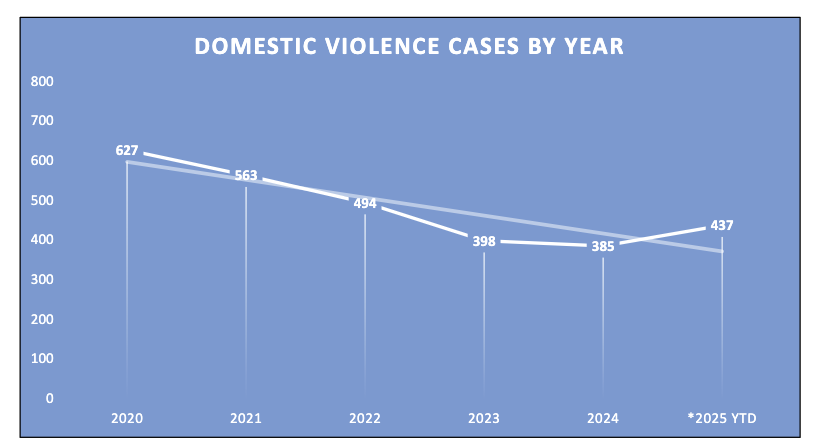
Vallejo Police Department officials presented data at Vallejo’s Public Safety Council Subcommittee meeting Wednesday showing 437 reported cases in 2025 compared to 385 in 2024, which follows a steady decline since the start of the 2020 pandemic.
The data also showed there are numerous repeat offenders in Vallejo, particularly in 2024-25, the department said. The number of suspects with multiple domestic violence cases went from 28 in 2024 to 43 in 2025. Eight domestic violence cases involved a firearm in both 2024 and 2025. Aside from guns, strangulation was the most lethal form of violence used, according to the police department.
Vallejo police said there was one domestic violence-related homicide each in 2024 and 2025. In December, 45-year-old Vallejo resident Zheer Queja Malassab was arrested in Pennsylvania on suspicion of fatally shooting his wife in her Vallejo apartment.
While no clear causes for the increase were presented, officials said they are hoping current partnerships can be better used to improve the resources available to survivors.
Lt. Josh Caitham said that during responses to domestic violence incidents, victims typically get a resource card to help them find services. However, he said they may need more information and support long before a call is made. “Not everybody wants to make a police report and not everybody wants to see police,” Caitham said.
Councilmembers Charles Palmares and Alexander Matias agreed that improving response times to domestic violence calls to help people before their lives are in danger is needed. The department said that officers, dispatchers, and partners from IHART – Vallejo’s mobile crisis response team – should begin attending training sessions which are planned to teach responders how to prioritize and handle domestic violence calls more effectively.
Representatives of local organizations partnering with the city attended the meeting to share how their services can also impact the current response to abuse cases.
Kari Cordero, executive director of SANE-SART – which provides resources across Napa, Solano, Marin and Sonoma counties including medical care and medical advocacy – said that having a victim sit down with a forensic examiner through a partnership with Kaiser Permanente leads to a 30% increase in the chances of prosecuting a perpetrator. These have an average response time of taking place within 60 minutes of a victim seeking service.
Nora Martinez and Raina Sanchez, navigators for the Solano Family Justice Center, a county-run resource center in Fairfield, said they offer walk-in services for victims of multiple forms of abuse as a confidential space to seek different kinds of resources. Martinez said that one of the biggest challenges is finding safe stays for victims as there is a shortage of emergency housing across the county. Survivors often must get transported outside county lines to reach the few safe houses available, she said.
“We really heavily rely on the emergency shelters within the community, and that can get really complicated because housing is a high-value resource,” she said.
The website domesticshelters.org currently shows that there are no shelters available for victims in Vallejo. Representatives for Solano County and SafeQuest Solano, a nonprofit tasked with providing safehouses in the county, did not specify where the nearest open shelters are available for victims in Vallejo when contacted for comment.
Studies show domestic violence is a major reason many women become homeless. According to the National Network to End Domestic Violence, between 22% and 57% of homeless women say that domestic violence was the immediate cause of their homelessness, and 38% of domestic violence victims lose their homes at some point in their lives.
Councilmember Tonia Lediju asked how sexual assault examinations and handling of evidence in a timely and sensitive manner can be improved. “We need to make sure that when a person walks into Kaiser, we’re not waiting and triaging for hours to come,” she said.
Cordero said that there are options for victims to present for an exam without providing specific details to law enforcement if they prefer, saying the Family Justice Center’s biggest issue is the lack of having its own crime lab. Victim evidence in Vallejo is required to go to police once it is reported as coming from an assault.
Victims may also get transferred to different jurisdictions for medical care, with different rules for evidence storage, which can create an additional barrier for people, Cordero said. She shared how a victim was sent for an examination in San Francisco instead of Kaiser Vacaville, and then was redirected to care in the North Bay after waiting for four hours.
In that position, she said “I would have given up six hours ago, I probably wouldn't have driven to Vacaville to get the exam. We need to look at ways to minimize and limit those barriers.”
Matias asked what can be done legislatively to ensure there can be no retaliation from property managers and landlords following a domestic violence call. Police officials said that some cities create a just cause ordinance to prevent such evictions, which Vallejo did during the pandemic.
Matias also asked for clarity on funding needs which may be necessary to support certain resources, such as shelters and temporary relocation services. He asked for the committee to present a draft action plan to the council for consideration at an upcoming meeting. This would include a summary requesting potential additional support, such as whether more funding may need to be allocated for resources such as shelters.
“I don’t know if we have emergency shelters to offer,” Matias said. “This winter we couldn't activate the extreme weather policy. And we were not able to provide housing for folks although we had unbelievable amounts of rain and it was cold as all heck. It’s been horrible since Thanksgiving. Knowing we have limitations on the housing front, if someone is in need of that service, where are they getting that funding from if the nonprofits don't have that funding?”
In response, city staff said that City Attorney Veronica Nebb will coordinate with the city manager’s office to gather information on available safe houses and emergency housing. Her staff will also review tenants’ rights related to eviction protections for survivors, specifically within apartments to share with the City Council at an upcoming meeting.
Resident and Vallejo Homeless Union member Eli Smith said she thinks that the city is taking a reactive approach and needs to better use services and relationships which are already in place.
“I’m wondering why we aren't calling an IHART team lead every time,” Smith said. “How are we going to get these people immediately on the ground when this happens in that moment, to connect (victims) to these services?”
Lediju, responding to Smith, said that she agreed that the city needs to assess how the current partnerships work and whether the system could be more effective.
“It’s going to be quite a few times (meeting) to ensure that individuals who respond to these calls, uniform or not uniform, are all on the same page and understand each and every time how to execute it,” Lediju said.
Those who are impacted by intimate partner violence can call the National Domestic Violence 24 Hour Hotline at (800) 799-7233. Locally, survivors can also call Solano Advocates for Victims of Violence’s 24 Hour Hotline at (800) 547-0495, Safequest Solano at (707) 422-7345 and Solano Family Justice Center at (707) 784-7635.
Solano County provided a list of resources for those in need of housing support, including Resource Connect Solano at (707) 652-7311; Solano Dream Center/Transformation Village at (707) 435-3995; 4th Second at (707) 335-0300 and the Fighting Back Partnership - Family Resource Center at (707) 648-5230.
Before you go...
It’s expensive to produce the kind of high-quality journalism we do at the Vallejo Sun. And we rely on reader support so we can keep publishing.
If you enjoy our regular beat reporting, in-depth investigations, and deep-dive podcast episodes, chip in so we can keep doing this work and bringing you the journalism you rely on.
Click here to become a sustaining member of our newsroom.
THE VALLEJO SUN NEWSLETTER
Investigative reporting, regular updates, events and more